

TL;DR:
- Used Tesla prices in 2026 range from the mid-$20,000s to the low-$40,000s depending on model year, mileage, and condition. Despite the federal used-EV tax credit expiring, Tesla's used prices rose, showing strong demand and brand loyalty. Buyers should focus on battery health, trim, and timing, as Tesla resale values outperform most competitors.
Used Tesla prices in 2026 cluster from the mid-$20,000s to the low-$40,000s for most common models, though the actual figure you pay depends on model year, mileage, battery health, and trim level. The pre-owned Tesla market has stabilized after a volatile 2023–2024 period, making it easier to gauge fair value now. What makes this market unusual is that used Tesla prices rose after the federal used-EV tax credit expired in late 2025, while prices for other used EVs fell. That counterintuitive trend tells you something important about Tesla's demand resilience and how policy changes shape second-hand Tesla prices.
What are the typical used Tesla price ranges by model?
Typical asking prices for used Teslas in early 2026 fall into clear neighborhoods by model and year. These are not fixed sticker prices. They are starting points that shift based on mileage, condition, and regional demand.

The table below shows the most common model-year ranges and their typical asking prices in the U.S. market as of early 2026.
| Model | Model Years | Typical Asking Price |
|---|---|---|
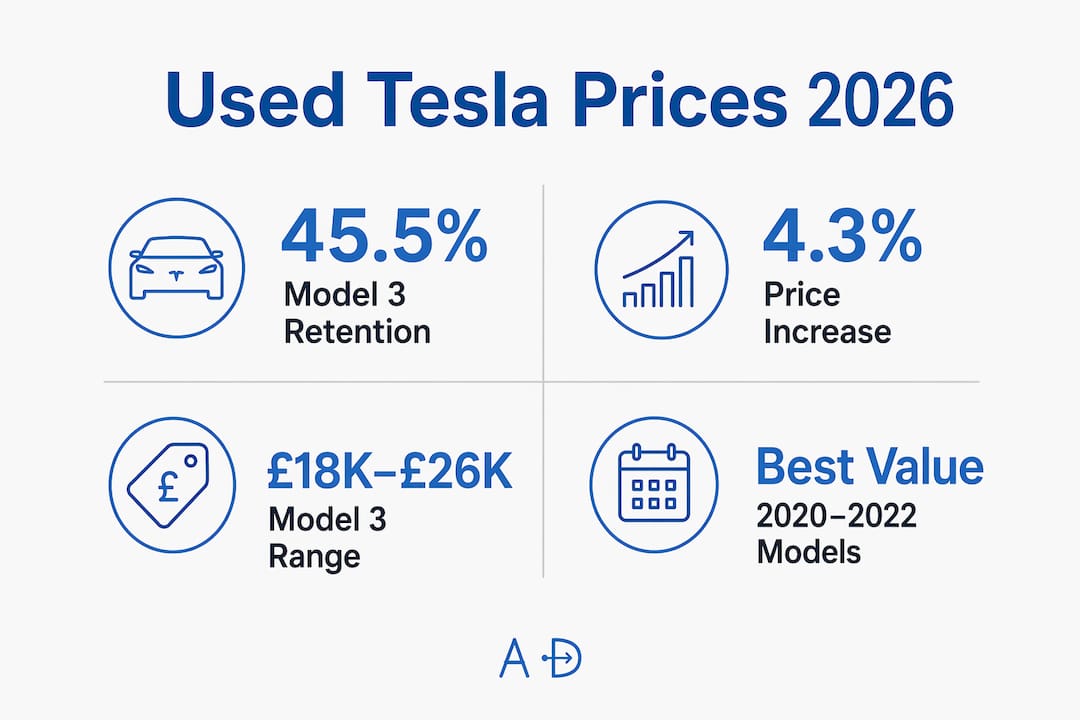
| Model 3 | 2017–2019 | £18,000–£26,000 |
| Model Y | 2020–2022 | £30,000–£40,000 |
| Model S | 2020–2022 | £40,000–£55,000 |
| Model X | 2020–2022 | £45,000–£60,000 |
| Cybertruck | 2024+ | Highly variable |
The Model 3 remains the most accessible entry point into the used Tesla market. A 2018 Model 3 Standard Range with 60,000–80,000 miles typically sits near the lower end of that £18,000–£26,000 band. A Long Range variant from the same year with under 50,000 miles pushes toward the top. The Model Y commands a meaningful premium over the Model 3 because it offers more cargo space and was built on a more refined production platform.
Luxury models like the Model S and Model X carry higher asking prices, but they also depreciate faster. Their complexity, frequent software updates, and the pace of Tesla's hardware changes make older versions feel dated more quickly than the mainstream models.
Pro Tip: Search listings by mileage bands rather than just model year. A 2021 Model 3 with 90,000 miles can price closer to a 2019 model than to a low-mileage 2021.
How did the end of the federal used-EV tax credit affect prices?
The expiration of the federal used-EV tax credit in late 2025 reshaped the market in a way most buyers did not expect. Used Tesla prices rose 4.3% from september 2025 to january 2026, based on a study of over 1.7 million one-to-five-year-old used cars. That rise happened while prices for other used EVs fell by 3.6% over the same period.
That gap is significant. It means Tesla's secondary market operates differently from the broader EV segment. The credit removal hurt demand for most electric vehicles, but Tesla buyers absorbed the change without retreating.
Why did this happen? A few reasons stand out:
- Brand loyalty. Tesla owners and buyers show stronger repeat-purchase behavior than most other EV brands.
- Charging network advantage. The Supercharger network remains a practical reason buyers prefer Tesla over alternatives.
- Inventory scarcity. Fewer late-model used Teslas hit the market in late 2025, tightening supply at a critical moment.
- Perceived technology lead. Buyers still associate Tesla with over-the-air updates and software features that other brands have not matched.
"The most important driver of used Tesla prices recently is timing around government incentives and policy changes. When the used-EV tax credit expired, Tesla's demand held firm while the rest of the used EV market softened. That divergence reflects Tesla's unique brand position and the practical advantages of its charging infrastructure."
For buyers in the UK, the direct federal credit does not apply, but the pattern matters. Global Tesla pricing trends influence UK asking prices, and UK-specific incentives or their removal create similar dynamics locally.
What factors push individual used Tesla prices up or down?
Model and year set the range. Individual condition factors determine where within that range a specific car lands. Battery health and trim options are the two biggest variables after mileage.
Here is how to think through each factor systematically:
-
Battery health. A Model 3 showing 90% battery capacity at 60,000 miles is worth meaningfully more than the same car showing 82%. Tesla's in-car battery report gives you a rough indicator, but a third-party diagnostic tool provides a more reliable reading.
-
Full Self-Driving (FSD) status. Transferable FSD capability adds real value. Non-transferable FSD adds nothing to the resale price. Always confirm transferability before factoring it into your offer.
-
Mileage bands. Pricing shifts noticeably at 50,000-mile intervals. A car just under 50,000 miles commands a premium over one just above it, even if the mechanical difference is negligible.
-
Geographic location. Regional demand differences can swing used Tesla values by thousands of pounds. Urban areas with dense charging infrastructure tend to show higher asking prices than rural regions.
-
Trim and options. Autopilot hardware generation, premium interior packages, and wheel upgrades all affect value. Two 2021 Model Y cars with identical mileage can differ by £3,000–£5,000 based on trim alone.
-
Service history and accident records. A clean history report supports the asking price. Any structural repair, even a minor one, justifies a lower offer.
Pro Tip: Use AI car valuation tools to cross-check a listing against real-time market data before you negotiate. A five-minute check can save you thousands.
How does Tesla resale value compare to other used EVs?
Tesla holds its value better than most other electric vehicle brands. After five years, the Model 3 retains approximately 45.5% of its original MSRP, the Model Y retains around 41.9%, the Model X retains about 38.8%, and the Model S retains roughly 37.9%. Those figures outperform the majority of competing EV brands in the same age bracket.
The Model 3 and Model Y show the strongest market liquidity. They sell faster and hold prices more consistently than the luxury models. That makes them the safest choice if you plan to resell within a few years.
The Model S and Model X tell a different story. Their higher complexity and faster hardware obsolescence accelerate depreciation. A 2019 Model S with the older Autopilot hardware feels significantly dated compared to a 2022 version, and the market prices that gap accordingly.
A few additional points worth knowing:
- New Tesla price cuts cause used prices to soften quickly, sometimes within weeks of an announcement. Timing your purchase around new-car pricing news can work in your favor.
- EV technology upgrades accelerate depreciation faster than combustion engine improvements. A major battery chemistry change or a new hardware generation can make current models feel obsolete sooner than buyers expect.
- The used Tesla market stabilized in 2026 after steep drops in 2023–2024. The steepest depreciation is behind the market, which means buyers are not catching a falling knife the way they were two years ago.
For buyers comparing affordable Tesla models against other used EVs at similar price points, Tesla's stronger resale value and charging network give it a practical edge. The pre-owned Tesla cost is higher than comparable non-Tesla EVs, but the total ownership picture often justifies the gap.
Key Takeaways
Used Tesla prices in 2026 are most accurately assessed by combining model-year ranges with battery health, mileage bands, trim level, and current market timing rather than relying on any single data point.
| Point | Details |
|---|---|
| Price ranges by model | Model 3 starts around £18,000; Model Y from £30,000; Model S and X from £40,000–£45,000. |
| Tax credit expiration effect | Used Tesla prices rose 4.3% after the federal credit expired, while other used EVs fell 3.6%. |
| Battery health matters most | Battery capacity and FSD transferability are the biggest value variables within any model-year range. |
| Tesla holds value better | Model 3 retains ~45.5% of MSRP after five years, outperforming most competing EV brands. |
| New price cuts move the market | Tesla factory price reductions soften used prices within weeks, so timing your purchase matters. |
My take on buying a used Tesla in 2026
The conventional advice is to buy the newest model you can afford. I think that is wrong for most used Tesla buyers right now.
The 2020–2022 model years represent the best value window in the current market. The steepest depreciation has already happened on those cars. You get a vehicle with modern hardware, a capable battery, and most of the software features that matter, at a price that reflects real-world wear rather than speculative demand. A 2022 Model Y Long Range with 40,000 miles is a genuinely good car at a fair price. A brand-new one costs nearly twice as much.
What I see buyers consistently overlook is the battery health check. Most people look at mileage and move on. Battery degradation is not linear, and a car with 70,000 miles that has been charged carefully can outperform a 40,000-mile car that spent two years plugged in at 100% overnight. Always get a battery diagnostic before you commit.
The other thing worth watching is Tesla's own pricing behavior. When Tesla cuts new-car prices, used values follow within weeks. Checking recent pricing trends before you make an offer costs you nothing and could save you a significant sum.
My honest advice: target a 2021 or 2022 Model 3 or Model Y, get a battery report, check the FSD transfer status, and run the listing against current market data. That process takes under an hour and eliminates most of the risk in buying a used Tesla.
— Mark Bowman
How Addapted helps you find the right used Tesla price
Knowing the price ranges is one thing. Confirming that a specific listing is fairly priced is another.

Addapted gives you real-time market pricing across multiple listings so you can see instantly whether a used Tesla asking price is above, below, or in line with the current market. The platform factors in mileage, model year, and listing history to show you the lowest, highest, and average prices for any model. You get a reliable car valuation in seconds, not hours of manual research. Before you make an offer on any second-hand Tesla, run it through Addapted and shop with the confidence of knowing exactly what the car is worth.
FAQ
What is the average price of a used Tesla Model 3 in 2026?
A used Tesla Model 3 from 2017–2019 typically asks between £18,000 and £26,000 in early 2026, depending on mileage, battery health, and trim level. Newer Model 3 variants from 2020–2022 command higher prices.
Why did used Tesla prices go up after the tax credit ended?
Used Tesla prices rose 4.3% after the federal used-EV credit expired in late 2025, driven by strong brand loyalty and tighter inventory. Other used EVs fell 3.6% over the same period.
How much does battery health affect used Tesla value?
Battery health is one of the biggest price variables within any model-year range. A car with strong battery capacity and transferable FSD can command thousands more than an identical model with degraded battery performance.
Which used Tesla model holds its value best?
The Model 3 retains approximately 45.5% of its original MSRP after five years, making it the strongest performer for Tesla resale value among all current models.
Is now a good time to buy a used Tesla in the UK?
The used Tesla market stabilized in 2026 after steep price drops in 2023–2024, meaning the worst depreciation is already priced in. Buyers who monitor new-car pricing announcements and check battery health carefully can find strong value in the current market.