

For most used-car buyers, Addapted is the strongest first stop: it pulls live listings, runs AI weighting across price history, and includes built-in VIN checks so you see what a car is actually trading for right now, not what a book said six months ago. Pair that with a secondary check from a book-style guide like NADA for conservative trade-in ranges, and you have a solid two-source baseline.
Here is the shortlist by goal:
- Buying a used car: Start with Addapted for real-time market comparisons and AI-backed pricing, then cross-check a VIN-history report to catch accidents or title issues.
- Trading in at a dealership: Pull a book-style guide (NADA or KBB) first so you know the floor dealers work from, then verify against live listings to see where retail sits.
- Listing for private sale: Use a listing-aggregator marketplace (CarGurus, Cars.com, Autotrader) to see what comparable cars are actually asking in your zip code, then set your price just above the midpoint.
- Verifying condition before buying: Order a Carfax or similar VIN-history report before trusting any valuation number.
Table of Contents
- Quick profiles: what each valuation approach actually does
- Why do different valuation sites give you different numbers?
- What to do when your estimates disagree
- How these picks were chosen
- Limitations of online valuation tools and how to work around them
- How valuation sites differ in interface and accessibility
- Key Takeaways
- The part most buyers skip
- Useful sources
- FAQ
Quick profiles: what each valuation approach actually does
Addapted
Addapted's AI car valuation platform pulls live listings across multiple sources, weights them against price history, and surfaces the lowest, highest, and average market prices for any model. The built-in car checker analyzes mileage patterns and listing details so you can spot an overpriced car in seconds. Best for active buyers who want real-time comparative pricing without bouncing between five different tabs. Enter a VIN or model, set your zip code, and you get a market snapshot that reflects what cars are actually selling for today.
Book-style national guides (NADA, KBB)
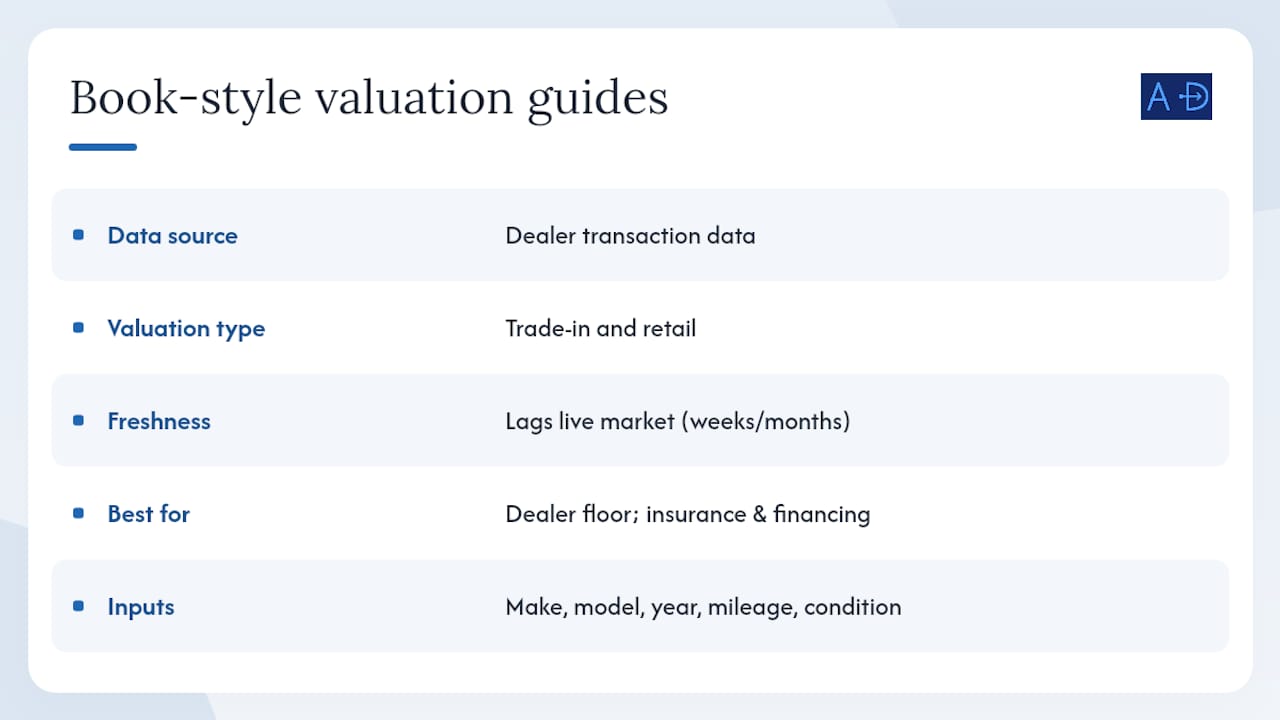
These publish periodic trade-in and retail reference values derived from dealer transaction data. NADA in particular is the guide dealers and insurers lean on for baseline valuations. The numbers are methodical and industry-accepted, but they lag the live market by weeks or months. Best for: understanding the conservative floor a dealer will start from, or for insurance and financing reference values. Input make, model, year, mileage, and condition to get a range.
Listing-aggregator marketplaces (CarGurus, Cars.com, Autotrader)
These platforms scrape active dealer and private-seller listings to show what cars are asking right now in your area. CarGurus layers a "deal rating" on top of listings to flag overpriced inventory. Cars.com and Autotrader give broad national and local inventory views. None of them are pure valuation tools, but the asking-price data is the freshest retail signal available. Best for: setting a private-sale list price or checking whether a dealer's asking price is in line with the market.
VIN-history and report providers (Carfax)
Carfax ties vehicle history (accidents, title brands, odometer rollbacks, service records) directly to a VIN. The valuation guidance it provides is secondary to the history function, but knowing a car has a clean title versus a salvage title can shift its value significantly. Best for: any buyer who wants to verify condition before trusting a valuation number. A clean Carfax does not guarantee a perfect car, but a flagged one is an immediate negotiating lever.
Auction and wholesale index providers
These aggregate transaction data from dealer auctions and wholesale channels. The numbers represent what dealers pay each other, which is typically well below retail. Unless you have trade access, these are harder to reach directly, but some services surface auction-derived data in consumer-facing tools. Best for: sellers who want to understand the absolute floor a dealer will offer, or buyers researching a vehicle category's wholesale ceiling.
Dealer-focused wholesale guides (Edmunds TMV, NADA dealer tools)
Edmunds' True Market Value (TMV) and NADA's dealer-facing tools blend dealer transaction data with regional pricing to produce what the market is actually paying, not just asking. Edmunds TMV is particularly useful for buyers because it reflects recent transaction prices rather than sticker prices. Best for: buyers who want a transaction-price benchmark rather than a listing-price benchmark.
Why do different valuation sites give you different numbers?
The short answer: they are measuring different things. A book-style guide and a live-listing aggregator are not disagreeing about your car's value. They are answering different questions entirely.
Here is what drives the gap:
- Data source type: Book guides use dealer transaction records compiled over weeks or months. Listing aggregators scrape active ads in real time. Auction indexes pull wholesale transaction data. Each reflects a different slice of the market.
- Update frequency: NADA and KBB update their values periodically. CarGurus and Autotrader reflect live inventory. Addapted pulls real-time listing data and weights it with price history. A car market that shifts quickly (high demand, low supply) will show a bigger gap between a book value and a live-market price.
- Estimate definition: Trade-in value is what a dealer will pay you. Private-sale value is what a private buyer might pay. Retail value is what a dealer lists it for. These three numbers for the same car can differ by thousands of dollars, and that is not an error.
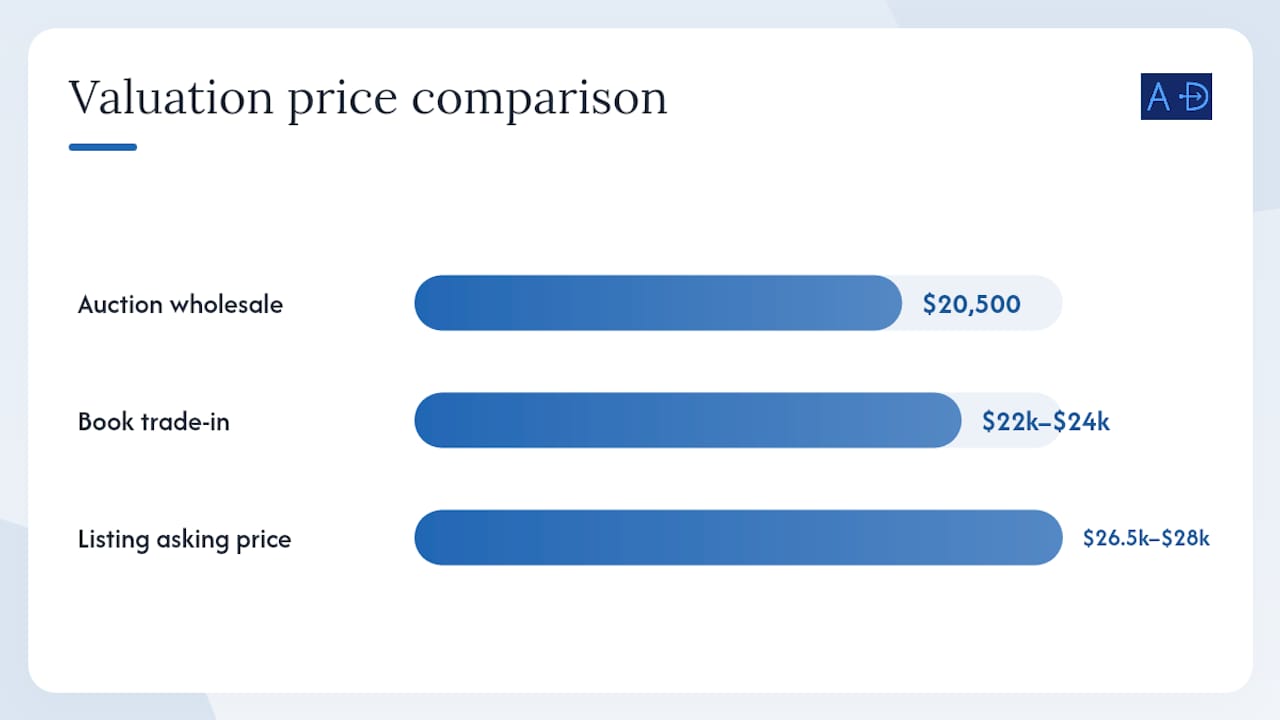
A quick example. Take a 2020 Honda CR-V EX with 45,000 miles in good condition. A book-style guide might show a trade-in range of $22,000–$24,000. A listing aggregator in a high-demand metro area might show comparable cars asking $26,500–$28,000. An auction index might show dealer-to-dealer wholesale at $20,500. All three numbers are correct for what they measure.
Trust signals to look for on any valuation site:
- Clear labeling of estimate type (trade-in vs. private sale vs. retail)
- Disclosed data sources (listings, dealer transactions, auctions)
- VIN integration so the estimate ties to the actual vehicle's history
- Methodology notes explaining how the number is calculated
- Regular update disclosures so you know how fresh the data is
What to do when your estimates disagree
Estimates from different tools will almost never match exactly. Here is how to turn that disagreement into a decision.
- Check local listings for comparable cars — Search your zip code on CarGurus or Cars.com for the same make, model, year, trim, and mileage range. What are they actually asking? That is your real competition if you are selling.
- Order a VIN-history report — A Carfax or similar report takes minutes and can explain a low estimate immediately (prior accident, title brand, odometer discrepancy). Budget roughly $40–$50 for a full single-vehicle report.
Quick timeline: Checking live listings takes 15 minutes. A VIN report is instant online. A dealer appraisal takes 30–60 minutes in person or a day or two for an online offer. An independent appraisal takes 2–5 business days.
Rules of thumb for negotiating: Start your private-sale list price at or just above the private-sale estimate from a listing aggregator. Expect a dealer trade-in offer to land 10–20% below that private-sale number. If a dealer's offer is below the book-style trade-in estimate, you have a documented basis to negotiate.
How these picks were chosen
The evaluation covered six axes: accuracy and freshness of pricing data, transparency about data sources and methodology, VIN integration, clarity of estimate labeling, cost to the user, and ease of use. Each approach was assessed by running the same vehicle (a 2021 Toyota Camry SE, 38,000 miles, good condition, mid-Atlantic zip code) through multiple tools and comparing outputs.
Patterns that emerged:
- Listing aggregators consistently returned fresher retail prices and reflected local supply-demand shifts faster than book guides.
- Book-style guides (NADA, KBB) gave more conservative and stable trade-in ranges, which is exactly what they are designed for.
- VIN-history providers added condition context that changed the interpretation of every other estimate.
- Tools without clear estimate-type labeling produced numbers that were easy to misread as one type when they were actually another.
Addapted is the recommended pick for active buyers because it combines live-listing comparison with AI valuation weighting, price-history analytics, and built-in car checks in a single workflow. That combination surfaces outliers and listing anomalies faster than checking sources separately. The subscription model also supports the kind of repeated, iterative research that serious buyers do across multiple vehicles over days or weeks. For a one-off check, the free trial covers the core functionality.
Comparing valuation approaches across multiple sources consistently shows that no single tool wins on every axis, which is why the methodology here recommends a two-source minimum: one real-time AI or listing check, one book-style or VIN-history check.
Limitations of online valuation tools and how to work around them
Online valuations are estimates, not appraisals. Every tool in this list has real constraints worth knowing before you rely on a number.
Common limitations:
- Listing prices are not transaction prices — An asking price on a listing aggregator is what a seller wants. The actual sale price is typically lower. Edmunds TMV and similar transaction-based tools are closer to what buyers actually pay.
- VIN history is incomplete — Carfax and similar services only capture reported events. An accident repaired privately without an insurance claim may not appear.
How to mitigate these gaps:
Use at least two estimate types. Verify condition honestly, or have a mechanic do a pre-purchase inspection. For any car over $20,000, a VIN report is not optional. Cross-check book values against live listings when the market has moved recently.
How valuation sites differ in interface and accessibility
Not all of these tools are equally easy to use, and the format matters depending on where you are in the buying or selling process.
Addapted is built for active buyers who want a fast, comparative view. The platform is designed around real-time search and comparison, with app-based workflows that support on-the-lot research as well as at-home analysis. The interface surfaces price ranges, mileage patterns, and listing details without requiring you to navigate between multiple sites.
KBB and NADA have clean, straightforward web interfaces optimized for single-vehicle lookups. KBB has a mobile app. Both are fast for a one-off check but are not designed for comparing multiple vehicles simultaneously.
CarGurus, Cars.com, and Autotrader are primarily listing platforms with valuation layers added. Their mobile apps are well-developed and widely used for on-the-lot price checks. The valuation data is embedded in listings rather than surfaced as a standalone tool.
Carfax is primarily a report service. The interface is simple: enter a VIN, pay for a report, download it. There is no comparison or browsing functionality.
Edmunds has one of the cleaner interfaces for research-heavy buyers, with TMV pricing, reviews, and specs integrated. Its mobile experience is solid for in-dealership use.
A practical note on privacy: most tools require only a VIN or make/model/year to return a valuation. Tools that ask for your email, phone number, or personal details before showing a price are collecting lead data, not improving your estimate. You can get accurate valuations without sharing contact information on most platforms.
Key Takeaways
Addapted's AI-powered live-listing valuation, combined with a secondary VIN-history or book-style check, gives used-car buyers the most complete and current price picture available.
| Point | Details |
|---|---|
| Start with real-time data | Use Addapted or a listing aggregator first to see what cars are actually asking in your market today. |
| Add a book-style check for trade-ins | NADA and KBB give the conservative floor dealers use; know that number before you walk into a dealership. |
| Always run a VIN-history report | A Carfax or equivalent report catches accidents, title issues, and odometer discrepancies that shift every other estimate. |
| Match estimate type to your goal | Trade-in, private-sale, and retail estimates are different numbers for the same car; use the right one for your situation. |
| Addapted for active buyers | Addapted combines live listings, AI valuation weighting, and built-in car checks in one platform, with a free trial to start. |
The part most buyers skip
Online car valuations have become genuinely good. The tools available today, especially AI-backed platforms that weight live listings against price history, are a real improvement over the static book values that dominated a decade ago. But there is a gap between what these tools promise and how most people actually use them.
The problem is not the tools. It is that buyers treat a single estimate as a fact. They pull one number from KBB, see it is $24,000, and walk into a dealership expecting $24,000. When the dealer offers $21,500, they feel cheated. The dealer is not necessarily wrong. The book value was a range derived from aggregate data, and the specific car, in that specific condition, in that specific market, may genuinely be worth $21,500 at wholesale.
The buyers who negotiate well are the ones who show up with three numbers: the book trade-in floor, the live-market private-sale range, and a dealer's written cash offer from a competing source. That combination turns a valuation into leverage. A single estimate, however accurate, is just a starting point.
There is also a subtler issue with condition grading. Every tool asks you to rate your car's condition, and almost everyone rates it one grade higher than a dealer will. That gap is not dishonesty. It is that most people have not seen their car the way a buyer will. A pre-sale inspection from a mechanic costs $100–$150 and gives you an honest condition assessment before you enter any numbers into any tool. That investment usually pays for itself in negotiating confidence alone.
Useful sources
- Consumer Vehicle Values | NADA
- Addapted - AI Car Valuations & Discovery
- Car Valuation Without Personal Details: 2026 Guide
- Top 5 Car Valuation Tool UK Alternatives 2026
- AI Car Valuations & Real-Time Market Price Checks
- AI Car Valuations & Real-Time Market Price Checks
For best results, use a combination of real-time listing data, a VIN-history report, and a book-style reference value. No single source covers all three dimensions.
FAQ
What is the most accurate free car valuation site in the US?
No single site is universally most accurate because accuracy depends on your goal. For live market pricing, Addapted and listing aggregators like CarGurus reflect current asking prices most closely. For trade-in reference values, NADA and KBB are the industry standard.
Why does KBB show a different value than Edmunds or CarGurus?
Each tool uses different data sources and measures a different estimate type. KBB and NADA use dealer transaction data to produce book values; CarGurus and Cars.com reflect live listing prices; Edmunds TMV tracks recent transaction prices. All three can be correct simultaneously because they are measuring different things.
Do I need to enter my VIN to get an accurate car valuation?
A VIN-based lookup is significantly more accurate than a make/model/year search because it captures the exact trim, factory options, and vehicle history. Tools like Addapted use VIN data to weight valuations against the specific vehicle's listing and history details.
How do I use car valuation estimates to negotiate a trade-in?
Pull both a book-style trade-in estimate (NADA or KBB) and a live-market private-sale range before visiting a dealer. If the dealer's offer falls below the book trade-in floor, you have a documented reference point. A competing written cash offer from CarMax or Carvana is the strongest negotiating tool.
Is it safe to enter my car's details on valuation websites?
Most valuation tools require only a VIN or make/model/year and do not need personal contact details to return an estimate. Sites that require an email or phone number before showing a price are collecting leads. For privacy-conscious buyers, Addapted's valuation guide covers how to get accurate estimates without unnecessary data sharing.