

TL;DR:
- Car valuation without personal details uses only vehicle data to estimate market value, protecting privacy. It provides realistic price ranges based on condition, mileage, and regional demand, useful for buyers and sellers. Cross-checking multiple tools and inputting accurate vehicle details yields the most reliable valuation results.
Car valuation without personal details is the process of estimating your vehicle's market value using only vehicle-specific data, such as your VIN or registration number, without submitting your name, email, or phone number. This approach gives you a realistic price range before you buy or sell, and it keeps your inbox free from dealer spam. Anonymous vehicle appraisal has become the standard expectation for privacy-conscious sellers and buyers across the UK. The method relies on condition, mileage, regional demand, and depreciation models to produce figures that reflect the real market, not a dealer's wishlist.
How do anonymous car valuation tools work?
Anonymous valuation tools generate a price estimate using only vehicle data. You enter a VIN, license plate, or basic details like make, model, and year. No account creation, no email address, and no phone number required.

The VIN is the most powerful input you can use. Exact VIN inputs pull precise trim levels, engine specifications, and factory options, which can shift a valuation by hundreds of pounds compared to a generic make and model search. A base trim and a fully loaded version of the same car are not worth the same amount, and a VIN tells the tool which one you actually have.
Once the tool has your vehicle data, it cross-references current market listings, recent sales, and regional pricing trends. Valuations present a price range from poor condition to pristine rather than a single number. That range is more honest than a headline figure because two cars with the same year and model can differ by thousands of pounds depending on service history and condition.
Key inputs that anonymous tools use to build your estimate:
- VIN or license plate for exact trim and specification matching
- Mileage to apply depreciation adjustments
- Condition rating (poor, fair, good, excellent) selected by you
- Location or postcode to factor in regional demand differences
- Market data from current listings and recent private sales
Pro Tip: Always use your VIN rather than just make and model when the tool allows it. The difference in accuracy is significant, especially for vehicles with multiple trim levels or optional packages.
What are the different car value tiers?
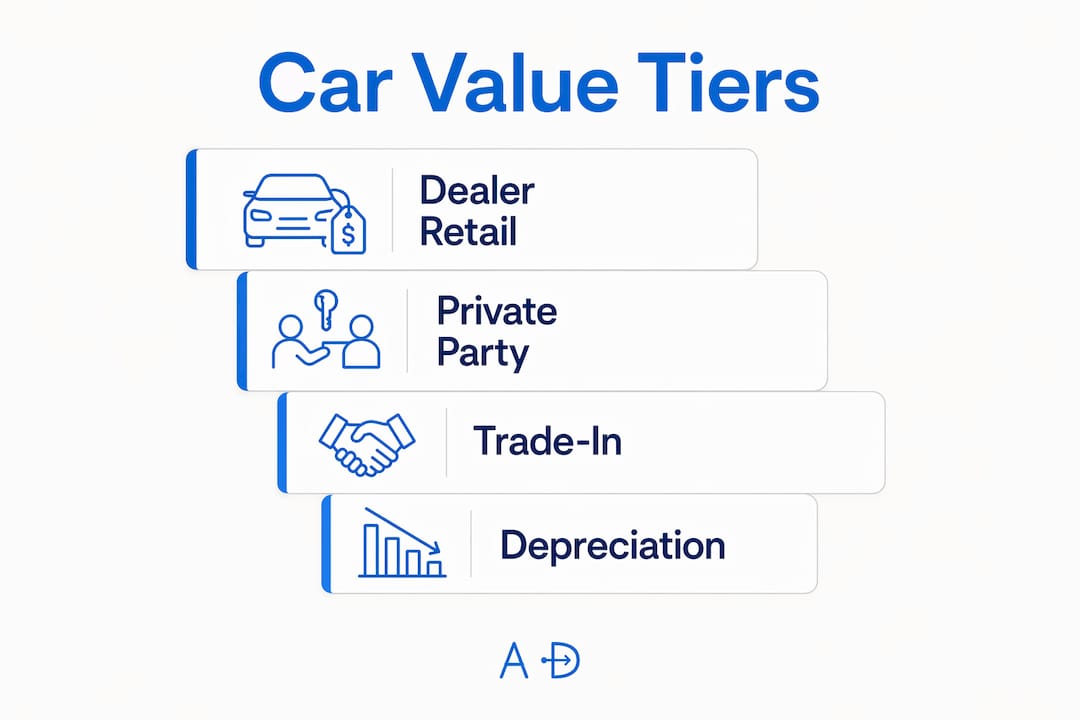
Three primary market value tiers exist for any used vehicle: trade-in, private party, and dealer retail. Each tier serves a different transaction type, and confusing them is one of the most common pricing mistakes sellers make.
Trade-in value is what a dealer offers when you hand over your car as part of a purchase. It is the lowest of the three tiers because the dealer needs room to recondition the vehicle and still profit on resale. Private party value sits above trade-in, typically by £1,500 to £4,000, and represents what you can realistically expect when selling directly to another individual. Dealer retail value is the highest tier. It reflects the price a dealer charges after reconditioning, warranty, and profit margin are factored in.
Dealer retail price factors in reconditioning costs and profit margins, making it an unrealistic target for private sellers. If you price your car at dealer retail as a private seller, buyers will walk. Private party value is the correct benchmark for anyone handling their own sale.
Depreciation also plays a significant role across all three tiers. Vehicles typically lose value at a rate that compounds with age, mileage, and condition. A car with higher-than-average mileage for its age will sit at the lower end of any tier's range, while a low-mileage, well-maintained example commands the top.
Pro Tip: Run your valuation at both the trade-in and private party tiers before you negotiate. Knowing both figures tells you exactly how much room a dealer has when they make you an offer.
Regional demand also shifts these tiers in ways that surprise most sellers. The same vehicle can vary by £2,000 or more between different parts of the UK. A diesel estate in rural Scotland carries different demand than the same car listed in central London. Always enter your actual location when running a no personal data vehicle value check.
How anonymous car valuations protect your privacy
Sharing your phone number or email with a valuation website has a predictable outcome: dealer calls and marketing emails that continue for months. Anonymous valuation services do not sell your contact details to dealers, which eliminates unsolicited calls entirely. You get a realistic price range with no personal exposure.
The privacy protections built into modern valuation platforms go further than simply not asking for your email. Sellers increasingly demand privacy-centric solutions, and platforms have responded with technology that keeps both parties anonymous until a transaction is genuinely agreed. Platforms allow messaging between buyers and sellers without exposing email addresses or phone numbers until a serious offer is on the table.
Specific privacy features to look for when choosing a valuation or listing platform:
- No sign-up required to receive an instant valuation estimate
- Intermediary messaging systems that mask your contact details from other parties
- No data sold to third parties or dealer networks
- Verified user systems that confirm identity without exposing personal information to other users
- Anonymous listing options that let you post a vehicle without your name or contact details being publicly visible
Some platforms use identity verification methods such as verified credentials while still hiding personal information from buyers and sellers. This approach builds trust in the transaction without creating a spam risk for either party. The result is a safer experience for cautious sellers who want to know their car's worth without triggering a flood of unsolicited contact.
The practical benefit extends beyond spam prevention. When you know your vehicle's value before entering any negotiation, you hold a stronger position. A seller who has run an anonymous appraisal knows the floor price and can negotiate from a place of knowledge rather than guesswork.
Tips to get the most accurate anonymous car valuation
Accuracy in a free car valuation with no details submitted depends entirely on the quality of the vehicle data you provide. Garbage in, garbage out applies here as much as anywhere.
-
Use your VIN whenever possible. A license plate lookup or VIN search retrieves your exact specification, including factory options that affect value. Generic make and model inputs miss this detail entirely.
-
Enter your precise odometer reading. A 5,000-mile difference significantly impacts valuation, sometimes by hundreds of pounds. Take a photo of your odometer before you start and use that exact figure.
-
Select your condition rating honestly. Overrating your car's condition produces an inflated estimate that will not survive a physical inspection. Rate it as a buyer would, not as an owner who has grown used to its flaws.
-
Enter your actual location. Regional demand differences are real. Factors like local preferences, climate, and vehicle type demand all shift the final figure. A postcode in the Midlands produces a different result than one in Edinburgh for the same car.
-
Cross-check across multiple tools. Agreement among independent valuation sources indicates a dependable price range. If three tools return figures within a few hundred pounds of each other, you have found your market value.
Pro Tip: Treat your valuation as a range, not a fixed price. The same year and model can differ by thousands depending on condition and history. Price toward the top of the range if your car is in excellent shape, and expect buyers to negotiate toward the middle.
Industry experts advise viewing valuation estimates as guides rather than guaranteed appraisals. The market sets the final price, and your valuation tells you where to start the conversation. You can also review UK car valuation tool alternatives to compare how different platforms approach anonymous pricing.
Key Takeaways
Car valuation without personal details gives you an accurate market price range using only vehicle data, protecting your privacy and eliminating dealer spam from the start.
| Point | Details |
|---|---|
| Use VIN for accuracy | VIN inputs retrieve exact trim and options, producing a more accurate estimate than make and model alone. |
| Know your value tier | Private party value, not dealer retail, is the realistic target for anyone selling their own car. |
| Protect your privacy | Anonymous tools do not share your contact details with dealers, eliminating unsolicited calls and emails. |
| Enter precise mileage | A 5,000-mile difference can shift your valuation by hundreds of pounds, so use your exact odometer reading. |
| Cross-check your results | Agreement across multiple independent tools confirms a reliable market value range for your vehicle. |
Why I think anonymous valuations are the only sensible starting point
I have watched sellers make the same mistake for years. They enter their details into a valuation form, get a number back, and then spend the next three months fielding calls from dealers who paid for that lead. The valuation was never really free. It cost them their privacy and their time.
The shift toward anonymous vehicle appraisal is not just a privacy trend. It reflects a more honest relationship between the tool and the person using it. When a platform does not need your phone number to give you a price, it signals that the valuation is the product, not you. That distinction matters.
What I find most useful about valuation ranges, rather than single figures, is that they force sellers to think like buyers. A range from fair to excellent condition tells you exactly what your car is worth at its worst and its best. That is more useful information than a single optimistic number that assumes your car is in perfect shape.
The next step for these tools is integrating real-time listing data with condition-adjusted ranges at a postcode level. Addapted already moves in this direction by pulling live market pricing across multiple listings, which means the range you see reflects what buyers are actually paying right now, not what they paid six months ago. That kind of real-time grounding is what separates a useful valuation from a rough guess.
My honest advice: run your anonymous appraisal first, before you speak to any dealer or post any listing. You will negotiate better, price more accurately, and avoid the spam that comes from handing over your details too early.
— Mark Bowman
Addapted gives you real-time car valuations with no personal data required
Knowing what your car is worth should not cost you your privacy. Addapted provides instant vehicle valuations by comparing real-time pricing across thousands of live listings, giving you the lowest, highest, and average prices for any model without asking for your name, email, or phone number.
The platform's car checker pulls mileage data, price history, and listing details so you can see exactly where a vehicle sits in the current market. Whether you are buying and want to confirm a fair deal, or selling and need a credible asking price, Addapted gives you the numbers you need to act with confidence. Visit Addapted to run your free, private car valuation now and see what the market is actually paying.
FAQ
What is car valuation without personal details?
Car valuation without personal details is the process of estimating a vehicle's market value using only vehicle data, such as VIN, registration, make, model, and mileage, without submitting any personal contact information.
Do anonymous car valuation tools give accurate results?
Anonymous tools produce reliable price ranges when you input accurate vehicle data. Cross-checking results across multiple independent tools confirms a dependable market value within a few hundred pounds.
Will I get spam calls after using a free car valuation tool?
Anonymous valuation services do not sell your contact details to dealers, so you will not receive unsolicited calls or emails after using them.
What is the difference between private party and dealer retail value?
Private party value is what you can realistically expect when selling directly to another individual. Dealer retail is higher because it includes reconditioning costs and profit margins, making it an unrealistic target for private sellers.
How do I get the most accurate anonymous car valuation?
Use your exact VIN, enter your precise odometer reading, select an honest condition rating, and input your actual postcode. You can also check what to look for when buying used to understand how condition affects pricing from a buyer's perspective.