

TL;DR:
- A used car history check provides detailed information about a vehicle's past ownership, accidents, and financial status.
- Most free checks offer limited data and do not reveal outstanding finance or theft records, which are only available in paid reports.
- Running a full history check with the vehicle’s VIN and registration before purchasing helps prevent costly mistakes and hidden problems.
A used car history check is a formal report that reveals a vehicle's past ownership, accident records, outstanding finance, and legal status before you buy. Skipping this step is one of the most expensive mistakes a UK car buyer can make. 1 in 3 cars carries a hidden history, including undisclosed accidents, finance issues, or odometer tampering. That statistic means the odds are genuinely against you if you rely on a seller's word alone. The industry term for the most thorough version of this report is an HPI check, which stands for Hire Purchase Investigation. Understanding both terms helps you ask the right questions and choose the right service.
What information does a used car history check provide?

A full vehicle history report covers far more ground than most buyers expect. HPI checks cover more than 80 data points, giving you a detailed picture of a car's life before it reached the forecourt. That depth is what separates a proper paid check from a basic free lookup.
Vehicle history reports typically include accident records reported to insurers, the number of previous owners, last recorded mileage, and safety recalls. Each data point tells you something specific about risk and value.
The core data points covered in a full report include:
- Accident and write-off history: Records whether the car was declared a total loss or repaired after a serious collision.
- Outstanding finance: Confirms whether a lender still has a legal claim on the vehicle. Buying a car with outstanding finance means the lender can repossess it, even from you.
- Mileage consistency: Flags discrepancies between recorded mileage at MOT tests and the current odometer reading.
- Stolen vehicle status: Checks the car against police databases. Owning a stolen vehicle can result in it being seized with no compensation.
- Previous owners and registration history: Shows how many people have owned the car and whether the registration plate has changed.
- MOT history: Lists pass and fail dates, advisories, and mileage at each test. This is one of the most revealing sections for spotting recurring mechanical problems.
- Safety recalls: Identifies open manufacturer recalls that have not yet been completed.
MOT history is publicly available through the DVLA vehicle history check tool on the UK government website at no cost. That free access is useful, but it does not cover finance, theft, or accident data.
How to obtain a used car history check: tools, costs, and options
The first thing you need for any vehicle history check is the car's Vehicle Identification Number (VIN) and its registration plate. Accurate vehicle identifiers are required to retrieve trustworthy data from official databases. The VIN is a 17-character code stamped on the chassis and printed in the V5C logbook.
Free vs. paid reports
Free checks exist, but they come with real limitations. No truly free HPI check exists that covers outstanding finance and stolen vehicle status. Free reports typically pull from public databases and give you basic registration data, MOT history, and tax status. They miss the data that costs money to access, specifically finance records and insurance write-off categories.
Basic VIN queries like VINCheck provide limited information such as whether a car is stolen or a total loss, but they do not replace a full paid vehicle history report. Think of free checks as a first filter, not a final answer.
The National Motor Vehicle Title Information System (NMVTIS) is a US federal database that protects consumers from fraud, stolen cars, and unsafe vehicles. In the UK, the equivalent data comes from insurance industry databases, DVLA records, and finance house registers. Reputable paid services pull from all of these simultaneously.
| Feature | Free check | Paid report |
|---|---|---|
| MOT history | Yes | Yes |
| Tax and registration status | Yes | Yes |
| Outstanding finance | No | Yes |
| Stolen vehicle status | Limited | Yes |
| Write-off category | No | Yes |
| Mileage discrepancy check | No | Yes |
| Safety recalls | No | Yes |
| Number of previous owners | No | Yes |
Paid reports from reputable services typically cost between £10 and £30 depending on the level of detail. That is a small amount compared to the potential cost of buying a car with £5,000 of outstanding finance attached.
Pro Tip: Always cross-reference the VIN on the report against the VIN stamped on the car's chassis and the one printed in the V5C logbook. A mismatch is a serious red flag that the car may have been "rung," meaning its identity has been swapped with a stolen vehicle.
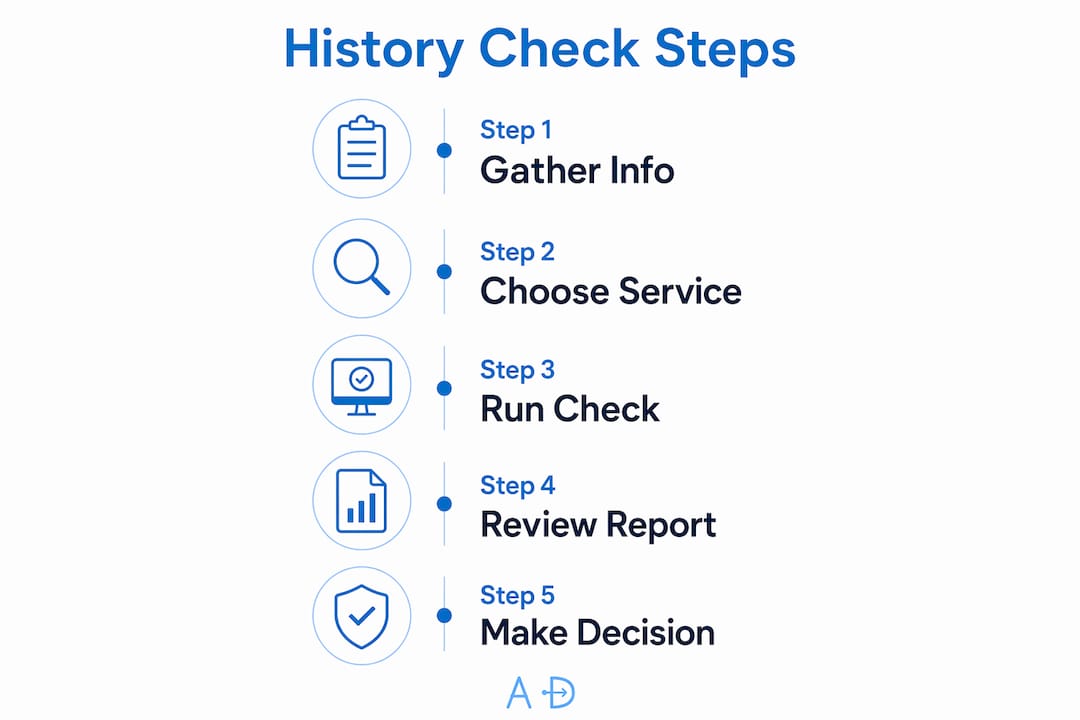
How to run a used car history check step by step
Running a check is straightforward once you know what you need. Follow these steps before handing over any money.
- Collect the vehicle details. Write down the registration number and locate the VIN. The VIN appears on a plate near the base of the windscreen, on the driver's door frame, or in the V5C logbook.
- Start with a free DVLA check. Visit the UK government's official vehicle enquiry service to confirm the car's make, color, MOT expiry, and tax status. This takes under a minute and costs nothing.
- Choose a paid history check service. Select a provider that pulls from insurance industry databases, finance registers, and police stolen vehicle records. Look for services that reference NMVTIS-equivalent data sources and carry industry accreditation.
- Enter the registration number and purchase the report. Most services deliver the report instantly as a PDF or on-screen summary. Keep a copy for your records.
- Review the report section by section. Do not skim. Read the finance section, the write-off section, and the mileage history in full.
- Check for red flags. Key warning signs include any outstanding finance, a Category S or Category N write-off marker, mileage that drops between MOT tests, and more than three previous owners on a car under five years old.
- Book a pre-purchase inspection if the report is clean. A clean history report does not guarantee mechanical soundness. A qualified mechanic can identify issues not reported in history checks, such as unreported accident damage and underlying mechanical problems.
Pro Tip: Run the check yourself rather than accepting a report provided by the seller. A seller-supplied report may be outdated or selectively presented. Fresh reports pulled on the day of viewing reflect the most current data.
Common mistakes buyers make with car history reports
The biggest mistake is treating a free report as sufficient. Free checks give you a starting point, but they leave the most financially dangerous data unchecked. Outstanding finance is the single most common hidden problem, and it never appears on a free report.
Watch out for these specific errors:
- Not verifying the VIN against the logbook. The V5C logbook should match the VIN on the car exactly. Any discrepancy suggests the car's identity may have been altered.
- Ignoring advisory notes on MOT records. Advisories are not failures, but repeated advisories for the same issue across multiple years signal a chronic problem the seller has never fixed.
- Confusing finance status with legal ownership. A seller can legally own a car and still have outstanding finance on it. The finance company holds a legal interest in the vehicle regardless of who holds the keys.
- Skipping a physical inspection. History reports cover documented events. Unreported accidents, poor repairs, and mechanical wear do not appear in any database.
- Overlooking mileage discrepancies. A car showing 60,000 miles on the clock but 85,000 miles at its last MOT test has had its odometer tampered with. This is a criminal offense and a serious safety concern.
- Buying without checking for car buying essentials. A history check is one layer of protection. Combining it with a physical inspection checklist covers both the paper trail and the physical condition.
What to do when a history check reveals problems
A problem on the report is not always a reason to walk away. The right response depends on the severity of the issue.
- Outstanding finance: Do not buy the car until the finance is cleared and you have written confirmation from the lender. Buying a car with active finance attached puts you at risk of repossession.
- Write-off marker (Category S or N): A Category S write-off means the car suffered structural damage. A Category N write-off means non-structural damage. Both require a professional inspection to assess repair quality before you consider proceeding.
- Stolen vehicle flag: Report the vehicle to the police immediately. Do not purchase it. Knowingly buying a stolen vehicle is a criminal offense.
- Mileage discrepancy: Walk away. Odometer fraud is deliberate and signals the seller cannot be trusted on any other aspect of the car.
- Minor issues (e.g., a single previous accident with documented repair): Use the finding to negotiate the price. A car with a disclosed and properly repaired accident is worth less than a clean-history equivalent. Get a pre-purchase inspection from a qualified mechanic to confirm the repair quality.
When the report is clean but you still feel uncertain, trust that instinct. A clean report combined with a seller who refuses a physical inspection is itself a warning sign.
Key Takeaways
A used car history check is the single most important step a buyer can take to avoid fraud, hidden debt, and unsafe vehicles before purchase.
| Point | Details |
|---|---|
| Free checks have real limits | Free reports miss outstanding finance and stolen status. Always use a paid report for full protection. |
| VIN verification is non-negotiable | Match the VIN on the report to the car's chassis and V5C logbook before proceeding. |
| MOT history reveals patterns | Repeated advisories for the same fault signal chronic problems a seller has not disclosed. |
| Outstanding finance is the top risk | A lender can repossess a car from you even if you bought it in good faith. Always confirm finance clearance in writing. |
| Pair the report with a physical inspection | History checks cover documented events. A mechanic finds what databases cannot. |
Why I think most buyers still get this wrong
The conventional advice is to "always get a history check." That advice is correct but incomplete. Most buyers run a free check, see a green result, and feel protected. They are not.
The free check confirms the car exists and has a valid MOT. It tells you almost nothing about whether you are about to inherit someone else's debt or buy a car that was written off and poorly repaired. I have seen buyers pay full market price for a car with £4,000 of outstanding finance because they relied on a free report and assumed it covered everything.
The other mistake I see constantly is treating the history report as the final word. A report is a paper trail. It only captures events that were reported to insurers, finance companies, or the police. A car that was driven into a wall and repaired privately will show a clean history. That is exactly why combining a paid report with a mechanic's inspection is the only approach that actually protects you.
Timing matters too. Run the check on the day you view the car, not the day before. Finance can be registered against a vehicle at any point. A report that was clean 48 hours ago may not be clean today.
— Mark Bowman
Addapted helps you check value alongside history
A clean history report tells you a car is safe to buy. It does not tell you whether the asking price is fair.
Addapted gives used car buyers real-time pricing data across multiple listings so you can see the lowest, highest, and average price for any model instantly. Use Addapted's car valuation tools alongside your history check to confirm you are paying a fair price, not just buying a car with a clean past. The platform also lets you compare mileage, price history, and listing details side by side. If you want to go deeper on evaluating your options, the car valuation tool guide covers the most reliable UK sources for accurate pricing. Knowing a car's history and its true market value together is the complete picture every buyer needs.
FAQ
What does a used car history check include?
A full vehicle history check covers accident records, outstanding finance, stolen status, mileage history, number of previous owners, MOT records, and open safety recalls. Free checks typically cover only MOT history and basic registration data.
Is a free HPI check good enough?
No truly free HPI check covers outstanding finance or stolen vehicle status. Free reports are useful as a first step but must be followed by a paid report for complete protection.
What information do I need to run a history check?
You need the car's registration number and its 17-character Vehicle Identification Number (VIN). Both are required to retrieve accurate data from official databases.
What does a Category S write-off mean?
A Category S write-off means the car suffered structural damage that was deemed uneconomical to repair by an insurer. The car can be legally repaired and returned to the road, but a professional inspection is required to verify the quality of that repair.
Can I check a car's MOT history for free?
Yes. The DVLA vehicle history check tool on the UK government website provides free access to MOT pass and fail dates, mileage at each test, and advisory notes. It does not cover finance, theft, or accident data.