

TL;DR:
- The average used car price in the UK is nearly £27,000 as of mid-2026. Prices depend on vehicle age, mileage, segment, and market timing, with used EVs showing higher volatility. Buyers should use transparent pricing tools and research to ensure they pay a fair price.
The average used car price in the UK currently sits at nearly £27,000, based on retail listing data from mid-2026. That number reflects a market shaped by wholesale trends, vehicle mix, and a growing shift toward pricing transparency. If you are shopping for a used car right now, understanding what drives that average is the difference between a fair deal and an expensive mistake. This article breaks down the real forces behind current used vehicle pricing and gives you a practical framework for evaluating any listing you encounter.
What is the used car price average right now?
The average retail listing price for a used vehicle reached nearly £27,000 in early july 2026, up from £26,918 in may 2026. That upward drift is modest, but it signals a market that has not yet pulled back to pre-2022 levels. Buyers who assume prices have "normalized" back to older benchmarks are likely to overpay.
The figure most people see on listing sites is the retail price. That is what a dealer charges a buyer. Wholesale price is what dealers pay at auction to acquire vehicles. These two numbers move at different speeds, and the gap between them is where dealer margins live. Knowing both gives you real negotiating context.
The used car market value also shifts depending on which vehicles are included in the average. Electric vehicles, compact cars, and premium SUVs each pull the number in different directions. A single headline figure rarely tells the full story.
What factors influence the average used car price?
Several forces push used car prices up or down, and most buyers only track one or two of them.
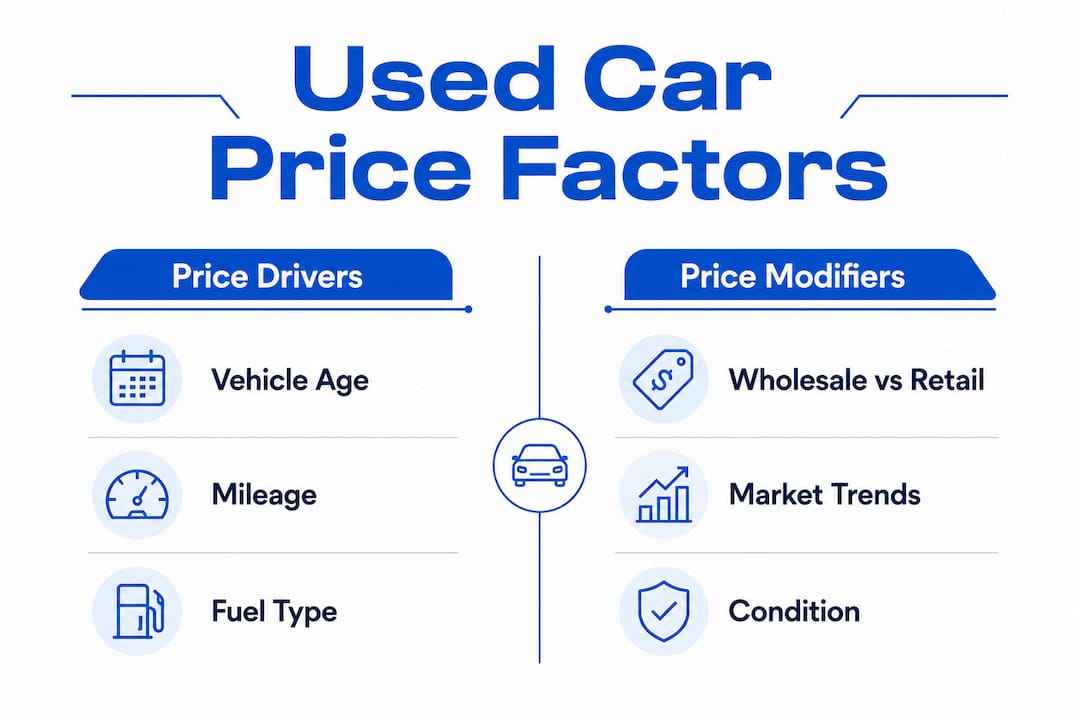
Vehicle age and mileage are the most obvious factors. A three-year-old car with 30,000 miles commands a significantly higher price than the same model at seven years and 80,000 miles. Depreciation is steepest in the first three years, which means buying a car that is two to four years old often delivers the best value per mile.

Wholesale versus retail pricing creates a gap that directly affects what you pay. Wholesale values declined 0.32% in one week in early july 2026, while retail prices stayed elevated near £27,000. Wholesale prices soften faster when demand cools, but dealers rarely pass those savings to buyers immediately.
Vehicle segment and type matter more than most buyers realize. The EV segment shows dramatically higher price swings than conventional vehicles. The EV price index rose 13.7% year over year in june 2026, compared to just 2.1% for non-EV vehicles. That gap means buying a used EV right now carries more pricing risk than buying a petrol or diesel equivalent.
Key factors that affect average pricing for used cars include:
- Mileage and service history: Low mileage with full dealer service history adds a clear premium.
- Seasonal demand: Spring and early summer push prices up as buyer activity peaks.
- Supply constraints: Fewer new cars during supply disruptions in 2020–2022 reduced used car availability, lifting prices.
- Consumer demand cycles: Sales conversion averaged 57.5% in june 2026, above the three-year average, showing buyers remain active despite elevated prices.
Pro Tip: When comparing listings, always check whether the car is petrol, diesel, hybrid, or electric before using the average price as a benchmark. EV pricing volatility means the "average" figure can mislead you significantly if the mix skews toward electric models.
How have recent market trends affected used car prices in 2026?
The used car market in 2026 is transitioning out of the spring selling season, and that shift is showing up in the data. Wholesale used-vehicle values rose 2.1% year over year in june 2026. That sounds positive, but the rate was 3.6% in may. The slowdown matters because wholesale prices typically lead retail prices by four to six weeks.
"Slower wholesale price growth signals a critical market shift important for consumers to track in 2026. The used vehicle market is normalizing as it transitions out of spring selling season, with measured depreciation balancing demand and pricing strategies."
The Black Book Used Vehicle Retention Index fell slightly in june 2026, down 0.1% from may and 0.5% below june 2025. A retention index tracks how well vehicles hold their value relative to original price. A small decline means depreciation is creeping back in, which is good news for buyers who have patience.
Seasonal patterns play a real role in used vehicle price trends. Spring and early summer are peak buying seasons in the UK. Dealers know demand is higher, so they hold firm on prices. By late summer and autumn, buyer activity typically drops and dealers become more willing to negotiate or reduce asking prices. If your purchase is not urgent, waiting until september or october could save you several hundred pounds on the same vehicle.
The current market sits in an interesting position. Prices remain elevated compared to pre-pandemic levels, but the rate of increase is clearly slowing. Buyers who act now pay near-peak retail prices. Buyers who wait three to six months may find the market has softened further, particularly if wholesale price growth continues to decelerate.
Pro Tip: Check used vehicle price trends monthly rather than relying on a single snapshot. A price that looks fair in april may look expensive by september if the market cools.
How can shoppers use pricing transparency to their advantage?
Pricing transparency in the used car market has improved significantly. No-haggle pricing models have spread across used vehicle retailing, making it easier to compare prices across dealers without the friction of negotiation. That is good for buyers who do their research.
The practical implication is that research now matters more than negotiation skill. When a dealer posts a fixed price, your leverage comes from knowing what comparable vehicles are listed for elsewhere. Checking multiple listings for the same make, model, year, and mileage band gives you a real market range rather than a single data point.
AI-powered valuation tools have changed how buyers assess fair market value. Platforms like Addapted let you view the lowest, highest, and average prices for any specific model in real time. That kind of side-by-side comparison was previously only available to dealers and trade buyers. Now any buyer can access it before walking into a forecourt.
Key steps for using pricing transparency effectively:
- Run a valuation before you visit any dealer. Knowing the average used car cost for your target model removes the information asymmetry dealers rely on.
- Compare at least five listings for the same model, year, and mileage range before deciding what a fair price looks like.
- Check price history on individual listings. A car that has dropped in price twice in four weeks is a negotiating signal.
- Use mileage-adjusted comparisons. A car with 20,000 fewer miles than average for its age should cost more. If it does not, ask why.
What practical steps help buyers evaluate if a price is reasonable?
Evaluating whether a listed price is fair requires more than comparing it to the average used car cost. The average is a starting point, not a verdict.
Check the vehicle's condition and history first. A full service history, no accident record, and a single previous owner all justify a premium above the average. A car with a patchy history, high mileage, or multiple owners should sit below it. Platforms that provide used car checks give you access to mileage records, outstanding finance checks, and write-off history before you commit.
Apply the £3,000 rule as a budget floor. The $3,000 rule holds that buyers should have at least £3,000 available upfront to be financially prepared for used car ownership. That covers the deposit, first service, and any immediate repairs. Stretching every penny to the purchase price with nothing left over is a common and costly mistake.
The table below gives a rough guide to typical price ranges by vehicle age and segment in the current UK market.
| Vehicle age | Budget segment | Mid-range segment | Premium segment |
|---|---|---|---|
| 1–3 years | £14,000–£18,000 | £20,000–£28,000 | £35,000+ |
| 4–6 years | £8,000–£12,000 | £13,000–£18,000 | £22,000–£30,000 |
| 7–10 years | £4,000–£7,000 | £7,000–£11,000 | £12,000–£18,000 |
| 10+ years | £1,500–£4,000 | £4,000–£7,000 | £7,000–£12,000 |
Note: Ranges reflect typical retail listing prices and vary by make, mileage, condition, and region.
A price sitting in the upper third of its segment range needs a clear justification. Low mileage, full service history, or manufacturer warranty extension are valid reasons. "It looks nice" is not.
Key Takeaways
The average used car price in the UK sits near £27,000 in mid-2026, but the right price for any individual vehicle depends on age, mileage, segment, and market timing.
| Point | Details |
|---|---|
| Current average price | Retail listings average nearly £27,000 in mid-2026, up from £26,918 in may. |
| Wholesale vs. retail gap | Wholesale prices soften faster than retail; tracking both reveals real dealer margins. |
| EV pricing volatility | Used EVs show 13.7% year-over-year price swings versus 2.1% for non-EV vehicles. |
| Market timing matters | Autumn purchases typically benefit from lower demand and more dealer flexibility. |
| Research beats negotiation | No-haggle pricing means preparation and comparison tools now drive better outcomes than haggling. |
The pricing data most buyers ignore
Most buyers walk into a used car purchase knowing the sticker price and almost nothing else. That is the single biggest mistake I see repeated across the market. The listed price is not the market price. It is the opening position of a seller who has already factored in your likely ignorance of wholesale trends, depreciation curves, and comparable listings.
The shift toward no-haggle pricing sounds like it levels the playing field. In practice, it only does so if the buyer has done the same research the dealer has. A fixed price from a dealer who bought a car at wholesale three months ago and has watched the market soften since is not necessarily a fair price. It is a price that protects their margin.
What I find most buyers miss is the vehicle mix problem. When you read that the "average used car price" is nearly £27,000, that figure includes everything from budget city cars to near-new premium SUVs. If you are shopping for a five-year-old family hatchback, that average is nearly useless as a benchmark. You need the average for your specific segment, age band, and mileage range.
The good news is that the tools to get that specific data now exist for ordinary buyers, not just trade professionals. The market is more transparent than it has ever been. The buyers who take advantage of that transparency will consistently pay less than those who rely on gut feel and a single listing.
— Mark Bowman
How Addapted makes used car pricing research faster
Knowing the average used car cost is one thing. Knowing whether the specific car in front of you is priced fairly is another challenge entirely.

Addapted gives you real-time pricing across multiple listings so you can see the lowest, highest, and average price for any model in seconds. The platform's car checker pulls mileage data, price history, and listing details into one place, so you are not manually cross-referencing five different sites. Whether you are comparing a three-year-old hatchback or a nearly new SUV, Addapted shows you what the market actually looks like before you make any commitment. Shop with the same data dealers use, and pay a price you can justify.
FAQ
What is the average used car price in the UK in 2026?
The average retail listing price for a used vehicle reached nearly £27,000 in mid-2026, up from £26,918 in may 2026. Prices vary significantly by vehicle age, segment, and mileage.
Why do wholesale and retail used car prices differ?
Wholesale prices are what dealers pay at auction, while retail prices are what buyers pay on the forecourt. Wholesale values tend to fall faster when demand softens, but dealers do not always reduce retail prices at the same pace.
Are used EV prices more volatile than petrol or diesel cars?
Used EV prices show significantly higher volatility. The EV price index rose 13.7% year over year in june 2026, compared to just 2.1% for non-EV vehicles, making used EVs a riskier purchase from a value-retention standpoint.
When is the best time to buy a used car in the UK?
Late summer and autumn typically offer better pricing as buyer demand drops after the spring and early summer peak. Dealers become more flexible on price when forecourt stock sits longer.
What is the £3,000 rule for buying a used car?
The £3,000 rule recommends having at least £3,000 available upfront before purchasing a used car. That buffer covers the deposit, initial running costs, and any immediate repairs without leaving the buyer financially exposed.