

TL;DR:
- Vault-like valuation tools that use VIN decoding and real-time market data outperform traditional model averages in accuracy and detail. Combining VIN-specific assessments, listing comparisons, and wholesale benchmarks provides the most reliable price estimates for private sellers, traders, and dealers. Using multiple data points and understanding wholesale floors can significantly improve negotiations and valuation precision.
The best alternatives to Kelley Blue Book combine VIN-specific decoding, verified retail-transaction data, and real-time market listings. For most private sellers, that means starting with a VIN-first valuation engine, cross-checking against live market listings, and running a wholesale benchmark before walking into any dealership.
Here is the quick mapping:
- Private sale: VIN-first valuation engine + market-listing comparator (e.g., Edmunds True Market Value or CarGurus Instant Market Value)
- Trade-in negotiation: Consumer estimate + wholesale/auction benchmark (e.g., Manheim Market Report or Black Book) to understand the dealer's floor
- Dealer or wholesale: Professional auction indexes and verified-transaction feeds (Manheim/MMR, Black Book, J.D. Power Verified Fair Price)
Three trust signals worth knowing before you pick a tool: Addapted pulls live market listings and price-history data at the VIN level; J.D. Power's Fair Purchase Price draws from over 12 million verified retail transactions; auction-based benchmarks such as the Manheim Market Report reflect what dealers actually pay at wholesale, not what consumers expect to receive.
Table of Contents
- How do the main KBB alternatives compare at a glance?
- How does each alternative actually differ from a KBB-style average?
- What do dealers actually use instead of KBB?
- How do you reconcile multiple valuations and set a realistic price?
- Which valuation tools are free, and when is it worth paying?
- Why does VIN-specific data produce more reliable prices?
- Which single alternative should you use for your situation?
- Key Takeaways
- Why the standard KBB workflow leaves money on the table
- Addapted gives you one place to check everything
- Useful sources and further reading
- FAQ
How do the main KBB alternatives compare at a glance?
The table below maps each valuation category against the dimensions that matter most for private sellers, trade-in negotiators, and wholesale buyers.
| Category | Best for | Primary data sources | VIN-specific? | Access / cost | Typical bias |
|---|---|---|---|---|---|
| Consumer-average estimators (KBB-style) | Quick checks, brand familiarity | Retail listings, dealer surveys | Model-level only | Free | Skews retail |
| VIN-first valuation engines | Uncommon trims, option packages | Factory option decoding, transactions | Yes | Free to freemium | Neutral to retail |
| Market-listing comparators | Private sale pricing, live market | Active listings, asking prices | Partial | Free | Reflects asking prices |
| Auction/wholesale benchmarks | Trade-in floor, dealer appraisal | Auction lanes, wholesale transactions | Partial | Dealer/subscription | Skews wholesale |
| Full-service appraisal platforms | All-in-one buyer/seller research | Listings + history + VIN + transactions | Yes | Freemium/subscription | Balanced |
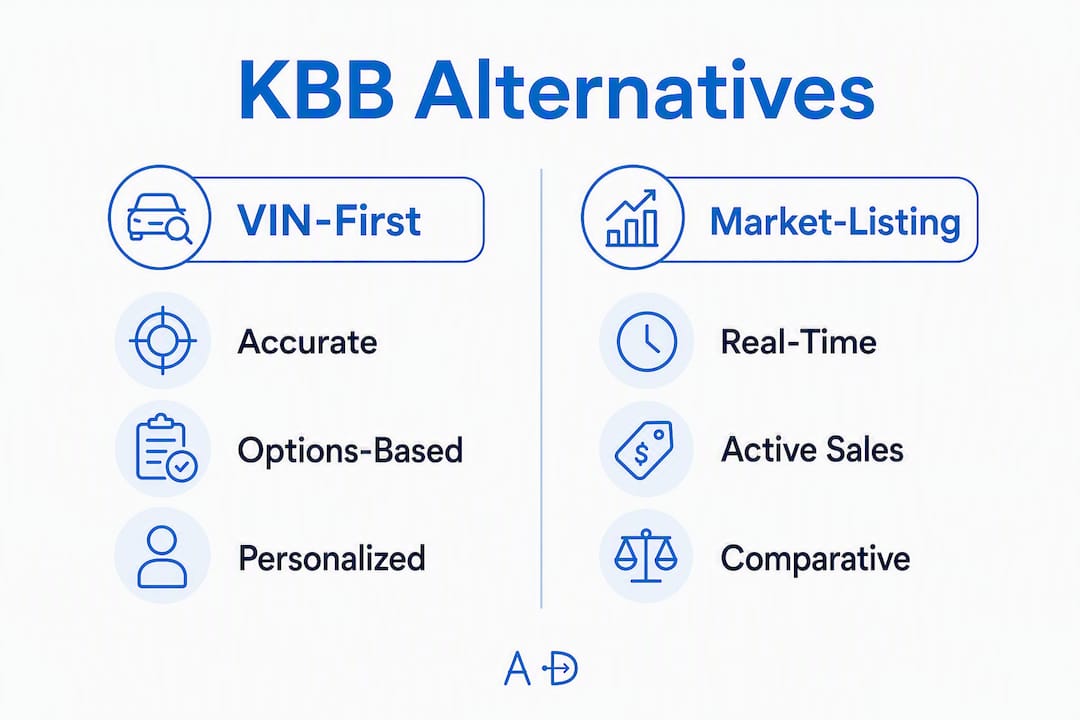
For a private seller, the most actionable categories are VIN-first engines and market-listing comparators. For trade-in negotiation, adding an auction benchmark gives you the number the dealer is working from.
How does each alternative actually differ from a KBB-style average?
KBB produces a model-level average. That is useful as a starting point, but it misses the detail that moves real money: factory options, regional demand, and current listing inventory. Here is how each category handles those gaps differently.

Consumer-average estimators
Tools like Edmunds True Market Value and NADAguides (NADA) work similarly to KBB. They aggregate dealer transaction data and owner surveys to produce a price range by make, model, year, and trim. The strength is speed and familiarity. The weakness is that "trim" is still a broad bucket. Two identically trimmed vehicles with different option packages can differ by thousands of dollars, and a model-level average will not capture that.
Use these for a fast sanity check or when you are shopping a common configuration. Do not rely on them alone for a rare trim or a heavily optioned vehicle.
VIN-first valuation engines
A VIN-first tool decodes the vehicle identification number to read the factory-installed options directly from the build record. That means the valuation reflects the actual car, not a statistical average of similar cars. Practitioners consistently flag this as the most reliable approach for uncommon configurations, because option-level decoding reduces pricing error on packages that add real market value (think tow packages, premium audio, or advanced safety suites).
Pro Tip: Before accepting any valuation, run the VIN through a decoder to confirm the options list matches what the seller describes. A mismatch between the listed options and the decoded build record is a red flag worth investigating.
For a deeper look at how VIN-based car checker apps compare in practice, Addapted's published guide covers the key differences.
Market-listing comparators
CarGurus Instant Market Value and TrueCar pull from active listings rather than historical transactions. That makes them excellent for understanding what sellers are asking right now in your ZIP code. The catch: asking prices are not sale prices. A listing that has sat for 45 days at $18,500 tells you something different than a car that sold in three days at $17,800. The best market-listing tools flag days-on-market and price-drop history, which is where the real signal lives.
Auction and wholesale benchmarks
Manheim Market Report (MMR) and Black Book are the tools dealers and lenders actually use. Both draw from auction-lane transactions, not retail listings, so their figures reflect what a dealer pays for a car at wholesale, not what a consumer expects to receive. Carfax adds a history layer: its vehicle-value tool combines transaction data with reported accident, service, and ownership records, which is useful for buyers assessing risk as much as price.
CoPilot takes a different angle, using AI to flag whether a specific listing is priced above or below comparable active inventory. It is more of a deal-alert tool than a pure valuation engine, but it is useful for buyers who want a second opinion on a specific listing.
What do dealers actually use instead of KBB?
Dealers rarely price trade-ins from KBB. They work from wholesale benchmarks that reflect what they can resell the car for at auction if retail does not work out. Understanding that changes how you walk into a negotiation.
The professional data categories dealers rely on:
- Auction-lane indexes: Manheim Market Report is the dominant wholesale benchmark in the U.S. It reflects actual auction sale prices, updated frequently, and is subscription-only for dealers.
- Black Book: Another dealer-grade feed that tracks weekly wholesale price movements by segment. Lenders use it heavily for loan-to-value calculations.
- Verified retail transaction feeds: J.D. Power's Verified Fair Price, built on over 12 million verified retail transactions, sits between wholesale and retail and is used by dealers who want to price competitively without leaving money on the table.
The gap between a wholesale benchmark and a retail consumer estimate can be $2,000–$5,000 on a typical used car, sometimes more on a high-demand segment. That gap is the dealer's reconditioning budget, carrying cost, and margin. Knowing the wholesale floor before you negotiate means you understand why the dealer's first offer looks the way it does.
Pro Tip: Look up the Manheim Market Report value for your vehicle's segment before your trade-in appointment. You will not have direct access to the exact figure, but published auction-index summaries and industry blogs often report segment-level wholesale trends. Walking in with that context makes the conversation more productive.
How do you reconcile multiple valuations and set a realistic price?
No single tool gives you the complete picture. The practical workflow is to gather three data points, weight them by scenario, and adjust for your specific situation.
- Get a VIN-specific estimate. Run your VIN through a tool that decodes factory options. This is your accuracy anchor. It accounts for the actual build, not a statistical average.
- Pull market-listing comparators. Check active listings within 150–250 miles for the same year, trim, and mileage range. Note the lowest asking price, the median, and how long listings have been sitting.
- Check a wholesale or auction benchmark. For trade-in scenarios, find the closest available wholesale reference for your segment. This tells you the dealer's likely floor.
- Adjust for your specifics. Mileage above or below the segment average, accident history, regional demand (trucks in rural markets, EVs in urban ones), and seasonality (convertibles in spring, 4WD in fall) all move the number.
Weighting by scenario:
- Private sale: Weight VIN-specific estimate 40%, market-listing comparator 50%, wholesale benchmark 10% (as a floor check only).
- Trade-in: Weight wholesale benchmark 50%, VIN-specific estimate 30%, market-listing comparator 20%.
- Wholesale/dealer: Weight auction benchmark 70%, VIN-specific estimate 30%.
A practical example: you are selling a 2020 pickup with a tow package and 62,000 miles. The VIN-decoded estimate comes in at $28,400. Active listings in your area for the same trim and mileage range sit between $27,800 and $30,200, with a median around $28,900. The wholesale benchmark for the segment is approximately $24,500. A private-sale asking price of $29,500 leaves negotiating room while staying competitive with the market. A trade-in expectation of $25,000–$26,500 is realistic given the dealer's wholesale floor.
Quick checks to verify a tool's accuracy before trusting it:
- Confirm the tool uses your actual VIN, not just year/make/model/trim dropdowns.
- Check when the pricing data was last updated (stale data in a fast-moving market is worse than no data).
- Verify the geographic scope matches your local market, not a national average.
Which valuation tools are free, and when is it worth paying?
Most consumer-facing tools are free. The professional feeds cost money, and for most private sellers, the free tier is sufficient.
- Free consumer tools: KBB, Edmunds, NADAguides, CarGurus, TrueCar, and Carfax's basic value estimate are all free for consumers. They cover the vast majority of common configurations well.
- Freemium VIN checks: Some VIN-decoding and history services offer a basic report free and charge for full history, option-level detail, or multiple reports. Carfax's full history report is a paid product.
- Subscription professional feeds: Manheim Market Report and Black Book are dealer/lender subscriptions. Consumers cannot buy direct access.
- Per-report pricing: Some VIN-history and appraisal services charge per report, typically $20–$40 for a full history and option-level decode.
When paying makes sense:
- Your vehicle has a rare trim, a significant option package, or a modification that a model-level average will not capture.
- The car is high-value (above $30,000), where a $40 report can save or earn multiples of that in negotiation.
- You are managing a fleet sale or multiple vehicles and need consistent, auditable pricing.
- You want privacy-friendly valuation without submitting personal contact details to dealer lead-generation systems. Addapted's platform is built for exactly this use case.
Why does VIN-specific data produce more reliable prices?
Make/model/year averages are built on the assumption that most cars in a given trim are similar enough to price together. That assumption breaks down fast. A base trim and a fully loaded version of the same model can differ by $8,000 or more at retail, yet a model-level average collapses them into one number.
J.D. Power's verified transaction dataset illustrates the scale of data needed to produce reliable fair-market snapshots. Even at that volume—over 12 million verified retail transactions—the precision gain from VIN-level option decoding is significant for vehicles with uncommon packages. Practitioners consistently report that option-level decoding reduces pricing error for unique or low-volume configurations, particularly when rare packages add real market premium.
For older or modified vehicles, the case for VIN-first tools is even stronger. A vehicle-history and option-level decode together will catch rare-package premiums or condition discounts that a broad average simply cannot see.
Pro Tip: When using an AI-powered valuation tool, confirm it is decoding your VIN rather than matching on year/make/model alone. The difference in output can be $1,500 or more on a well-optioned vehicle.
Which single alternative should you use for your situation?
If you have to pick one approach today, here is the recommendation ladder:
- Private sale: Start with a VIN-first valuation engine, then cross-check against CarGurus Instant Market Value or a similar market-listing comparator. The combination of option-level accuracy and live market context gives you a defensible asking price.
- Trade-in negotiation: Pull a consumer VIN-specific estimate first, then find the closest available wholesale benchmark for your segment. Walking in knowing both numbers puts you in a much stronger position.
- Dealer or wholesale: Manheim Market Report is the industry standard. If you do not have direct access, use J.D. Power's Verified Fair Price as the closest publicly accessible proxy.
- All-in-one for buyers: Addapted combines VIN-first valuation, live market-listing comparisons, price-history tracking, and vehicle-authenticity checks in one platform. For a used car buyer who wants to assess multiple listings quickly and confidently, it removes the need to juggle four separate tools.
Key Takeaways
No single valuation tool is right for every scenario. The most reliable approach combines a VIN-specific estimate, a market-listing comparator, and a wholesale benchmark, weighted by whether you are selling privately, trading in, or buying at wholesale.
| Point | Details |
|---|---|
| Use at least two tool categories | Combine a VIN-specific estimate with a market-listing comparator before finalizing any price. |
| Know the wholesale floor | Dealers work from auction benchmarks; J.D. Power's dataset covers over 12 million verified retail transactions. |
| VIN decoding beats averages | Option-level decoding reduces pricing error for uncommon trims and well-optioned vehicles. |
| Weight sources by scenario | Private sale favors listing data; trade-in favors wholesale benchmarks; wholesale favors auction indexes. |
| Addapted for all-in-one buyers | Addapted combines VIN-first valuation, live listings, and price-history checks in a single platform. |
Why the standard KBB workflow leaves money on the table
Most people check KBB, see a number, and treat it as the answer. That is the wrong way to use any valuation tool, including KBB itself.
The real problem is not that KBB is inaccurate. It is that a single model-level average cannot account for the variables that actually move price: a tow package on a truck, a premium audio system on a luxury sedan, or a regional shortage of a specific color combination. The tools that close that gap are VIN-first engines and live market comparators, used together.
What most articles on this topic miss is the wholesale layer. Dealers are not pricing your trade-in from KBB. They are pricing it from Manheim or Black Book, then working backward to a retail offer that leaves their margin intact. If you walk into a trade-in negotiation knowing only the retail estimate, you are negotiating from incomplete information. Knowing the wholesale floor, even approximately, changes the conversation entirely.
The workflow in this article, which uses three data categories weighted by scenario, is not complicated. It takes about 20 minutes and can realistically shift a private-sale price or a trade-in offer by $1,000–$3,000 in your favor.
Addapted gives you one place to check everything
Most valuation workflows require four browser tabs and a spreadsheet. Addapted collapses that into one platform: VIN-first valuation, live market-listing comparisons across multiple sources, price-history tracking, and vehicle-authenticity checks, all in one place.
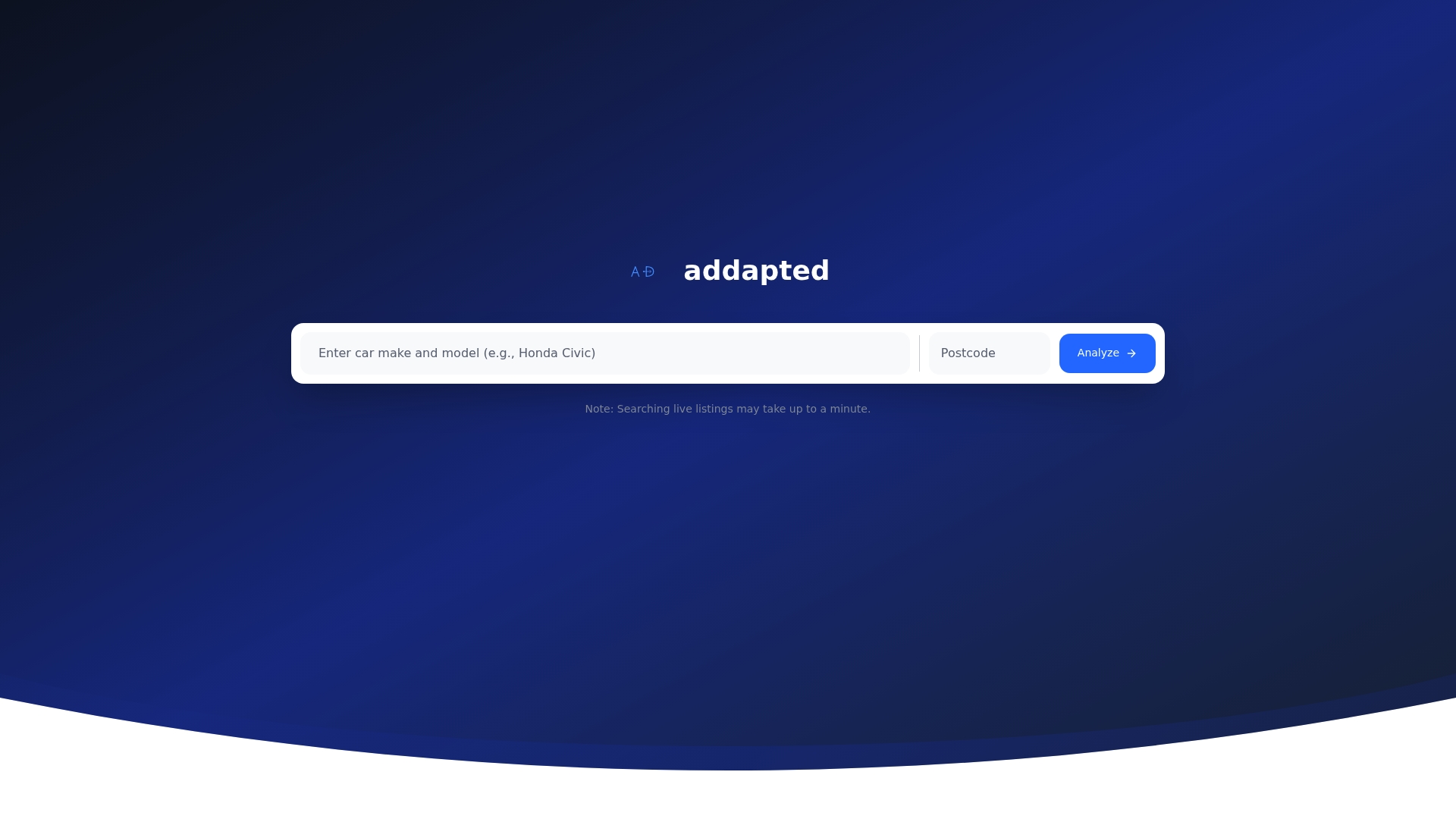
For used car buyers who want to know whether a specific listing is priced fairly before they make an offer, Addapted's real-time pricing engine shows the lowest, highest, and average prices for any model, alongside mileage and listing-detail analysis. The free trial gives you full access to the comparison and valuation tools with no commitment required.
Start your free trial at Addapted and check your first car in under two minutes.
Useful sources and further reading
- 9 Best Car Value Sites Reviewed — Groups consumer and professional valuation sites by data quality, main use, and ease of use.
- Top Sites Like kbb.com | Similarweb — Traffic and audience-overlap analysis showing the breadth of KBB alternatives by monthly visits.
- Top KBB Alternatives | Semrush — Visibility and authority metrics for the main sites competing in the vehicle-valuation space.
- Kelley Blue Book Alternatives | CB Insights — Market-intelligence profiles covering consumer and professional alternatives, including VIN-report providers and valuation APIs.
- Autotrader alternatives guide | Addapted — Covers related automotive pricing resources and their strengths for fair market value research.
- Used car price comparison frameworks | Addapted — Practical frameworks for comparing dealer pricing and listing data across multiple sources.
FAQ
Is there another website like KBB?
Yes. Edmunds, NADAguides, and CarGurus are the closest consumer-facing alternatives, each using similar data sources (dealer transactions, listings, and owner surveys) to produce retail, trade-in, and private-party estimates.
What do dealers use instead of KBB?
Dealers primarily use Manheim Market Report (MMR) and Black Book, both of which draw from auction-lane wholesale transactions rather than retail listings. J.D. Power's Verified Fair Price, built on over 12 million verified retail transactions, is also widely used for retail-side pricing.
Which is better, Edmunds or KBB?
Edmunds True Market Value tends to reflect actual transaction prices more closely because it weights recent dealer sales heavily. KBB is more widely recognized by consumers, which can make it useful as a negotiation reference point, but Edmunds is generally considered more precise for what cars actually sell for.
What is the $3,000 rule for cars?
The $3,000 rule is an informal guideline suggesting that a used car priced $3,000 or more below market value likely has a significant undisclosed issue. It is a buyer's heuristic, not an industry standard, and is best used as a prompt to run a VIN history check and independent inspection rather than as a hard pricing rule.
Can Addapted replace multiple valuation tools?
Addapted combines VIN-first valuation, live market-listing comparisons, price-history tracking, and vehicle-authenticity checks in one platform, covering the functions that typically require separate consumer tools for private-sale and buyer research scenarios.