

TL;DR:
- AI can accurately estimate UK used car values when powered by live market data and detailed inputs. Combining photos, full vehicle details, and regional market comparisons improves accuracy and negotiation leverage. However, the estimates are limited by incomplete data and mechanical or modified vehicle issues.
AI can produce an accurate instant valuation for most UK used cars when it has live market data and either full registration details or good photos. That's the short answer. The longer version is that the quality of what you put in determines the quality of what you get out, and a registration-only estimate is a starting point, not a negotiating position.
Here's what to do right now:
- Run an instant valuation using your registration number and confirm the trim level and options
- Add accurate mileage, service history, and MOT status
- Upload clear photos from multiple angles if the tool supports it
- Cross-check with a second source and compare the price ranges
- Book a pre-purchase inspection (PPI) before committing if anything looks off
What to avoid:
- Relying on a single tool's output without cross-checking
- Skipping photos when visible damage could affect the price
- Ignoring regional price differences across the UK
Pro Tip: When a car has visible bodywork damage or interior wear, weight a photo-enabled estimate higher than a registration-only figure. The photo scan adjusts for condition; the registration lookup cannot.
Table of Contents
- How AI valuation tools calculate used-car prices in the UK
- How accurate are AI valuations, and what limits them?
- How to get the most accurate AI valuation before you visit a seller
- How to use an AI valuation when you're actually buying
- Sanity-check your estimate: compare tools and weight photo-enabled results
- Key Takeaways
- The gap between what AI valuations promise and what actually matters
- Addapted gives UK buyers a faster path to a fair price
- Further reading and sources
- FAQ
How AI valuation tools calculate used-car prices in the UK
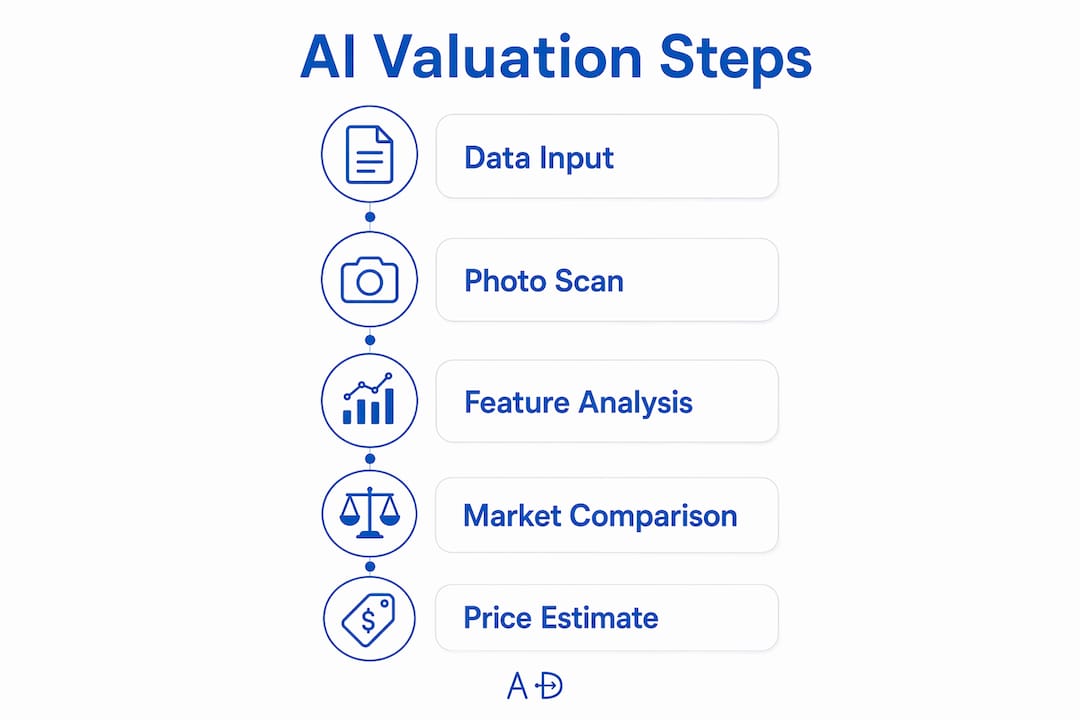
The data behind a modern AI vehicle valuation tool is considerably richer than most buyers realize. A registration-only lookup pulls the vehicle's make, model, trim, engine, and factory options from the DVLA database. That's a solid foundation. But the model then layers on live listings, recent private-party and trade sales, auction results, mileage benchmarks, regional demand signals, and timestamped market data to produce a price range that reflects what the car is actually selling for today, not six months ago.
The core inputs most platforms use:
- Live listings: millions of active adverts updated daily to reflect current supply and demand
- Recent sales data: completed transactions from private sellers, dealers, and trade auctions
- Mileage and condition: deviation from average annual mileage and any flagged damage
- MOT and service history: gaps or advisories that affect residual value
- Trim and options: factory-fitted extras that move the price meaningfully
- Regional demand signals: local supply-demand imbalances that shift prices by postcode area
On the machine-learning side, platforms typically engineer 120+ features per vehicle and blend guidebook values with live comps to produce a recommended price range and, in some cases, a bid range for trade buyers. An AI appraisal module can deliver a 360-degree valuation in roughly 60 seconds by layering condition grades over live market data. Large listing sites generate what they call an "Instant Market Value" by analyzing millions of local listings and updating valuations frequently to reflect current supply and demand.
Photo-based condition grading adds another layer. A visual scan returns a standardized score, often aligned to industry scales like the NAAA 0–5 grade, covering exterior panels, glass, interior, and tires. That score feeds directly into the price adjustment.
| Input type | Typical output | Confidence level | Best use |
|---|---|---|---|
| Registration only | Broad price range | Moderate | Quick sanity check |
| Registration + full details | Narrower price range with trim adjustment | High | Pre-visit research |
| Photo-enabled + full details | Condition-adjusted offer range | Highest | Negotiation and PPI triage |
Models are retrained on a defined cadence. Some platforms retrain monthly on millions of market transactions to account for seasonality and recent market shifts, which is why a valuation from three months ago may no longer reflect what a seller is asking today.
How accurate are AI valuations, and what limits them?
Accuracy claims in this space tend to be high. One UK AI valuation platform has reported high levels of independent validation accuracy by analyzing numerous features per vehicle across an extensive dataset. That figure refers to model fit against a sample of known transactions, not a guarantee that any single valuation will land within a specific pound amount of the final sale price. Think of it as the model's average error rate across a large dataset, not a promise for your specific car.
What actually limits accuracy in practice:
- Incomplete vehicle details: wrong trim level or missing options can shift the estimate by hundreds of pounds
- Rare or modified cars: low transaction volume means the model has less data to learn from; accuracy drops noticeably for niche or heavily modified vehicles
- Photos that miss mechanical issues: photo-based scans flag visible body, glass, and interior damage but cannot detect engine faults, gearbox wear, or electrical problems
- Regional market fluctuations: a model popular in London may command a different price in rural Scotland; not all tools weight this equally
- Data freshness: a valuation pulled during a market spike or trough may not reflect the baseline
Consumer-facing tools also separate trade-in values from private-party and retail values, and the gap between them can be significant. A trade-in figure reflects wholesale or auction pricing; a retail figure includes dealer margin and demand premium. Knowing which type you're looking at matters before you walk into a negotiation.
One short note on privacy: before uploading photos or registration data, check the platform's privacy policy to confirm how your data is stored and whether it's shared with third parties. Reputable tools are transparent about this; if the policy is hard to find, that's a signal.
How to get the most accurate AI valuation before you visit a seller
Follow these steps in order and you'll arrive at a negotiation-ready estimate rather than a rough ballpark.
- Enter your registration number and confirm the trim. The DVLA lookup is fast, but it won't always distinguish between a base model and a higher spec. Verify the trim level manually against the seller's listing.
- Add accurate mileage and service history facts. Mileage deviation from the annual average is one of the strongest price signals. A full service history can add meaningful value; gaps reduce it.
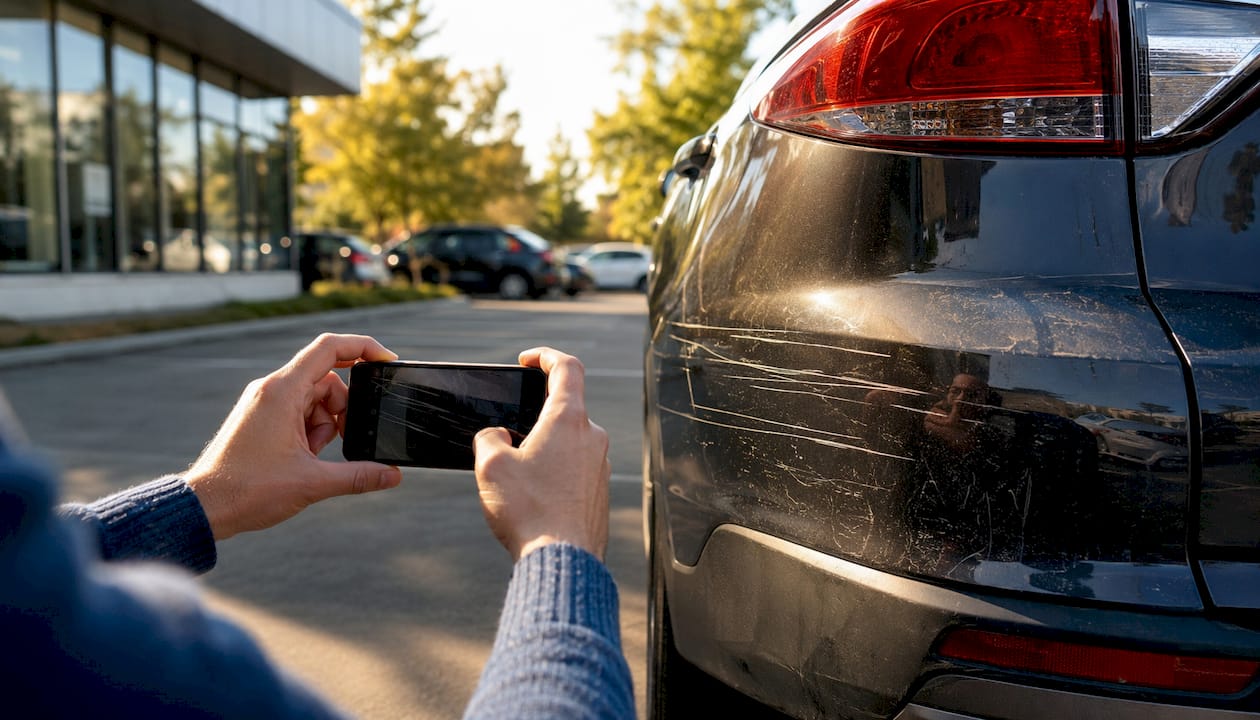
- Upload clear photos from multiple angles. Aim for 6 images: front, rear, both sides, interior, and odometer. If service stickers are visible, include those too. Good lighting matters more than camera quality.
- Ground the estimate against the seller's asking price and live local listings. Pull up similar cars in the same region and note the range. This gives you context for whether the AI estimate is conservative or aggressive relative to the current market.
- Save or screenshot the timestamped estimate. You'll want this for negotiation. A dated valuation showing the car is priced above the market range is a concrete talking point.
Photo tips that actually move the needle: shoot in daylight, avoid direct sun glare, and focus on known damage points like door edges, bumpers, and wheel arches. If the car has a dent or scuff, photograph it directly. The AI condition grade is only as good as what the photos show.
For speed, a registration-only lookup is fine for deciding whether a listing is worth visiting. For negotiation power, go photo-enabled with full details. The difference in output quality is significant, especially for condition-sensitive adjustments. You can also value a car without sharing personal details on some platforms, which is worth knowing before you start.

Pro Tip: If you're unsure about a car's mechanical condition after the photo scan, a professional engine diagnostic before purchase can surface issues the AI simply can't see from images alone.
How to use an AI valuation when you're actually buying
An AI estimate is most useful as a structured input to your buying decision, not a final verdict. Here's how to apply it at each stage.
At the listing stage, ask yourself:
- Is the asking price within 10% of the AI estimate's upper range?
- Does the listing match the trim and mileage the valuation assumed?
- Are there regional comps that support or undercut the estimate?
During negotiation:
- Present the condition-adjusted range, not just the headline figure. "The market range for this trim at this mileage is £X–£Y, and the photo scan flagged a rear bumper scuff that typically costs £150–£300 to repair" is a far stronger position than "the AI said it's worth less."
- Use repair-cost findings from the photo scan as a specific deduction, not a vague discount request.
- If the seller's asking price sits above the upper range of multiple tools, that's a concrete data point, not an opinion.
Red flags that should trigger a PPI:
- Photo scan flags structural panel misalignment (potential accident repair)
- Mileage looks low relative to the car's age and service stamps
- Service history has gaps around high-wear intervals (timing belt, clutch)
- The AI estimate is significantly below the asking price with no obvious explanation
Questions to ask the seller that directly affect valuation:
- How many previous owners?
- Is the service history full and stamped?
- Has it had any accident damage or bodywork repairs?
- When is the MOT due, and were there any advisories?
- Has the timing belt been changed at the recommended interval?
Keep a record of every valuation you run, including the timestamp, the tool used, and the estimate range. If you escalate to a finance or trade-in decision, that evidence trail supports your position.
Sanity-check your estimate: compare tools and weight photo-enabled results
Running a single valuation and trusting it is the most common mistake buyers make. Proprietary datasets and target markets (retail versus wholesale) cause real variance across providers, so a three-source cross-check is the practical standard.
Here's a reproducible workflow:
- Run a registration-only estimate on a tool with strong UK listing coverage. Note the price range and the date.
- Run a photo-enabled scan with full vehicle details. This is your anchor estimate because it accounts for visible condition.
- Pull a live-market comp by searching identical or near-identical cars in your region and noting the asking price range.
- Combine the three into a weighted estimate. A reasonable weighting: photo-enabled result at 50%, registration-plus-details at 30%, live-market comps at 20%.
- Decide: is the car worth visiting, worth an offer, or worth a PPI before committing?
Why does the photo-enabled result carry the most weight? Because photo-based AI scans produce a standardized condition grade using component-level signals across exterior, interior, glass, and tires. That grade feeds directly into a condition-adjusted value. A registration-only tool assumes average condition; a photo scan doesn't.
Methodologies for converting detected damage into value impact often use repair-cost matrices and Monte Carlo simulations to produce credible intervals for the estimate. That's a more honest representation of uncertainty than a single number.
Pro Tip: Log each valuation with a screenshot, the tool name, and the timestamp. If a seller disputes your offer, you can show three independent estimates with dates, which shifts the conversation from opinion to evidence.
For a broader look at how UK valuation tools differ in their datasets, the UK valuation tool comparison at Addapted's blog breaks down the key differences.
Key Takeaways
AI valuations are most accurate when you combine a photo-enabled scan, full vehicle details, and a live-market cross-check, then use the result as a structured negotiation input rather than a final price.
| Point | Details |
|---|---|
| Photo-enabled beats registration-only | Photo scans adjust for visible condition; registration-only assumes average condition and produces a broader range. |
| Cross-check at least two tools | Proprietary datasets vary; a three-source weighted estimate is more reliable than any single output. |
| 99% accuracy has a context | Independent validation accuracy of up to 99% applies across large datasets, not as a per-vehicle guarantee. |
| AI can't replace a PPI | Photo scans miss mechanical and electrical faults; use the AI estimate for triage, then book a physical inspection for red-flag cars. |
| Addapted for UK buyers | Addapted provides instant market comparisons, price history analysis, and live listing data to support the full valuation workflow. |
The gap between what AI valuations promise and what actually matters
There's a version of the AI valuation story that gets told a lot: plug in a registration, get a number, walk into the negotiation armed with data. That version isn't wrong, but it undersells the real risk and oversells the certainty.
The part most buyers miss is that an AI estimate is only as good as the data the model was trained on, and that data skews toward common, well-traded cars. For a Ford Focus or a Volkswagen Golf, the model has seen tens of thousands of comparable transactions and the output is genuinely reliable. For a lightly modified Japanese import or a low-volume prestige car, the confidence interval widens considerably, and the tool may not tell you that clearly.
The other thing worth saying plainly: photo-based condition grading is genuinely useful, but it's a triage tool, not a mechanical inspection. A car can look immaculate in six photos and have a gearbox that's six months from failure. The AI sees what the camera sees. That's why the workflow in this article ends with a PPI for any car where the numbers are close or the history is unclear. The AI gets you to the right shortlist faster; the inspector confirms whether the car on that shortlist is actually worth buying.
Addapted's approach, combining real-time market comparisons with live listing data and price history, is built around exactly this workflow: use the data to narrow the field, then verify before you commit.
Addapted gives UK buyers a faster path to a fair price
Most buyers spend hours comparing listings manually, unsure whether the asking price is reasonable or inflated. Addapted cuts that process down to minutes. Enter a registration, pull an instant market comparison across live UK listings, and see the lowest, highest, and average prices for that model right now, not last quarter.
The platform's car checker tools cover mileage analysis, price history, and listing details, so you can spot a car that's been sitting unsold for months or one that's priced below the market average before you even contact the seller. That's the kind of edge that turns a negotiation from guesswork into a structured conversation.
Addapted fits directly into the workflow this article describes: run your instant estimate, compare live comps, identify red flags, then decide whether to visit or walk. Start your free check at Addapted and see what the market says your target car is actually worth.
Further reading and sources
- Addapted: AI car valuations and real-time market comparisons — methodology overview and side-by-side comparison approach
- Addapted: best car-buying apps in the UK — how app-based workflows use AI for valuations
- Addapted: used car price average for UK buyers — market-average context and price momentum
- Addapted: used car price comparison — how UK dealers price used cars and the role of AI
- Brego.io: AI vehicle valuations — independent accuracy validation and data-point methodology
- Dr. Vin: photo-based condition grading — how visual scans produce NAAA-aligned condition grades and repair-cost estimates
- Carketa: AI car appraisal tool — 60-second appraisal methodology and model retraining cadence
- Consumer Reports: car value estimator — trade-in versus retail value distinctions
FAQ
Can AI accurately value my used car in the UK?
Yes, for common models with full registration details and photos, AI valuations are highly accurate. One UK platform reported independent validation of up to 99% accuracy across large datasets, though rare or modified vehicles carry wider uncertainty.
Which car valuation approach is most accurate in the UK?
A photo-enabled estimate combined with full vehicle details and a live-market cross-check produces the most reliable result. Registration-only lookups are useful for a quick sanity check but assume average condition, which can skew the figure.
How do AI valuations handle regional price differences across the UK?
Most AI models incorporate regional demand signals, meaning a car in high demand in one area may be priced differently than the same model in a lower-demand region. Cross-checking with live local listings alongside your AI estimate accounts for this variance.
Are UK used car prices currently falling?
UK used car prices have been adjusting after the post-pandemic highs, with supply recovering and demand moderating in many segments. Running a current AI estimate against live listings on Addapted gives you the most up-to-date picture for the specific model you're considering.
What is the 12-car rule in the UK?
The 'multiple car' rule is an informal HMRC guideline suggesting that selling a number of cars in a year may indicate trading activity rather than private selling, which can have tax implications. It is not a fixed legal threshold, and HMRC assesses each case on its own facts.