

No-haggle car buying means a dealer posts a firm, one-price listing up front — no back-and-forth, no counter-offers. It's the right move when you value speed and simplicity, but only if you verify that fixed price against real market data before you sign anything.
Top benefits at a glance:
- Faster transactions — no multi-hour negotiation sessions
- Predictable budgeting — you know the vehicle price before you walk in
- Easier comparison across multiple listings
- Less stress for buyers who find negotiation uncomfortable
The main trade-off: A posted price is not automatically the lowest available price. A skilled negotiator at a traditional dealership can sometimes do better. The fix is simple: run an AI valuation with a tool like Addapted before you commit, so you know exactly where the asking price sits relative to the market.
Table of Contents
- What does the no-haggle model actually mean?
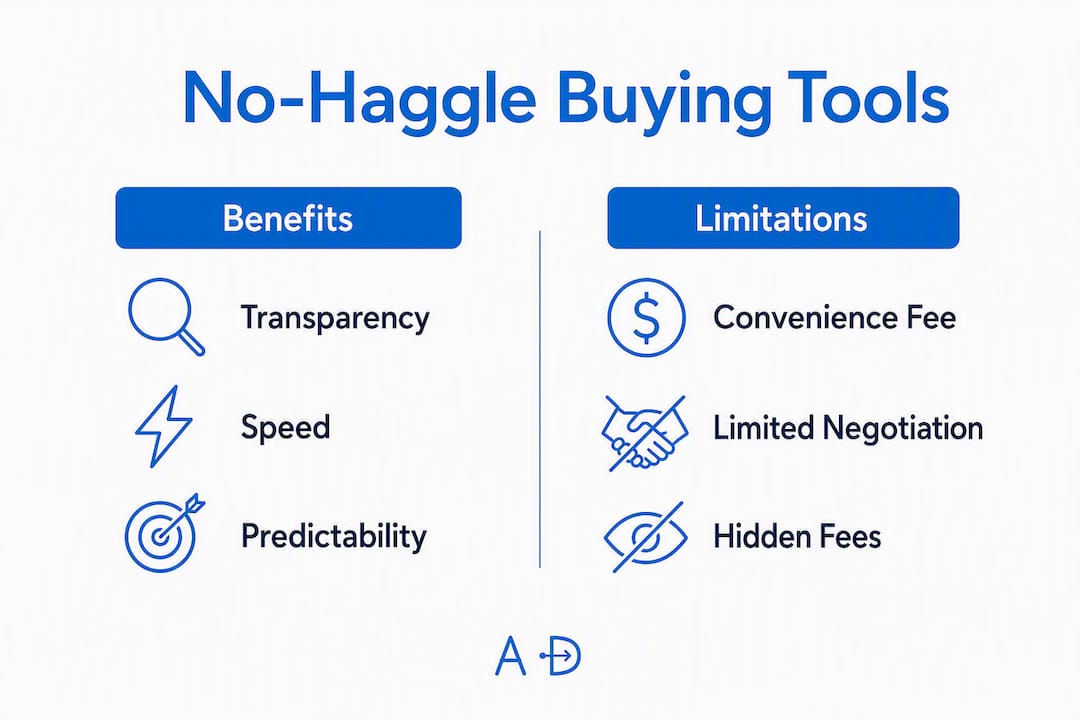
- What are the real pros and cons of no-haggle buying?
- How to prepare before committing to a no-haggle listing
- How do digital tools verify a no-haggle price?
- Step-by-step checklist for buying from a no-haggle seller
- Common pitfalls and red flags to watch for
- When does a no-haggle purchase actually make sense?
- The verdict on no-haggle car buying
- Key Takeaways
- The price is fixed — your research shouldn't be
- Addapted helps you verify any no-haggle price instantly
- Useful sources and further reading
- FAQ
What does the no-haggle model actually mean?
The industry term is "one-price selling." The dealer sets a single advertised price — the sticker price is the purchase price, full stop. No back-and-forth negotiation is part of the model; the seller prioritizes speed and transparency over price flexibility.
What the fixed price usually covers: the vehicle itself. What it typically does not cover:
- State and local taxes
- Registration and title fees
- Dealer processing or documentation fees
- Finance and insurance (F&I) add-ons like extended warranties or gap insurance
- Your trade-in value
No-haggle options appear across several channels: dedicated online car retailers, some franchise dealer networks that have adopted one-price policies, and membership or broker programs that pre-negotiate pricing on your behalf. Some membership programs negotiate pricing on behalf of buyers, though those services often carry their own fees.
Pro Tip: Ask for the out-the-door (OTD) price in writing before you visit. The sticker price and the OTD price are two different numbers — sometimes by several thousand dollars.
What are the real pros and cons of no-haggle buying?
| Pros | Cons |
|---|---|
| Faster purchase — often same-day | Base price may carry a convenience premium |
| Transparent, comparable pricing | No room to negotiate the vehicle price down |
| Less emotional stress | F&I add-ons can still inflate the final cost |
| Easier to budget in advance | Trade-in offers may be lower than market value |
| Simpler cross-dealer comparison | Limited inventory at some one-price sellers |

The convenience premium is real but not always large. One-price dealers often price competitively from the start because they know digitally savvy shoppers will compare listings online. The risk is not the vehicle price — it's the finance office. Extended warranties, gap insurance, and paint protection packages are where margins get rebuilt on a no-haggle deal.
Pro Tip: Never negotiate monthly payments. Always negotiate the OTD price. A lower monthly payment achieved by stretching the loan term can cost you significantly more in interest over time.
How to prepare before committing to a no-haggle listing
Skipping prep because the price is "already set" is the most common mistake buyers make. Here's what to do first:
- Secure pre-approved financing. Get a rate from your bank or credit union before you visit. It gives you a budget ceiling and a benchmark to compare against dealer financing.
- Set a firm walk-away OTD price. Calculate taxes, registration, and a reasonable doc fee for your state, then add them to the listed vehicle price.
- Run a vehicle history check. Verify the VIN for accident history, ownership count, and odometer consistency.
- Pull market comps. Check the lowest, highest, and average prices for the same make, model, year, and mileage range in your region. Addapted's AI car valuation tool does this in seconds.
- Estimate your trade-in value independently. Research your vehicle's market value before the dealer makes an offer — never let their offer be your first data point.
Pro Tip: Print or screenshot your trade-in valuation and your market comp report. Showing a dealer a concrete number shifts the conversation, even when the vehicle price is fixed.
How do digital tools verify a no-haggle price?
AI valuations are particularly useful with fixed-price listings because they expose any cushion the seller has already built into the posted price. Here's the workflow:
- Enter the VIN or model details. Input the year, make, model, trim, and mileage. A VIN gives you the most precise result.
- Check the price history. Has the listing price dropped recently? A price drop signals the seller knows it was high.
- Compare lowest, highest, and average market prices. If the no-haggle price sits near the top of the range for comparable vehicles, you have a data point to reference — or a reason to walk.
- Adjust for condition and location. Regional supply and demand shifts prices. A truck priced at the national average may be above market in Texas, where supply is higher.
- Run a VIN-based history check. Accident history, title issues, and odometer rollbacks all affect fair value and should factor into your assessment.
| Tool feature | Why it matters for no-haggle buying |
|---|---|
| Real-time market pricing | Confirms whether the fixed price is competitive right now |
| Price history graph | Shows if the listing has been sitting and dropping |
| Lowest/highest/average range | Positions the asking price within the actual market |
| Mileage and condition adjustment | Accounts for above- or below-average wear |
| VIN history check | Flags accidents, title issues, or odometer discrepancies |
| Instant price-drop alerts | Notifies you if a listing you're watching becomes a better deal |
Pro Tip: A no-haggle price at the 75th percentile of the market range is not a deal — it's a convenience fee. Know where the price sits before you decide it's fair.
Step-by-step checklist for buying from a no-haggle seller
Before you visit or commit online:
- Run an AI valuation and pull market comps for the exact vehicle.
- Verify the VIN history report.
- Secure pre-approved financing with a rate in hand.
- Calculate your maximum OTD price including taxes and fees.
- Research your trade-in value independently.
At the dealership or during the online purchase flow:
- Request a fully itemized OTD quote in writing.
- Ask: "Can you break down every fee on this quote?"
- Review the F&I menu — decline add-ons you don't need or can buy cheaper elsewhere.
- Ask for the reconditioning report and any available vehicle history disclosure.
- Confirm the trade-in offer against your independent research.
What remains negotiable even at a no-haggle dealer:
- Trade-in value
- Financing rate (if using dealer financing)
- F&I add-on products and their prices
- Dealer-installed accessories
Common pitfalls and red flags to watch for
The vehicle price being fixed does not mean the transaction is risk-free. Watch for these:
- Inflated dealer fees. Doc fees vary widely by state. A $900 documentation fee in a state where $200 is typical is a red flag.
- Mandatory add-ons. Some dealers bundle paint protection or nitrogen-filled tires into the listed price. Ask what's included before assuming the sticker is clean.
- Mileage discrepancies. Cross-check the odometer reading against the VIN history report. A gap suggests tampering.
- Hidden accident history. One-price dealers often provide reconditioning and history reports — if a seller won't share one, that's a problem.
- Price not including taxes or registration. Always confirm whether the advertised price is pre-tax.
F&I add-ons are where no-haggle margins get rebuilt — extended warranties, gap insurance, and credit life insurance are high-margin products. You can decline all of them, buy them later, or source them independently at lower cost.
Pro Tip: If the OTD quote comes back significantly higher than your pre-calculated estimate, pause the deal. Ask for a line-by-line breakdown before signing anything.
When does a no-haggle purchase actually make sense?
No-haggle works best for specific buyer profiles. It's not universally better or worse than traditional negotiation.
Choose no-haggle if you:
- Have limited time and want a same-day or next-day transaction
- Find negotiation stressful or are buying in an unfamiliar market
- Have already verified the asking price with market data and it's fair
- Are buying remotely and need a predictable, documented price
Consider a traditional dealership if you:
- Are confident negotiating and willing to invest several hours
- Have found a specific vehicle priced above market and want room to move
- Have a high-value trade-in and want to maximize the offer through negotiation
Decision flow: if you've run your comps and the no-haggle price lands within the average market range, the time savings alone often justify it. If the price sits near the top of the range and the seller won't budge on add-ons, a traditional dealer with negotiation room may get you to a lower OTD figure.
Membership and broker programs offer a third path — pre-negotiated pricing through clubs or services — but they typically charge fees and limit your inventory choices.
The verdict on no-haggle car buying
No-haggle buying is a genuinely good option for buyers who do their homework first. The fixed price removes negotiation stress and speeds up the transaction. The risk is paying a convenience premium without realizing it. Verify the asking price against live market data, request an itemized OTD quote, and treat the F&I office as a separate negotiation. Do those three things and the no-haggle process works in your favor.
Before you visit any no-haggle seller:
- Run an AI valuation to confirm the price is market-rate
- Request the full OTD breakdown in writing
- Check the VIN history for accidents and title issues
Key Takeaways
No-haggle car buying saves time and reduces stress, but only pays off when you verify the fixed price against real market data before committing.
| Point | Details |
|---|---|
| Verify before you visit | Run an AI valuation to confirm the no-haggle price sits within the average market range. |
| Always request OTD pricing | The sticker price excludes taxes, fees, and add-ons — the OTD figure is what you actually pay. |
| F&I is still negotiable | Extended warranties and add-on products are high-margin; decline or source them independently. |
| Trade-in value is not fixed | Research your trade-in independently before the dealer makes an offer. |
| Addapted speeds up verification | Addapted's AI valuation shows lowest, highest, and average market prices plus VIN history in seconds. |
The price is fixed — your research shouldn't be
Most buyers treat a no-haggle listing as the end of their research. It should be the beginning. A fixed price tells you what the seller wants; it says nothing about what the market supports. The buyers who get the best outcomes from one-price deals are the ones who arrive with data — a valuation report, a comp range, a trade-in figure — not the ones who trusted the sticker because negotiation was off the table.
The F&I office is where this gets interesting. A dealer who posts a transparent vehicle price has every incentive to recover margin through the finance menu. Gap insurance, extended warranties, and paint sealant are not inherently bad products — but they're priced for maximum margin at the point of sale. Knowing that going in changes how you handle the conversation.
No-haggle is a process improvement, not a price guarantee. Use it for what it actually delivers: speed, simplicity, and a documented price. Bring your own data for everything else.
Addapted helps you verify any no-haggle price instantly
Knowing a price is "fixed" is not the same as knowing it's fair. Addapted gives used car buyers the exact data needed to close that gap: instant AI valuations, real-time market pricing, and VIN-based history checks that show you the lowest, highest, and average prices for any model in seconds.
Before your next no-haggle purchase, run the listing through Addapted. You'll see where the asking price sits in the live market, whether the price has dropped recently, and whether the vehicle history is clean — all before you set foot in a dealership or click confirm on an online order. Buyers who arrive with a printed valuation report are in a fundamentally stronger position, even when the vehicle price isn't up for debate.
Start your free trial at Addapted and verify your next no-haggle listing in under a minute.
Useful sources and further reading
- What to Know About Buying From No-Haggle Car Dealerships — Capital One: Covers the mechanics of one-price selling and the importance of OTD pricing.
- What Does No-Haggle Car Buying Really Mean? — Chase: Explains F&I risks and how online transparency affects dealer pricing.
- Is No-Haggle Car Buying a Good Idea? — LendingTree: Compares no-haggle and traditional negotiation and covers membership/broker programs.
- The Truth About "No Haggle" Car Deals — UFCU: Credit union perspective on no-haggle channels and buyer preparation.
- AI car valuation and market comparison — Addapted: Instant valuations, price history, VIN checks, and live market pricing for used car buyers.
- How AI valuations work for used cars — Addapted Blog: Background on how AI-derived valuations use live market data to price vehicles accurately.
- Used car price comparison guide — Addapted Blog: Methods for comparing prices across multiple listings in a no-haggle context.
FAQ
What is no-haggle car buying?
No-haggle car buying, also called one-price selling, means the dealer posts a fixed vehicle price with no negotiation. The posted price is the purchase price, though taxes, fees, and F&I add-ons are typically added on top.
Is a no-haggle price always a fair price?
Not automatically. A fixed price is transparent but not guaranteed to be the lowest available. Running an AI valuation that shows the lowest, highest, and average market prices for the same vehicle confirms whether the asking price is competitive.
What can I still negotiate at a no-haggle dealership?
The vehicle price is fixed, but trade-in value, financing rate, and F&I add-on products typically remain open for discussion — even at one-price dealers.
How do I protect myself from hidden fees on a no-haggle deal?
Always request a fully itemized out-the-door quote before signing. This breaks out taxes, registration, doc fees, and any add-ons so you can compare the true cost against your pre-calculated budget.
Can Addapted help me verify a no-haggle listing?
Yes. Addapted provides instant AI valuations, price history, and VIN-based checks that show where a no-haggle asking price sits relative to the live market — giving you the data to confirm a fair deal before you commit.