

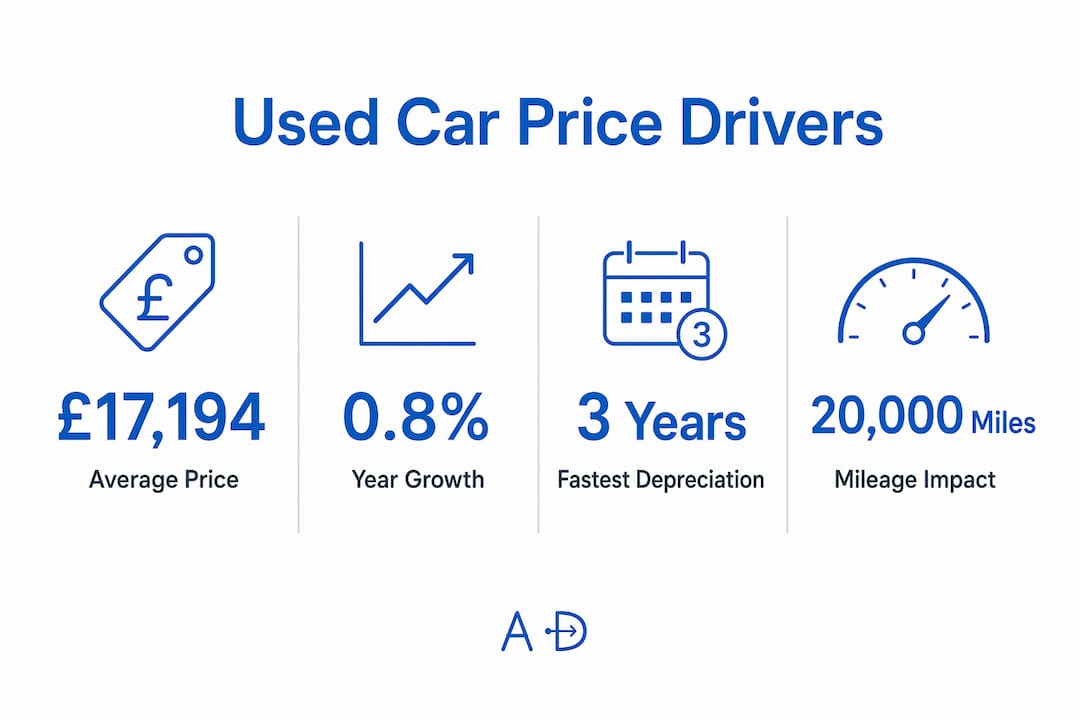
The average used car price in the UK hit £17,194 in June 2026, a 0.8% year-on-year rise and the strongest growth rate since August 2023. That headline number, though, hides a market that is anything but uniform.
Key figures at a glance:
- Average used car price: about £17,000 (June 2026, Autotrader)
- Average days to sell: typically within a month (unchanged month-on-month and year-on-year)
- 3–5 year old EVs: prices significantly increased year-on-year to around £19,000, selling notably faster than average
- 10–15 year old cars: prices rose notably year-on-year to around £7,200
- Cars over 15 years: prices increased year-on-year maintaining value above £5,000
£17,194 — the UK's average used car asking price in June 2026, the highest annual growth rate in nearly three years.
The market is split. Clean, retail-ready EVs and older budget cars are both gaining ground, while average-condition part-exchange vehicles face real pricing pressure. If you're buying or selling right now, knowing which segment you're in changes everything.
How are used car prices in the UK trending right now?
The clearest story in 2026 is acceleration at both ends of the price spectrum. April saw prices rise 1.8% month-on-month to £17,397, the fastest monthly increase since november 2021, driven by EV demand surging 59% year-on-year and older vehicles outperforming the wider market.

| Segment | Average Price | Year-on-Year Change |
|---|---|---|
| — | — | — |
| 1–3 years | — | — |
| 3–5 years (EV) | £19,000 | prices significantly increased year-on-year |
| 5–10 years | — | — |
| 10–15 years | £7,238 | Up 7.8% |
| Over 15 years | above £5,000 | prices increased year-on-year |
| Used EVs (all ages) | — | — (first positive annual growth since december 2022) |
BCA's auction data tells a parallel story: average auction values rose 4% month-on-month in june 2026 to £7,568, though that figure sat £178 below June 2025. Demand was strongest in the first half of june before softening as the holiday period approached. Fuel costs have pushed buyers toward EVs, while petrol and diesel interest softened in April by 6.5% and 18.1% respectively.
Seasonal note: Price softening in the second half of june is normal. What is different in 2026 is the intensity of new car competition, which is putting pressure on younger used vehicles specifically.
How do you accurately value a used car in the UK?
Getting a valuation right means layering several inputs, not just checking one price guide. The main approaches used in the UK market are:
- Guide prices from tools like CAP HPI and Glass's, which provide baseline trade and retail values adjusted for mileage and condition
- Market comparables: searching live listings for identical or near-identical vehicles to see what sellers are actually asking
- Condition-based adjustments: a full service history, single ownership, and no accident markers can add hundreds of pounds over a comparable car without those attributes
- Speed-of-sale signals: a car listed for 45 days in a market where the average is 30 days is almost certainly overpriced or has a history issue worth investigating
Mileage matters more than most buyers realize. A car with 20,000 miles below the average for its age typically commands a premium, while high-mileage examples often sit unsold until the price drops to reflect the additional wear.
Pro Tip: Use Addapted's car checker to pull real-time pricing across live listings, view price history, and check mileage against market averages in seconds. AI-powered valuation reflects current market fluctuations far more accurately than static guidebooks.
For anyone buying a used EV, checking the used Tesla prices guide is worth the five minutes, given how rapidly that segment is moving.
What factors push used car prices up or down?
Several forces shape the price of any individual car, and understanding them helps you spot both a fair deal and an overpriced listing.

Vehicle age and depreciation: New cars lose value fastest in the first three years. The 10–15 year old segment is bucking that pattern entirely in 2026, with prices rising nearly 8% year-on-year as buyers seek affordable, reliable transport.
Mileage and condition: These two variables interact. A low-mileage car in poor cosmetic condition often sells for less than a higher-mileage car that is genuinely retail-ready. BCA's data consistently shows that clean stock commands a premium over average part-exchange vehicles.
Fuel type and running costs: Fuel price fluctuations are reshaping buyer preferences. EV demand on Autotrader surged 59% year-on-year in April 2026. Diesel interest, by contrast, fell sharply as running-cost calculations shifted.
Make, model, and regional demand: Land Rover typically commands higher used prices compared with brands like Vauxhall. The gap reflects brand perception, running costs, and supply. Regional pricing also varies: urban markets like London and the South East tend to carry higher asking prices than the North or Midlands.
"We are seeing significant polarisation in demand, with most EVs finding buyers quickly, while average part-exchange vehicles need to be priced very competitively to attract interest. The market's sweet spot remains the three-to-five-year-old sector, where clean, retail-ready vehicles continue to command a significant premium." — Stuart Pearson, COO at BCA
Seasonality: Spring typically lifts prices as demand picks up after winter. Summer softening is normal, but 2026's june data shows the underlying market remains firm despite seasonal headwinds.
Average prices by make and where to buy in the UK
The table below draws on current market data to show where popular makes sit on the used market.
| Make | Avg. Used Price |
|---|---|
| Land Rover | — |
| Volvo | — |
| Audi | — |
| BMW | — |
| Mercedes-Benz | — |
| Volkswagen | — |
| Toyota | — |
| Kia | — |
| Ford | — |
| Vauxhall | — |
| Fiat | — |
EVs like Tesla averaged £21,323 on the used market in April 2026, with demand outpacing supply in the 3–5 year age bracket. For buyers who want to buy a used car online, comparing dealer and private-sale prices side by side is the fastest way to spot where the market is.
Regional buying options: Enfield, in North London, is home to Big Motoring World, one of the UK's larger used car supermarkets. Its scale means pricing tends to reflect retail market rates closely, making it a useful benchmark for what dealers in the South East are actually charging. Private sales in the same region often run 5–10% below dealer asking prices, though without the consumer protections that come with a regulated dealer.
- Dealer purchases offer statutory rights under the Consumer Rights Act 2015
- Private sales are "buyer beware" with no right to return
- Auction purchases (BCA, Manheim) suit trade buyers who can assess condition in person
If you're financing a purchase, checking whether a car tracker is required by your lender is worth doing before you sign anything.
Expert insights and the tools that actually help
Marc Palmer, writing for Autotrader's insight blog, has noted that the used car market's health in 2026 is underpinned by robust consumer demand, with 83.8 million cross-platform visits recorded in April alone and transactions up 3% year-on-year. That level of buyer activity keeps stock moving and limits the room sellers have to overprice.
Stuart Pearson at BCA has been direct about the polarization: retail-ready vehicles sell fast and at full price; average stock needs aggressive pricing to move at all. That divide is the single most useful piece of intelligence for anyone negotiating right now.
Speed of sale is the market's most honest signal. A car that has sat for 45 days when the average is 30 is telling you something the asking price is not.
Pro Tip: Target listings that have been live for more than 30 days. The seller is likely motivated, and you have real negotiating room. Pair this with an Addapted price check to know exactly what comparable cars are selling for before you open the conversation.
For a full breakdown of how to approach the negotiation itself, the 2026 UK negotiating guide covers the specific tactics that work in the current market.
See what any used car is really worth before you buy

Addapted gives you instant access to real-time pricing across thousands of live UK listings. Check mileage against market averages, view price history, and get an AI-powered valuation in seconds. Whether you're buying or selling, you'll know exactly where a car stands before you commit.
Check any car's value now and shop with the market data on your side.
Key Takeaways
UK used car prices in 2026 average £17,194, with older vehicles and clean EVs outperforming the wider market while average-condition stock faces growing pricing pressure.
| Point | Details |
|---|---|
| Average market price | The UK used car average hit £17,194 in june 2026, up 0.8% year-on-year. |
| EV segment surge | 3–5 year old EVs rose 8.9% year-on-year to £19,000 and sell in just 21 days. |
| Older cars hold value | The 10–15 year age bracket rose 7.8% year-on-year to £7,238, defying seasonal softening. |
| Speed of sale signals pricing | Cars selling in under 30 days are priced right; listings beyond 30 days have negotiation room. |
| Market polarization | Retail-ready stock commands full price; average part-exchange vehicles need competitive pricing to attract buyers. |
FAQ
Are used car prices dropping in the UK?
Not overall. The average UK used car price rose 0.8% year-on-year to £17,194 in june 2026, the strongest annual growth since august 2023. Younger vehicles (under three years old) are seeing some softening, but older cars and EVs are rising.
What is the average price of a used car in the UK?
The average asking price was £17,194 in june 2026 according to Autotrader's Retail Price Index, with vehicles typically selling within 30 days.
Where is the cheapest place to buy a used car in the UK?
Prices tend to be lower in the North of England and Midlands compared to London and the South East. Private sales consistently undercut dealer prices, though without the legal protections that come with buying from a regulated dealer.
What is the best second-hand car to buy in the UK?
The 10–15 year old segment offers the strongest value retention in 2026, with prices rising 7.8% year-on-year to an average of £7,238. For buyers who want newer technology, 3–5 year old EVs are selling fast but hold their value well.