

The out-the-door (OTD) price is the total cash amount you pay to drive a used car off the lot: negotiated vehicle price plus state sales tax, title and registration fees, documentation fee, and any dealer add-ons you agreed to. Before you set foot in a dealership, the FTC recommends requesting this number in writing. That single step prevents bait-and-switch pricing and lets you compare offers from multiple dealers on equal footing. One thing OTD does not cover: loan interest. The total you repay over a 60- or 72-month loan will be higher than your OTD figure, sometimes by thousands.
- Negotiated vehicle price — the number you actually agreed on, not the sticker
- State sales tax — varies by state; non-negotiable
- Title and registration fees — set by your state DMV
- Documentation fee — dealer-set; varies widely by state
- Dealer add-ons — only if you accepted them
Table of Contents
- What's normally bundled into an OTD quote
- How to calculate your estimated OTD price
- Watch out for these dealer tactics
- How financing, trade-ins, and incentives affect your OTD
- How to verify a fair OTD before you visit the dealer
- Documents to verify before you sign anything
- Scripts you can use word for word
- Key Takeaways
- Why OTD is the only number that actually protects you
- Addapted gives you the market data to set a fair OTD target
- Useful sources
- FAQ
What's normally bundled into an OTD quote
The OTD formula is straightforward: vehicle price + taxes + registration/title + dealer fees. Every legitimate line item falls into one of those four buckets. Sales tax and registration are government-set and non-negotiable. Documentation fees, on the other hand, are dealer-set and vary from under $100 to over $800 depending on the state. Dealer add-ons — VIN etching, paint protection, extended warranties, gap insurance — should appear as separate line items, and you can refuse most of them.
Items that belong outside the OTD quote include loan interest, auto insurance, and ongoing maintenance. Financial professionals are clear on this: OTD is the sale total only. Total cost of ownership is a separate, larger calculation.
Pro Tip: Ask the dealer to email you a fully itemized OTD breakdown before you visit. If they list only a single "fees" line instead of separate charges, push back. Dealers who itemize have nothing to hide.
How to calculate your estimated OTD price
You can estimate your all-in price before talking to any dealer. Here's the method:
- Start with the negotiated selling price — the number you plan to offer or the advertised price you're targeting.
- Apply your state's sales tax rate — look it up on your state's Department of Revenue website; rates vary from 0% (Oregon, Montana, New Hampshire, Delaware) to over 9% in some counties.
- Add registration and title fees — check your state DMV's fee schedule; these are fixed by law.
- Add the documentation fee — ask the dealer upfront; a reasonable range is $100–$500 in most states.
- Add any accepted dealer add-ons — only include what you've agreed to.
Worked example
| Line Item | Amount |
|---|---|
| Negotiated vehicle price | $36,500 |
| Sales tax (7%) | $2,555 |
| Registration and title fees | $280 |
| Documentation fee | $499 |
| Estimated OTD total | $39,834 |
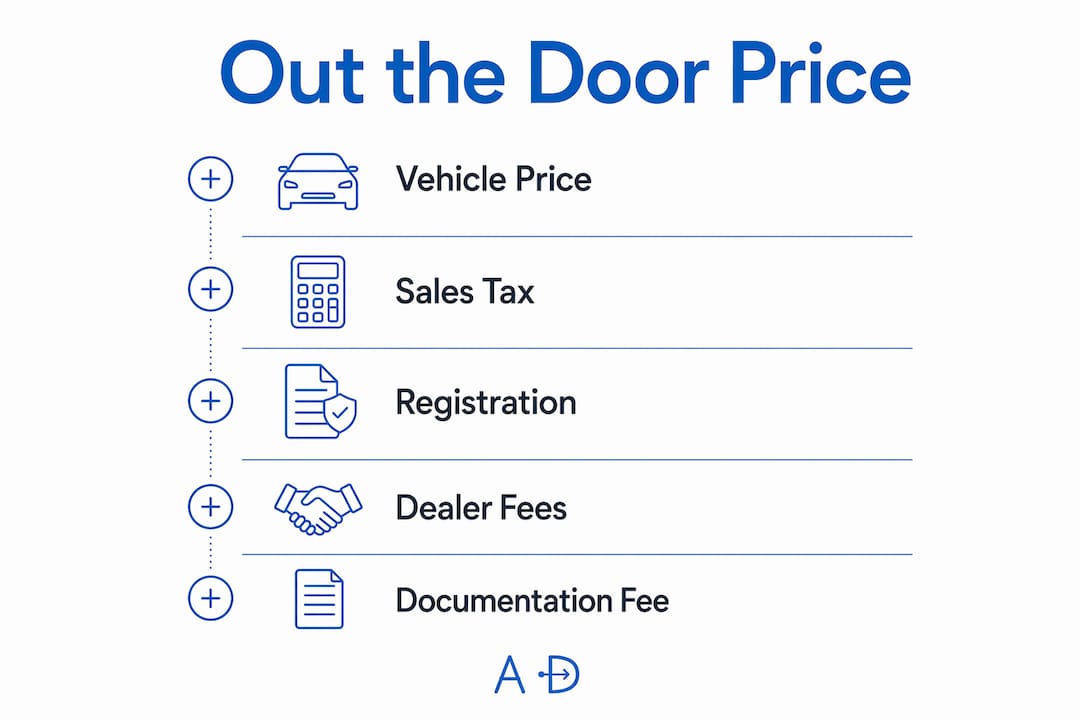
This example aligns with the breakdown where 7% tax on $36,500 is $2,555, not $3,334.
This worked example shows how $3,334 in taxes and fees turns a $36,500 deal into a nearly $40,000 transaction. The negotiated discount you fought for can disappear fast once fees are added.

Pro Tip: Use your state DMV's online fee calculator to get the exact registration amount before you negotiate. Knowing the fixed costs lets you focus your negotiation energy on the vehicle price and doc fee.
Watch out for these dealer tactics
Dealers have well-worn ways to obscure the complete purchase price. Knowing them in advance is the best defense.
- Monthly-payment focus — "What can you afford per month?" is a trap. A dealer can extend the loan term to make any price look affordable while the total cost climbs.
- Dealer reserve (APR markup) — dealers can mark up the lender's buy rate without disclosing it on the OTD quote. A 2% APR markup on a $38,000 loan can cost roughly $2,160 over 72 months.
- Finance office add-ons — after you agree on a vehicle price, the F&I office may present a menu of products (warranties, protection plans) as if they're standard. They're not.
- Vague fee lines — a single "dealer fee" or "processing fee" with no breakdown is a red flag.
If a dealer refuses to provide a written, itemized OTD quote before you visit, treat that as a strong signal the advertised price is bait. The FTC warns that advertised prices often bury eligibility restrictions or financing requirements in fine print.
Pro Tip: Never reveal your monthly payment target or whether you have a trade-in until you have a signed, itemized OTD. Once a dealer knows your payment ceiling, they can reverse-engineer the loan structure to extract more margin without changing the OTD number.
How financing, trade-ins, and incentives affect your OTD
OTD is a cash-at-sale figure. The moment you finance, a second number enters the picture: total interest paid over the loan term. Those are two different things, and conflating them is how buyers overpay.
- Pre-approval matters — getting pre-approved by your bank or credit union before visiting gives you a known buy rate. The dealer's financing offer is then a competing bid, not your only option.
- Dealer reserve — if the dealer arranges financing, they may mark up the lender's rate. Ask what the lender's buy rate is and whether a markup was added.
- Trade-in value — get a written trade-in offer (from Kelley Blue Book, Edmunds, CarGurus, or the dealer) before you negotiate the vehicle price. Mixing the two lets dealers give with one hand and take with the other.
- Incentives and rebates — manufacturer rebates typically reduce the vehicle price before taxes are calculated; confirm this with the dealer in writing.
| Scenario | OTD | APR | 72-Month Total |
|---|---|---|---|
| OTD $39,834, 5% APR | $39,834 | 5% | — |
| OTD $38,000, 7% APR | $38,000 | 7% | — |
A lower OTD with a higher APR can end up costing nearly the same or more. Always run the numbers with a loan calculator after you lock the OTD figure.
How to verify a fair OTD before you visit the dealer
This is the workflow that separates prepared buyers from everyone else.
- Run a market valuation — use Addapted's instant car valuation to see the lowest, highest, and average prices for the exact model and mileage you're targeting. That range becomes your OTD ceiling.
- Pull a VIN history report — services like Carfax surface accident history, odometer discrepancies, and title issues that affect what a car is actually worth.
- Check state DMV fees — confirm registration and title costs on your state's DMV website so no line item surprises you at signing.
- Get pre-approved — a pre-approval letter from your bank or credit union locks your rate and removes the dealer's financing leverage.
- Request a written OTD by email — send the dealer the VIN, your offer, and ask them to confirm the complete itemized price in writing before you drive to the lot.
- Kelley Blue Book and Edmunds provide market value ranges for used vehicles.
- CarGurus shows days-on-market data, which signals dealer motivation to negotiate.
- Carfax and similar VIN history services flag title problems and mileage rollbacks.
Pro Tip: Email the dealer the exact OTD number you're willing to pay and ask for written confirmation. Dealers who respond with a counter in writing are negotiating in good faith. Those who insist you come in first are not.
Documents to verify before you sign anything
Bring this checklist to the dealership and check every item against the pre-agreed OTD.
- Written, itemized OTD quote — the document you received before visiting
- Bill of sale — must match the OTD line for line; question any new charges
- Financing paperwork — shows the APR, loan term, and total interest; ask for the lender's buy rate
- Trade-in worksheet — confirms the agreed trade-in value as a separate line
- Title and registration documents — verify the fees match your DMV lookup
If any number on the sales contract differs from your pre-agreed OTD, stop and ask for an explanation in writing. The FTC advises that if a dealer won't honor a price, you can report the discrepancy to the FTC directly.
Pro Tip: Photograph the itemized OTD quote on your phone before entering the finance office. Having it visible during signing makes it harder for new charges to slip through.
Scripts you can use word for word
Email to request a written OTD:
At the dealership, asking for itemization:
Declining add-ons in the finance office:
Walking away:
- Send the OTD email before visiting.
- Confirm the written OTD matches the bill of sale at signing.
- Decline all F&I add-ons unless you researched and budgeted for them.
- Walk if the numbers change.
Key Takeaways
The OTD price is the only reliable number to negotiate on: it includes every cost you pay at sale and leaves no room for dealers to hide margin in fees or loan structure.
| Point | Details |
|---|---|
| Demand itemized OTD in writing | Request a line-by-line breakdown by email before visiting the dealer. |
| Know the formula | OTD = vehicle price + sales tax + registration/title + doc fee + accepted add-ons. |
| Never negotiate on monthly payments | Dealers extend loan terms to make any price look affordable while total cost rises. |
| Lock OTD before discussing financing | Revealing your payment target or trade-in early lets dealers reverse-engineer hidden margin. |
| Validate with Addapted | Use Addapted's instant valuation to set a realistic OTD ceiling before contacting any dealer. |
Why OTD is the only number that actually protects you
Most car-buying advice focuses on negotiating the vehicle price. That's necessary but not sufficient. A dealer who agrees to your price can still recover margin through a marked-up APR, an inflated doc fee, or a finance-office add-on menu. The OTD figure closes all of those doors at once because it forces every cost into a single, auditable number.
The deeper issue is information asymmetry. Dealers run these transactions daily; most buyers do it a handful of times in their lives. The monthly-payment frame exists precisely because it obscures the total. An OTD anchor flips that dynamic: you're negotiating one number, not a web of interdependent variables.
Market-validation tools change the equation further. When you walk in knowing the average transaction price for that exact model and mileage, the dealer's opening number is just a starting point, not an authority. That's the practical case for running a valuation check before you ever contact a dealer.
Addapted gives you the market data to set a fair OTD target
Knowing what a car is worth before you negotiate is the difference between guessing and knowing. Addapted pulls real-time pricing across multiple listings so you can see the lowest, highest, and average prices for any used car model in seconds. Run a VIN-based check to surface price history and listing details, then set your OTD ceiling with confidence.
The workflow is simple: use Addapted's car valuation tool to establish your target price, email the dealer your itemized OTD request, and verify the numbers match when you arrive. If the dealer's quote is above the market range Addapted shows, you have the data to push back or walk. Start with a free trial at addapted.net and know exactly what you should be paying before you set foot in a showroom.
Useful sources
- FTC consumer guidance — Car Dealer Ads and Promotions: the primary source for written OTD requests and dealer ad rules
- State DMV fee lookups — search "[your state] DMV registration fee calculator" to confirm title and registration costs before visiting
- Vehicle history reports — Carfax and similar VIN-based services for accident history, title status, and odometer verification
- Market valuation — Addapted for instant comparative pricing; Kelley Blue Book and Edmunds for market value ranges
- Loan calculator — use any bank or credit union's auto loan calculator after locking OTD to estimate total interest paid
- Closing-cost context — for a broader look at how one-time transaction fees work, this guide to closing costs explains which fees are fixed versus negotiable
FAQ
What does out the door price include?
The OTD price includes the negotiated vehicle price, state sales tax, registration and title fees, the documentation fee, and any dealer add-ons you agreed to. It does not include loan interest or insurance.
How do I calculate my OTD price?
Add the negotiated selling price, your state's sales tax, DMV registration and title fees, and the dealer's doc fee. For example, a $36,500 vehicle with 7% tax ($2,555), $280 in registration fees, and a $499 doc fee has an OTD total of $39,834.
Should I negotiate OTD or monthly payment?
Always negotiate the OTD price. Monthly payments can be manipulated by extending the loan term, which hides the true total cost while making the deal appear affordable.
What if the dealer won't give me a written OTD?
A refusal to provide a written, itemized OTD is a red flag that the advertised price may be bait. The FTC advises buyers to get all discounts and offer details in writing, and to report dealers who won't honor advertised prices.
How can Addapted help me verify a fair OTD?
Addapted provides instant market valuations showing the lowest, highest, and average prices for any used car model, so you can set a realistic OTD target before contacting dealers and verify whether a quote is in line with the market.