

TL;DR:
- Pairing numeric filters with identity and history checks helps find reliable used cars in the UK. Verifying listings through official records confirms details like mileage, write-off status, and ULEZ compliance before viewing. Using combined tools streamlines the process, reducing risk and ensuring accurate, confident purchases.
The most effective approach to finding a reliable used car in the UK is pairing numeric filters (min/max price, mileage range) with identity and history filters (VRM lookup, write-off category, ULEZ compliance), then confirming every shortlisted result against DVLA and MOT records before you travel anywhere. Filters narrow the field fast. Official checks confirm what filters can't see. Tools like Addapted combine both steps in one place, which cuts the time between search and confident shortlist significantly.
Quick-start checklist: Set Min/Max price → Mileage From/To → First registration date range → ULEZ compliance flag → Write-off category exclusion → Run VRM + MOT history check + V5C + vehicle-history report before viewing.
Table of Contents
- What advanced car search filters actually matter in the UK?
- How to combine filters for your specific buyer goal
- What to verify before you travel to view a car
- How do UK car search filters actually get their data?
- How Addapted brings these filters together in one workflow
- Key Takeaways
- Why filters alone won't protect you
- Addapted puts filters and verification in one place
- Useful UK sources for car checks and buyer guidance
- FAQ
What advanced car search filters actually matter in the UK?
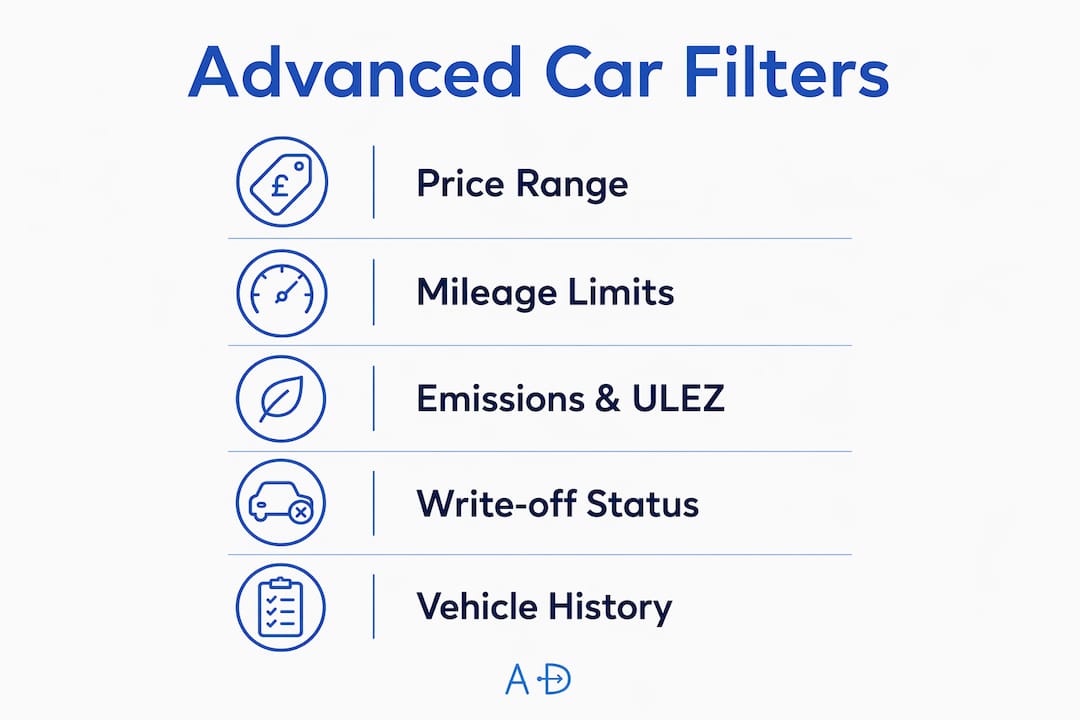
Most search tools offer price and mileage sliders. The filters that genuinely change your risk and running costs go several layers deeper.
Core numeric filters: price and mileage
Min/Max price and Mileage From/To are the starting point on virtually every dealer search, from franchised approved-used platforms to independent aggregators. Set these too tight and you'll see three results. Set them too loose and you're back to scrolling through 400 listings. A practical approach: anchor your max price 5–10% below your actual ceiling to leave negotiating room, and set mileage upper limits that reflect realistic annual UK averages (roughly 8,000–10,000 miles per year as a general benchmark).

Vehicle identity and provenance filters
VRM (registration number) lookup connects a listing directly to DVLA records, giving you the official make, model, engine size, and first registration date in seconds. First registration date filtering matters beyond age: a car registered in March versus September of the same year can have a meaningful difference in depreciation and warranty status. Number of previous owners is another filter worth applying early. Fewer owners generally means a more traceable service history, though a single fleet owner with full records can be better than two private owners with none.
Specification filters
Fuel type, transmission, body type, and engine size all affect insurance group, fuel cost, and day-to-day suitability. Dealer search interfaces typically expose these alongside first registration date and CO2/MPG fields. Filtering by transmission is especially useful if you're buying for a specific driver: an automatic-only filter eliminates a huge chunk of irrelevant results immediately.
Emissions and ULEZ filters
CO2 output and combined MPG ranges are now standard fields on most UK dealer platforms. ULEZ compliance is the filter that matters most for London commuters and anyone driving regularly into other UK clean-air zones. APIs and dealer fields commonly expose a dedicated ulez_compliant flag, making it straightforward to exclude non-compliant vehicles entirely rather than calculating CO2 thresholds manually.
History and status filters
Write-off category (Cat A, B, S, or N) filters are among the most important red-flag tools available. Excluding Cat A and Cat B is non-negotiable; Cat S and Cat N require careful judgment and a price discount. MOT history presence as a filter signals whether a car has a documented mileage timeline at all. Active vs. recent/expired listings (typically a 90-day lookback window) let you compare what cars are selling for against what sellers are asking right now.
| Filter Type | Key Fields | Why It Matters |
|---|---|---|
| Numeric | Min/Max price, Mileage From/To | Shapes result volume and budget fit |
| Identity/Provenance | VRM, First reg date, Num. owners | Links to DVLA; flags fleet vs. private history |
| Specification | Fuel, Transmission, Body type, Engine | Affects insurance group and running costs |
| Emissions/Access | CO2, MPG, ULEZ compliance | Critical for clean-air zones and fuel budgets |
| History/Status | Write-off category, MOT presence, Insurance flags | Primary risk filters |
| Listing state | Active vs. recent/sold (90-day) | Benchmarks fair market price |
Pro Tip: When a search tool labels itself "advanced," check whether it includes real purchasing dimensions like ULEZ compliance, write-off category, and number of owners. Cosmetic filters like interior color don't change your risk profile.
How to combine filters for your specific buyer goal
Different goals need different filter presets. Here are four practical combinations with their trade-offs.
-
Low-mileage near-new: Price max at your ceiling, mileage max at a moderate upper limit, first registration within the last couple of years, fuel and transmission to preference, write-off categories excluded. Trade-off: Result count drops sharply; expect to expand your geographic radius or relax the registration window by 6 months to see enough options.
-
Low running costs / ULEZ-safe commuter: ULEZ compliant = yes, fuel type = petrol or hybrid (or electric), CO2 max at 100g/km, MPG min at 45. Trade-off: Older compliant diesels may appear; cross-check their real-world MPG against the listed figure.
-
Family car with space and safety: Body type = SUV or estate, seats = 5+, transmission = automatic (optional), mileage max at a typical upper limit for used family cars, write-off excluded. Add a geographic filter within 50 miles to keep viewings manageable. Trade-off: Popular family SUVs in this range sell quickly; use price-drop alerts to catch relisted stock.
-
Bargain fixer-upper with service history: Price max at £8,000, mileage up to 80,000, MOT history present, service history = full, write-off Cat S/N included but flagged. Trade-off: Requires the most thorough pre-viewing verification; a vehicle-history report is non-negotiable here.
| Preset | Key Filters | Expected Result Size | Top Verification Priority |
|---|---|---|---|
| Low-mileage near-new | Mileage ≤10k, reg ≤24 months | Small | MOT timeline, V5C |
| ULEZ-safe commuter | ULEZ = yes, CO2 ≤100g/km | Medium | Emissions confirmation, MOT |
| Family SUV/estate | Body = SUV/estate, seats 5+ | Medium–large | Write-off check, service history |
| Budget fixer-upper | Price ≤£8k, Cat S/N included | Large | Full HPI report, advisories |
What to verify before you travel to view a car
RAC Drive advises treating paperwork and history checks as part of the filtering system, not a separate afterthought. Filters find candidates; official checks confirm them.
Stepwise verification workflow:
- VRM lookup: Confirm make, model, color, and engine match the listing. Discrepancies here end the conversation.
- MOT history timeline: Every MOT test records an odometer reading for cars over three years old. A drop in recorded mileage between tests, or a suspicious gap with no test, is a strong clocking indicator. Check via GOV.UK's free MOT history service.
- V5C check: Confirm the registered keeper count, address history, and that the V5C number matches what the seller holds.
- Vehicle-history report: Paid HPI-style reports reveal outstanding finance, stolen flags, plate changes, and write-off status that no filter can surface on its own.
- Service history and advisories: Repeated advisories for the same item across multiple MOTs signal a known issue the seller has been managing, not fixing.
Red flags that should stop a viewing: Any mileage drop between MOT entries. Outstanding finance showing on a history report. A write-off category the seller didn't disclose. A V5C with a different address than the seller's. If you spot any of these, walk away before spending time or travel costs.
For used car history checks, the GOV.UK MOT check is free and takes under a minute. A paid vehicle-history report typically costs £10–£30 and is worth every penny on any car above £5,000.
How do UK car search filters actually get their data?
The filter fields you see on a search platform are populated by a stack of data feeds working behind the scenes.
DVLA/VRM data provides the official registration record: make, model, first registration date, engine size, and color. This is the authoritative source for identity filters. The GOV.UK MOT database supplies the mileage timeline and test outcomes for every car that has had an MOT, which powers mileage-timeline checks and advisory history. Dealer and marketplace feeds contribute listing-level data: asking price, photos, dealer location, and listing date. Specialist APIs like MarketCheck's UK tools document parameters including vrm, vehicle_registration_date_range, ulez_compliant, write_off_category, and insurance_group, pulling from aggregated market and history data.
The 90-day recent-listing window (labeled search_uk_recent_cars in MarketCheck's API documentation) covers expired and sold listings from the past 90 days. Comparing active listings against this window tells you whether a car is priced at, above, or below recent market. A listing active for several weeks while similar cars sold recently at a noticeable discount can signal room for negotiation.
| Filter Field | Primary Data Source | Reliability Note |
|---|---|---|
| VRM / Registration | DVLA | Authoritative; always cross-check listing details |
| First registration date | DVLA | Exact; use for age and depreciation filtering |
| MOT history / mileage | GOV.UK MOT database | Free; check directly at gov.uk |
| ULEZ compliance | TfL / API flag | Verify against TfL checker for London zones |
| Write-off category | Insurance industry / HPI | Requires paid report for full detail |
| CO2 / MPG | Manufacturer data via DVLA | Standardized test figures; real-world varies |
| Active vs. recent listings | Marketplace / API 90-day window | Best for price benchmarking |
Pro Tip: If you're buying a car with a Thatcham-approved tracker already fitted, check whether it affects the insurance group rating. Approved tracker costs vary, but the insurance savings on higher-risk vehicles can offset the price quickly.
How Addapted brings these filters together in one workflow
Addapted is built specifically for UK used-car buyers who want to combine market pricing, VRM lookups, and history checks without jumping between five different tools.
What Addapted gives you:
- Instant AI-powered valuation showing lowest, highest, and average prices for any model
- VRM lookup that pulls registration details and connects to mileage and history data
- MOT and mileage timeline integration to flag clocking risks
- ULEZ compliance flag and write-off/insurance indicators built into search results
- Active vs. recent listing toggle for 90-day price benchmarking
- Price-drop alerts so you catch relisted stock before other buyers do
Step-by-step workflow with Addapted:
- Set your filter preset (price, mileage, fuel type, ULEZ, write-off exclusion).
- Run a VRM lookup on any shortlisted car to pull the official registration record and instant valuation.
- Open the MOT timeline and history check to review mileage entries and advisories.
- Compare the asking price against active and recent sold listings using the 90-day window.
- Shortlist your top two or three results and request V5C and service history from the seller before booking a viewing.
For context on how Addapted's valuation sits within the broader UK market, the car valuation tool comparison on the Addapted blog covers the main alternatives and where each fits. If you want to understand used car price averages before setting your price filter, that's a useful starting point for calibrating your thresholds.
Key Takeaways
The most reliable used-car searches pair advanced filters (price, mileage, ULEZ, write-off category) with official verification (DVLA, MOT timeline, V5C, vehicle-history report) before any viewing.
| Point | Details |
|---|---|
| Start with numeric filters | Set Min/Max price and Mileage From/To first; they shape every result that follows. |
| Add identity and history filters | VRM lookup, first registration date, write-off category exclusion, and ULEZ flag cut risk before you read a single listing. |
| Use the 90-day window | Compare active listings against recent/sold results to judge whether an asking price reflects the real market. |
| Verify before you travel | Run MOT timeline, V5C, and a paid vehicle-history report on every shortlisted car; mileage drops between MOT entries are the clearest clocking signal. |
| Addapted combines all steps | Addapted's platform runs VRM lookups, instant valuations, MOT timelines, and price-drop alerts in one workflow for UK buyers. |
Why filters alone won't protect you
The conventional wisdom in used-car buying is that better filters mean better results. That's true up to a point. What buyers consistently underestimate is how much a well-filtered result can still hide.
A car that passes every filter, including low mileage, ULEZ compliant, no write-off flag, and a fair asking price, can still have a clocked odometer. The filter pulled the listing because the seller entered a plausible mileage figure. The MOT timeline is what catches it. Two consecutive tests showing 62,000 miles and then 58,000 miles is a number a filter will never surface, but a 30-second check on GOV.UK will.
The buyers who waste the most time and money are those who treat a filtered shortlist as a pre-vetted list. It isn't. Filters are a narrowing tool, not a verification tool. The verification step, VRM, MOT timeline, V5C, history report, is where the real due diligence happens. Running both in sequence, the way Addapted's workflow is designed, is what separates a confident purchase from an expensive mistake.
Addapted puts filters and verification in one place
Addapted gives UK used-car buyers something most search tools don't: the ability to run advanced filters, instant AI valuations, and VRM-based history checks in a single workflow, without switching between GOV.UK, a history-check site, and a pricing tool separately.
Set a filter preset, pull an instant valuation, and check the MOT timeline on any shortlisted car, all from one platform. The 90-day price comparison feature shows you whether a listing is priced above or below recent market, so you go into every negotiation with real data. Start a free trial at Addapted and run your first filter preset today.
Useful UK sources for car checks and buyer guidance
- GOV.UK MOT history check: Free mileage timeline and test history for any UK-registered car over three years old. Use this first on every shortlisted result.
- DVLA vehicle enquiry: Official registration details including make, model, color, and tax/MOT status.
- RAC Drive used-car buying checklist: Comprehensive document checklist covering V5C, MOT certificate, service history, and vehicle-history reports.
- Carwow used-car inspection guide: Practical walkthrough of what to check physically and how to read MOT mileage timelines for clocking detection.
- Whatbreaks used-car buying checklist: Covers paid history checks and what HPI-style reports typically reveal (outstanding finance, stolen flags, write-off status).
- MarketCheck UK API documentation: Technical reference for filter parameters including VRM, ULEZ compliance, write-off category, and the 90-day recent-listing window.
FAQ
What filters should I always use when searching for a used car in the UK?
At minimum, set Min/Max price, Mileage From/To, first registration date, and write-off category exclusion. Add ULEZ compliance if you drive in a clean-air zone.
How does the MOT history timeline help detect a clocked car?
Every MOT test records an odometer reading for cars over three years old, so a drop or unexplained gap in mileage between tests is a clear sign the odometer has been tampered with. Check it free via GOV.UK's MOT history service.
What is the 90-day recent-listing window and why does it matter?
The 90-day window covers expired and sold listings from the past 90 days, letting you compare what similar cars actually sold for against current asking prices to judge whether a deal is fair or overpriced.
Do I need a paid vehicle-history report if I've already filtered by write-off category?
Yes. Write-off category filters depend on the data the listing platform holds; a paid HPI-style report pulls directly from insurance industry records and also reveals outstanding finance, stolen flags, and plate changes that filters won't catch.
How does Addapted combine filters and verification?
Addapted runs VRM lookups, instant AI valuations, MOT mileage timelines, ULEZ flags, and active vs. recent price comparisons in one workflow, so UK buyers can shortlist and verify without switching between multiple tools.