

TL;DR:
- The Consumer Rights Act 2015 protects UK used car buyers from traders by ensuring vehicles are of satisfactory quality, fit for purpose, and properly described. Buyers can reject faulty cars within 30 days or seek repairs and refunds up to six months, with the trader bearing the proof burden during the first six months. Private sales and auctions are outside these protections, but documenting everything and using pre-purchase checks can help safeguard your rights.
Buying a used car from a trader in the UK gives you strong legal protections under the Consumer Rights Act 2015. The law requires that any vehicle sold by a trader must be of satisfactory quality, fit for purpose, and as described. If the car falls short on any of those counts, you have the right to a full refund within 30 days, or a repair, replacement, or price reduction after that window. These protections apply automatically to every purchase from a trader made after October 1, 2015. They do not apply to private sales or auction purchases, where your rights are far more limited. The Motor Ombudsman is the UK's dedicated automotive dispute resolution body and a trusted source of guidance when things go wrong.
What does the Consumer Rights Act 2015 cover for used car buyers?
The Act sets three core standards every trader must meet when selling you a vehicle.
Satisfactory quality is the broadest and most frequently invoked standard. A car must be free from defects, safe to drive, durable, and in a condition that reflects its age, mileage, and price. An older, high-mileage car will not be held to the same standard as a nearly new one, but it still needs to be roadworthy and broadly fit for everyday use. Public statements in advertising, on the dealer's website, or in sales pitches all count toward this assessment.
Fit for purpose covers both the car's ordinary use and any specific use you told the dealer about before buying. If you told the dealer you needed a vehicle capable of towing a specific load, and it cannot do that, you have a claim even if the car is otherwise fine.
As described means exactly what it says. Every detail in the listing, the advert, and the verbal pitch must be accurate. Engine size, service history, number of previous owners, and any stated features all form part of the contract. If the car does not match the model or sample you examined, you are entitled to a remedy.
The Act also requires the trader to have the legal right to sell the vehicle. If they do not actually own it and cannot transfer clean title to you, you are entitled to a remedy regardless of the car's condition.
What the Act does not cover
Your statutory rights do not apply in every situation. The Act excludes:
- Faults you were told about before purchase
- Defects that were obvious and would have been noticed on a reasonable inspection
- Damage you caused yourself after purchase
- Mistakes you made, such as ordering the wrong specification
- Simply changing your mind or finding a cheaper alternative elsewhere
Private sales and motor auctions sit outside the Act's protections. No Consumer Rights Act coverage exists for those transactions. In a private sale, you can only claim if the seller misrepresented the vehicle. At an auction, the terms and conditions of the auction house govern your position.
Pro Tip: If you buy online from a dealer, you get an additional 14-day cancellation right under the Consumer Contracts (Information, Cancellation and Additional Charges) Regulations 2013, on top of your standard Consumer Rights Act protections. That is a meaningful extra layer for remote purchases.
Your rights and remedies when a used car turns out to be faulty
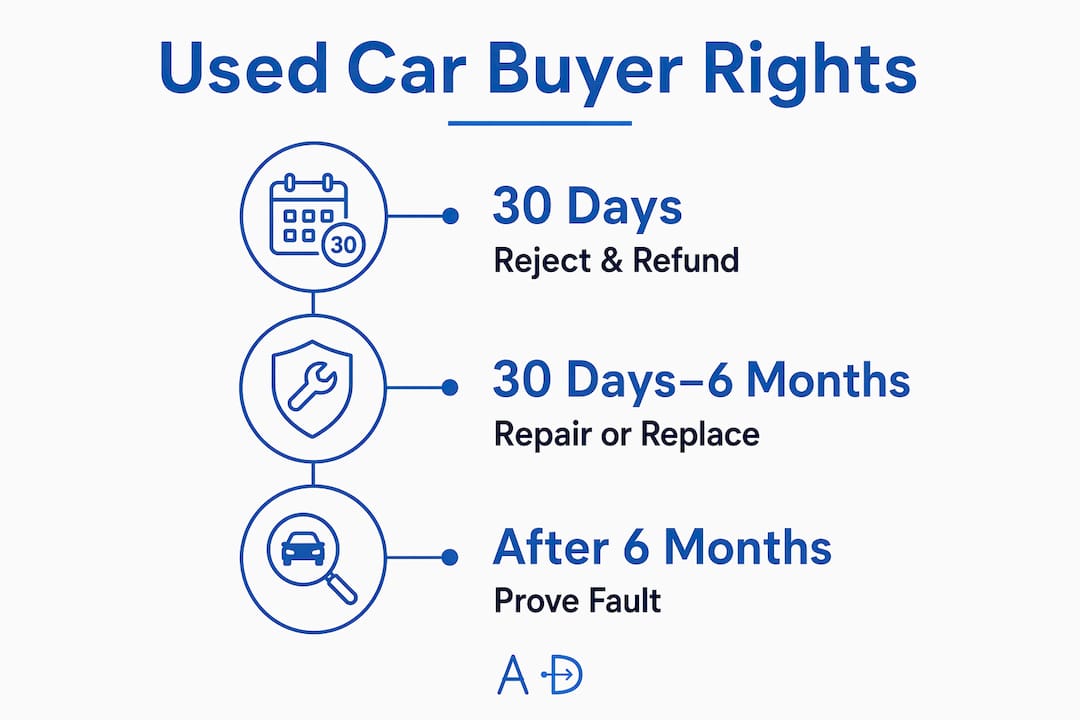
The Act creates three distinct windows for making a claim, each with different rules.

The 30-day short-term right to reject
Within 30 days of purchase, you can reject the car and demand a full refund with no deductions for mileage or use. The trader must refund you promptly and, at the latest, within 14 days of agreeing to the refund. If you part-exchanged a vehicle as part of the deal, you are entitled to get it back in its original condition. If that is not possible, you are entitled to its equivalent value.
This is your strongest remedy. You do not need to give the dealer a chance to repair the car first. You simply notify them that you are rejecting it, state the fault, and request your money back. For the first six months, the burden of proof that the fault did not exist at the time of sale is on the trader.
Rights between 30 days and six months
Once the 30-day window closes, your options shift. You can still request a repair or replacement, but the trader gets one attempt to fix the problem. If that repair fails, or if the replacement vehicle is also faulty, you can then seek a price reduction or exercise the final right to reject. Under the final right to reject, the trader may deduct an amount from your refund to reflect the use you have had from the vehicle.
The key legal advantage in this period is the burden of proof. For the first six months after purchase, the law assumes any fault existed at the time of sale. The trader must prove the car was in good condition when you bought it. You do not have to prove the fault was there from the start.
After six months
After six months, the burden of proof reverses. You must now demonstrate that the fault was present at the point of sale, not something that developed through normal use. This is harder to do without an independent technical report. Claims can still be made up to six years after purchase under contract law, but the evidential bar is significantly higher.
Remedies at a glance
| Time since purchase | Your primary remedy | Deduction for use? | Burden of proof |
|---|---|---|---|
| 30 days | Full refund (short-term right to reject) | No | Trader |
| 30 days to six months | Repair or replacement; then price reduction or final rejection | Yes (on final rejection) | Trader |
| After six months | Price reduction or final rejection (if fault proven) | Yes | Consumer |
The "fair wear and tear" defense
Traders sometimes reject claims by arguing that a fault is simply fair wear and tear for a car of that age and mileage. This defense is intentionally broad and subjective. Whether it applies depends on the specific vehicle, its price, its history, and the nature of the fault. A worn clutch on a ten-year-old car with 120,000 miles is a different argument from a failed gearbox on a three-year-old car with 30,000 miles. An independent technical report from a qualified mechanic is often the most effective way to counter this defense, because it establishes that the fault exceeds what is reasonable for the vehicle's history.
Pro Tip: Document everything from day one. Photograph the car at collection, keep all paperwork, and send any complaint to the dealer in writing, even if you also call them. Written records are your strongest asset if a dispute escalates.
How to handle a problem with a used car from a dealer
Acting quickly and methodically gives you the best chance of a resolution.
Step-by-step process for raising a complaint
-
Identify the fault clearly. Note when it appeared, what it affects, and any warning signs you observed. The more specific you are, the harder it is for the dealer to dismiss.
-
Contact the dealer in writing. Email or a recorded letter creates a paper trail. State the fault, reference the Consumer Rights Act 2015, and specify the remedy you want (refund, repair, or replacement). The dealer is your primary legal contact, not the manufacturer. Going to the manufacturer first often delays resolution, because they are not legally liable under the Act for the sale contract.
-
Give the dealer a reasonable deadline. Fourteen days is standard. State that you expect a written response.
-
Gather independent evidence if needed. If the dealer disputes the fault or claims fair wear and tear, commission an independent inspection from a qualified mechanic or an organization such as the RAC or AA. Their written report carries weight in any dispute.
-
Escalate if the dealer does not respond or refuses. Your options at this stage include:
- Citizens Advice: Free, impartial guidance on your rights and next steps. Their consumer helpline can advise on how to frame your claim and what evidence to gather.
- The Motor Ombudsman: The UK's automotive alternative dispute resolution (ADR) body. If the dealer is registered with The Motor Ombudsman's Garage or Vehicle Sales Code, you can submit a formal complaint for independent adjudication at no cost to you.
- Trading Standards: If the dealer has acted unfairly or deceptively, Trading Standards can investigate and take enforcement action.
- Small Claims Court: For disputes up to £10,000 in England and Wales, the small claims track is a relatively accessible route if other avenues fail.
What to keep as evidence
- The original sales contract and any adverts or listings
- All written communications with the dealer
- Photographs of the fault and the car's condition at collection
- Any independent inspection reports
- Records of mileage at purchase and at the time of the fault
Dealer-provided warranties vs. your statutory rights
A dealer may offer a warranty on top of your legal rights. That warranty can extend coverage beyond what the Act provides, but it cannot replace or reduce your statutory rights. If a dealer tells you that a fault is not covered by their warranty, that does not end the matter. Your rights under the Consumer Rights Act exist independently and cannot be signed away. The warranty is an addition, not a substitute.
Tools and resources to check a used car's history and value before you buy
Checking a car's history and market value before you sign anything is one of the most practical steps you can take. It does not affect your statutory rights under the Act, which apply regardless, but it dramatically reduces the chance of a dispute arising in the first place.
Addapted offers an AI-powered car valuation tool that gives you real-time pricing across live market listings. You can see the lowest, highest, and average prices for any model, compare mileage against price history, and spot listings that are priced above or below the market. That kind of data is directly relevant to the "satisfactory quality" standard: if a car is priced as a premium example but its history suggests otherwise, you have a concrete basis for negotiation or caution before you commit.
A used car history check can reveal outstanding finance, written-off status, stolen vehicle flags, and mileage discrepancies. Any of these could affect your rights or the dealer's ability to legally sell the car at all.
Key tools and checks worth running before purchase:
- Addapted's valuation and price comparison: Real-time market data to confirm you are paying a fair price and to benchmark the car against comparable listings.
- DVLA vehicle enquiry: Free check confirming tax, MOT status, and basic registration details.
- HPI or similar history check: Paid reports that flag outstanding finance, write-offs, stolen status, and mileage anomalies. These are not mandatory for your statutory rights, but they surface problems before they become disputes.
- Independent pre-purchase inspection: A qualified mechanic's report on mechanical condition. Statutory rights apply whether or not you commission one, but an inspection gives you documented evidence of the car's condition at the point of sale, which is invaluable if a fault emerges later.
- Addapted's price history analysis: Tracks how a listing's price has moved over time, which can signal a car that has been sitting unsold or has had undisclosed issues.
Pro Tip: Screenshot and save the dealer's online listing before you buy. If the car later turns out not to match its description, that saved listing is direct evidence for an "as described" claim under the Act.
Before you visit a dealer, it is worth reading through what to check when buying a used car so you arrive knowing exactly what to look for and what questions to ask.
Key Takeaways
The Consumer Rights Act 2015 gives UK used car buyers from traders the right to reject, repair, or get a refund, with the burden of proof on the trader for the first six months after purchase.
| Point | Details |
|---|---|
| Short-term right to reject | Reject a faulty car within 30 days for a full refund with no deduction for mileage or use. |
| Burden of proof | For the first six months, the law assumes the fault existed at sale; the trader must prove otherwise. |
| Repair or replacement window | Between 30 days and six months, the trader gets one attempt to repair; failure triggers a price reduction or final rejection right. |
| Private sales excluded | The Act does not cover private sales or auctions; only purchases from traders carry these protections. | | Evidence is critical | Written records, photographs, and independent inspection reports are your strongest assets in any dispute. |
FAQ
Does the Consumer Rights Act 2015 apply to second-hand cars?
Yes. The Act covers used cars bought from a trader after October 1, 2015, requiring them to be of satisfactory quality, fit for purpose, and as described. It does not apply to private sales.
How long do I have to return a faulty second-hand car?
You have 30 days from the date of purchase to reject the car and claim a full refund with no deduction for use. After 30 days and up to six months, you can request a repair or replacement first.
Can I reject a second-hand car from a dealer?
Yes. Within the first 30 days you can reject it outright for a full refund. After that window, you must first give the dealer one opportunity to repair or replace the vehicle before exercising the final right to reject.
Can I return a used car to a dealership in the UK?
You can return it within 30 days if it is faulty, or after a failed repair attempt within six months. Simply changing your mind is not a ground for return unless you bought online, in which case a 14-day cancellation right applies under the Consumer Contracts Regulations 2013.