

TL;DR:
- Dealer documentation fees cover administrative costs like contract preparation and DMV filings but often serve as dealer profit. Fees vary greatly by state, with caps in some and no limits in others, leading to high charges in uncapped states. Negotiating the total out-the-door price based on market data is the most effective way to handle these fees.
A dealer documentation fee (commonly called a "doc fee") is an administrative charge a dealership adds to cover the paperwork involved in processing your vehicle sale: drafting the sales contract, handling the title transfer, recording any lien, and submitting DMV filings. It is dealer revenue, not a government tax or registration fee. Those are separate line items entirely.
Doc fees vary widely by state, generally lower in states with caps and significantly higher with no limits. Actual processing costs are typically much lower than what some dealers charge. Several states have statutory caps; California caps the fee at $85. In states without caps, fees can be considerably higher.
What to do right now:
- Look up your state's cap or typical range before you set foot in a dealership.
- Ask for a written out-the-door price that includes the doc fee from the start.
- Negotiate the total price, not the fee line item.
Table of Contents
- What dealer documentation fees actually cover
- How much should you expect to pay?
- Are doc fees legal, and how do state caps work?
- Practical tactics to reduce or avoid an excessive doc fee
- Where the doc fee appears on your paperwork
- Red flags and questionable add-ons to challenge
- How Addapted helps you set a confident OTD target
- Key Takeaways
- The OTD strategy is the only one that consistently works
- Know your number before you negotiate
- Useful sources
- FAQ
What dealer documentation fees actually cover
The fee is supposed to pay for a specific set of administrative tasks. In practice, it also generates profit for the dealer, which is why amounts vary so dramatically from one store to the next.
Legitimate tasks the fee is meant to cover:
- Preparing the retail installment contract and buyer's order
- Processing the title transfer and lien filing with the state
- Submitting registration paperwork to the DMV
- Handling finance contract documentation
What it does not cover: state sales tax, registration fees, title fees, or any third-party charges. Those appear as separate line items on your purchase order. A dealer who bundles them into the doc fee is misrepresenting the charges.
On a typical purchase order, you will see a line labeled "Documentary Fee," "Processing Fee," or "Dealer Fee" sitting below the vehicle price and above the tax/title/registration block. The number there is pure dealer revenue.
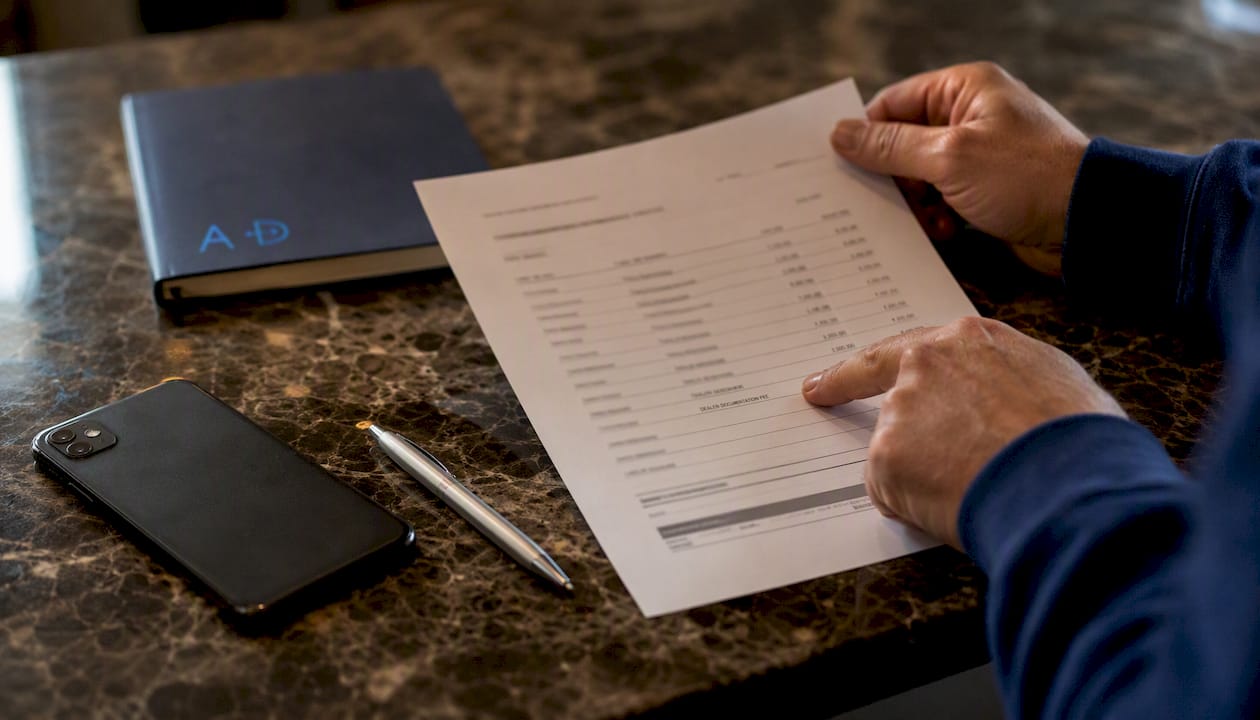
Pro Tip: Before signing, ask for the itemized worksheet and compare it line-by-line against the federal Truth in Lending Act (TILA) disclosure. The doc fee must appear as part of the "amount financed" under Regulation Z, so any discrepancy between the worksheet and the TILA box is worth questioning.
How much should you expect to pay?
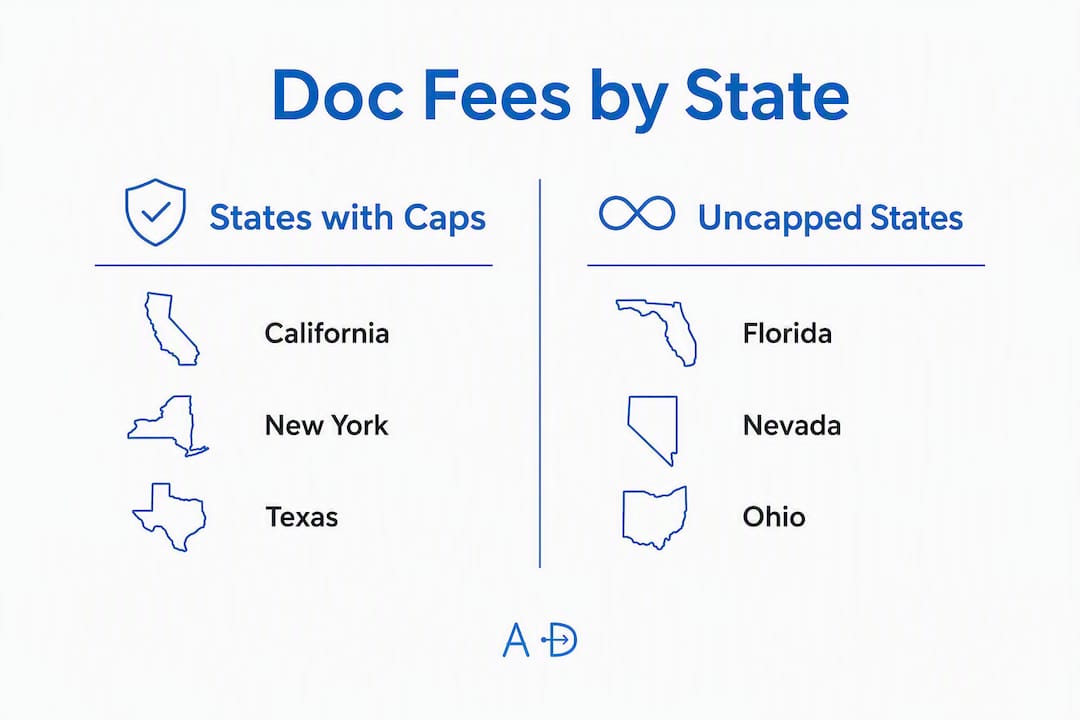
The honest answer: it depends almost entirely on your state. At least 15 states cap doc fees by statute; in uncapped states, $500–$999 is common, and some dealers push past $1,000.
| State | Cap / Typical Range | Notes |
|---|---|---|
| California | $85 (capped) | Fixed statutory maximum |
| New York | — | Low statutory cap |
| Iowa | — | Fixed cap |
| Washington | ~$150 (capped) | Fixed cap |
| Oregon | — | Fixed cap |
| Florida | $800–$999 (uncapped) | Among the highest in the country |
| Texas | $500–$999 | Varies widely by dealer |
| Ohio | Regulated by statute | Formula-based; see Ohio Revised Code |
| Georgia | $500–$700 (uncapped) | Common range |
| Colorado | $500–$700 (uncapped) | Common range |
California's $85 ceiling is the most aggressive cap in the country. Florida sits at the opposite end: no cap, and dealers there treat the fee as a reliable profit center. The gap between actual processing costs ($50–$150) and what uncapped dealers charge is substantial, which is why knowing your state's rules before you shop matters.
A note on medians: In uncapped states, the median doc fee tends to cluster around $400–$600, but individual dealers within the same metro area can vary by $400 or more. Shopping two or three dealers in the same market often reveals that spread quickly.
Are doc fees legal, and how do state caps work?
Doc fees are legal in every state. The question is whether your state limits how much a dealer can charge.
States regulate doc fees in a few different ways. Some set a hard dollar cap (California's $85 is the clearest example). Others use a formula tied to the Consumer Price Index, so the maximum adjusts annually. Ohio's Revised Code explicitly permits a documentary service charge and provides statutory guidance on how it must be disclosed, making it a useful model for understanding how a regulated regime works. Still other states leave the amount entirely to dealer discretion, with only a disclosure requirement.
What "disclosure required" actually means: In some states, dealers must include the doc fee in any advertised price. If a dealer advertises a vehicle at $28,000 and then adds a $799 doc fee at the desk, that may violate state advertising rules even if the fee itself is legal.
If you suspect an overcharge or deceptive advertising:
- Check your state's DMV or attorney general consumer protection page for the current cap
- Report deceptive pricing or undisclosed mandatory fees to the FTC and your state AG's office.
No dealer is required to waive a doc fee, but they are required to disclose it accurately and, in capped states, to stay within the legal limit.
Practical tactics to reduce or avoid an excessive doc fee
The single most effective move is to negotiate the out-the-door (OTD) price rather than arguing about the doc fee as a line item. Here is why that works: many dealers keep their doc fee uniform across all customers to avoid discrimination exposure. A sales manager who cannot waive the fee for you without waiving it for everyone can still lower the vehicle price to offset it.

1. Check your state cap first. Before contacting any dealer, confirm whether your state has a statutory maximum. If the dealer's fee exceeds it, you have a legal argument, not just a preference.
2. Get written OTD quotes by email. Contact three or four dealers for the same make, model, and trim. Ask specifically: "What is the out-the-door price including all dealer fees, taxes, and registration?" Dealers who respond in writing are committing to a number you can compare directly.
3. Have your market valuation ready. Use a tool like Addapted to pull the average, lowest, and highest prices for the exact vehicle you want. Walk in knowing the market range, and your OTD target becomes a data-backed ask rather than a guess.
4. Use these short scripts:
- At first contact: "Before we go further, can you confirm the doc fee amount and give me a written out-the-door price?"
- In-person, if the fee feels high: "I've seen this model listed at [market average]. I'm happy to move forward if we can get the total out-the-door to [your target]. The doc fee is part of that total."
- At the finance desk: "The worksheet shows a $799 doc fee. My state cap is $150. Can you adjust the vehicle price to bring the OTD to what we agreed?"
5. Know when to walk. If a dealer refuses to budge on the OTD and the fee is well above your state cap or the market norm, a competitor in the same metro area may charge $300 less in doc fees alone. That is a real dollar difference worth a 20-minute drive.
Pro Tip: Ask about the doc fee at the very start of negotiations, not at the finance desk. Buyers who wait until signing lose leverage because the deal is emotionally closed before the fee surfaces.
Where the doc fee appears on your paperwork
The fee shows up under several different labels depending on the dealership's system: "Documentary Fee," "Doc Fee," "Processing Fee," "Administrative Fee," or simply "Dealer Fee." All of these are the same charge.
Where to look and when to act:
- Buyer's order / purchase agreement: The doc fee appears as a line item below the vehicle price, usually in a section labeled "Fees" or "Other Charges." Check this before you sign anything.
- Finance worksheet: If you are financing, the worksheet shows how the doc fee folds into the amount financed. A $700 doc fee financed over 60 months at 7% APR adds roughly $140 in interest on top of the fee itself.
- TILA disclosure (federal Reg Z): The doc fee must be included in the "amount financed" box. If the number on the TILA disclosure does not match the worksheet, stop and ask for a correction before signing.
The right time to raise the doc fee is before you sit down at the finance desk, ideally in writing before you visit the dealership. Once you are in the finance office, the deal feels done and your leverage shrinks fast.
Red flags and questionable add-ons to challenge
A doc fee covers paperwork. Anything beyond that is a separate charge, and some of those charges are worth pushing back on hard.
Common add-ons that are not doc fees:
- Detailing fee: Dealers are expected to deliver a clean vehicle. A separate "detailing" or "prep" charge on top of the doc fee is often pure margin.
- Advertising fee: Some dealers pass their regional advertising costs to buyers. This is not a government fee or a third-party service you requested.
- Delivery fee: Legitimate if the vehicle was physically transported from another location and you can see a third-party invoice. Questionable if the car was already on the lot.
- "Processing" or "admin" add-ons: If a line item duplicates what the doc fee is supposed to cover, ask the dealer to explain the difference in writing.
The test for any add-on is whether it corresponds to a documented third-party service or a written dealer policy. If the dealer cannot produce either, you have grounds to challenge it.
Short responses that work:
- "Can you show me the third-party invoice for that charge?"
- "Is this fee listed in your advertised price? If not, I'd like it removed."
- "My OTD quote didn't include this. Can you adjust the vehicle price to keep us at the agreed total?"
How Addapted helps you set a confident OTD target
Knowing the market price for a specific vehicle is what turns a doc fee conversation from a guessing game into a data-backed negotiation. Here is how to use Addapted's tools before you contact a dealer:
1. Look up the exact make, model, trim, and mileage range. Addapted shows you the average price, the lowest current listing, and the highest listing across live market data. That spread tells you immediately whether a dealer's asking price is at the top, middle, or bottom of the market.
2. Factor in the expected doc fee. If you are shopping in Florida, add $800–$999 to the market average. In California, add $85. In most uncapped states, adding $500–$999 reflects the typical range. That adjusted number is your OTD target.
3. Check price history. Addapted's price history data shows whether a listing has been sitting and dropping or was just posted at a firm price. A vehicle that has dropped twice in 30 days is a better negotiating position than one listed yesterday.
4. Present the number by email first. Send the dealer your OTD target with a note that it is based on current market data. Dealers respond differently to a buyer who clearly knows the market than to one who is guessing.
Pro Tip: Run your valuation on Addapted before you contact any dealer. Having the average, lowest, and highest prices for your target vehicle in hand means your OTD ask is grounded in real market data, not a number you pulled from a single listing.
Key Takeaways
Doc fees are legal, vary widely by state, and are most effectively handled by negotiating the total out-the-door price rather than fighting a single line item.
| Check your state cap first | Many states cap doc fees; California's is $85, while fees in uncapped states like Florida are much higher. | Get written OTD quotes | Email multiple dealers asking for the full out-the-door price before visiting in person. | | Negotiate the total, not the line | Dealers often keep doc fees uniform to avoid discrimination claims; lower the vehicle price instead. | | Verify the TILA disclosure | The doc fee must appear in the "amount financed" box; confirm it matches the worksheet before signing. | | Use Addapted for market data | Addapted's average, lowest, and highest price data helps you set a credible OTD target that already absorbs the expected doc fee. |
The OTD strategy is the only one that consistently works
Most buyers spend energy trying to get a dealer to waive the doc fee entirely. That almost never works, and the reason is structural: dealers set a uniform fee across all customers specifically to avoid the appearance of charging different buyers different amounts. A sales manager who waives it for you has to justify why they did not waive it for the last buyer. That is a legal and operational headache they are not going to take on for a single deal.
The smarter move is to treat the doc fee as a fixed cost of doing business at that dealership, fold it into your OTD target, and ask the dealer to lower the vehicle price to hit that number. You get the same financial outcome without asking the dealer to break their own policy. The buyers who walk out with the best deals are almost always the ones who came in with a specific OTD number grounded in market data, not the ones who argued about individual line items.
Know your number before you negotiate
Arguing about a $700 doc fee at the finance desk is the least effective place to have that conversation. Addapted puts you in a stronger position before you walk in: instant market pricing across live listings, price history for the exact model you want, and the average, lowest, and highest prices in your market. You set one OTD target that takes the doc fee into account, and you present that number by email before you visit.
That is a different negotiation than most buyers have. Instead of reacting to whatever the dealer puts on the worksheet, you are anchoring to a number you calculated from real market data. Addapted's car valuation tools are built for exactly this: giving you the market context to shop with confidence. Run a free valuation on your target vehicle at Addapted before you contact your first dealer.
Useful sources
These are the primary sources used for state cap data, consumer guidance, and reporting options. Check your state's DMV page before you shop.
- Documentary Service Charge: Ohio Dealer Licensing — Statutory text and disclosure requirements for Ohio; a useful model for understanding regulated regimes.
- FTC Report Fraud Portal — File a complaint about deceptive pricing or undisclosed mandatory fees.
- California DMV Fee Calculator — Verify California registration and title fees separately from the doc fee.
- Florida DHSMV Fee Schedule — Florida's government title and registration fees, distinct from dealer doc fees.
Check your state attorney general's consumer protection page for state-specific advertising rules and how to report a dealer that charges above the statutory cap.
FAQ
What is a reasonable doc fee at a dealership?
In a capped state, a reasonable fee is whatever the statute allows — often $85–$150. In uncapped states, $500–$999 is common, and it's defensible to negotiate fees above that range by asking the dealer to lower the vehicle price to offset them.
Do dealers have to charge a doc fee in Ohio?
No. Ohio law permits dealers to charge a documentary service fee but does not require them to. The Ohio Revised Code sets disclosure requirements and provides statutory guidance on how the fee must be presented.
Can you refuse to pay dealer fees?
You can refuse, but the dealer can also refuse to sell you the car. The more practical approach is to negotiate the out-the-door price so the vehicle price absorbs the doc fee, rather than asking the dealer to waive it outright.
Why are dealer doc fees so high in some states?
In uncapped states, dealers set doc fees at whatever the market will bear. Since actual processing costs run $50–$150, the remainder is margin. Dealers also keep fees uniform across customers to avoid discrimination claims, which means the fee rarely drops — but the vehicle price can.