

A fair mileage benchmark for a used car is roughly 12,000 miles per year, which Kelley Blue Book recommends as a practical middle-ground figure for buyers. Run the math on common ages: a 3-year-old car should sit at roughly 36,000 miles, a 5-year-old at about 60,000 miles, and a 10-year-old at approximately 120,000 miles. Those numbers are approximate guidelines rather than hard cutoffs. A car within 10% of these figures is still reasonable. What matters is whether the odometer reading is backed by real service records and a clean history report.
Key Takeaways
A fair mileage benchmark of 12,000 miles per year is the most reliable starting point for U.S. buyers, but service history, use type, and a pre-purchase inspection matter more than the odometer number alone.
| Point | Details |
|---|---|
| Miles-per-year rule | Divide odometer by vehicle age; 10,000–15,000 miles/yr is the normal band, with 12,000 as the practical midpoint based on buyer consensus. |
| Verify records, not just miles | A documented higher-mile car often beats a low-mile car with missing service history. |
| Low mileage can hide problems | Cars logging under 5,000 miles/yr may have storage damage to seals, tires, and fluids. |
| PPI is non-negotiable | A pre-purchase inspection catches compression loss, leaks, and collision repair that no history report reveals. |
| Use Addapted for comps | Addapted's instant valuation tool lets you compare mileage-adjusted prices across live listings before you negotiate. |
Table of Contents
- 1. How to calculate fair mileage for any listing
- 2. What counts as low, average, or high mileage?
- 3. What matters more than the odometer number
- 4. How mileage moves price and ownership costs
- 5. How to verify an odometer and inspect before buying
- 6. When very low mileage is actually a problem
- 7. Quick checklist: is this listing's mileage fair?
- The odometer is a starting point, not the whole story
- Useful sources
- FAQ
1. How to calculate fair mileage for any listing
The formula is simple: divide the odometer reading by the car's age in years. That gives you miles per year, which you compare against a baseline band.
Formula: Odometer miles ÷ vehicle age in years = miles per year
To reverse it, multiply the car's age by your baseline (12,000 miles/yr) to get the expected odometer. A 2019 model bought in 2026 is 7 years old, so the expected reading is roughly 84,000 miles.
Worked examples:
- 2019 model, 60,000 miles: 60,000 ÷ 7 = 8,571 miles/yr. Below average. Worth checking for underuse signs.
- 2021 model, 50,000 miles: 50,000 ÷ 5 = 10,000 miles/yr. Right in the normal band. No red flags from mileage alone.
- 2018 model, 130,000 miles: 130,000 ÷ 8 = 16,250 miles/yr. Above average. Expect more wear; prioritize service records.
Adjusting the baseline:
- Use 10,000 miles/yr for urban buyers in dense metro areas (New York, DC), where state-level data show substantially lower annual mileage.
- Shift toward 14,000–15,000 miles/yr for rural states like Wyoming, where driving distances are longer.
- Commercial or fleet vehicles often log 20,000+ miles/yr; treat those with a separate inspection standard.
- For partial-year calculations, round the vehicle's age to the nearest quarter year (e.g., a car from March 2022 is 4.25 years old in mid-2026).
According to compiled FHWA-based data, Americans average roughly 11,327 miles per vehicle per year nationally. Recent analyses (MoneyGeek, KBB, TrueDrivingCost) consistently support using 12,000 miles per year as a practical buyer baseline and midpoint.
2. What counts as low, average, or high mileage?
The bands below reflect U.S. market expectations and insurer benchmarks.
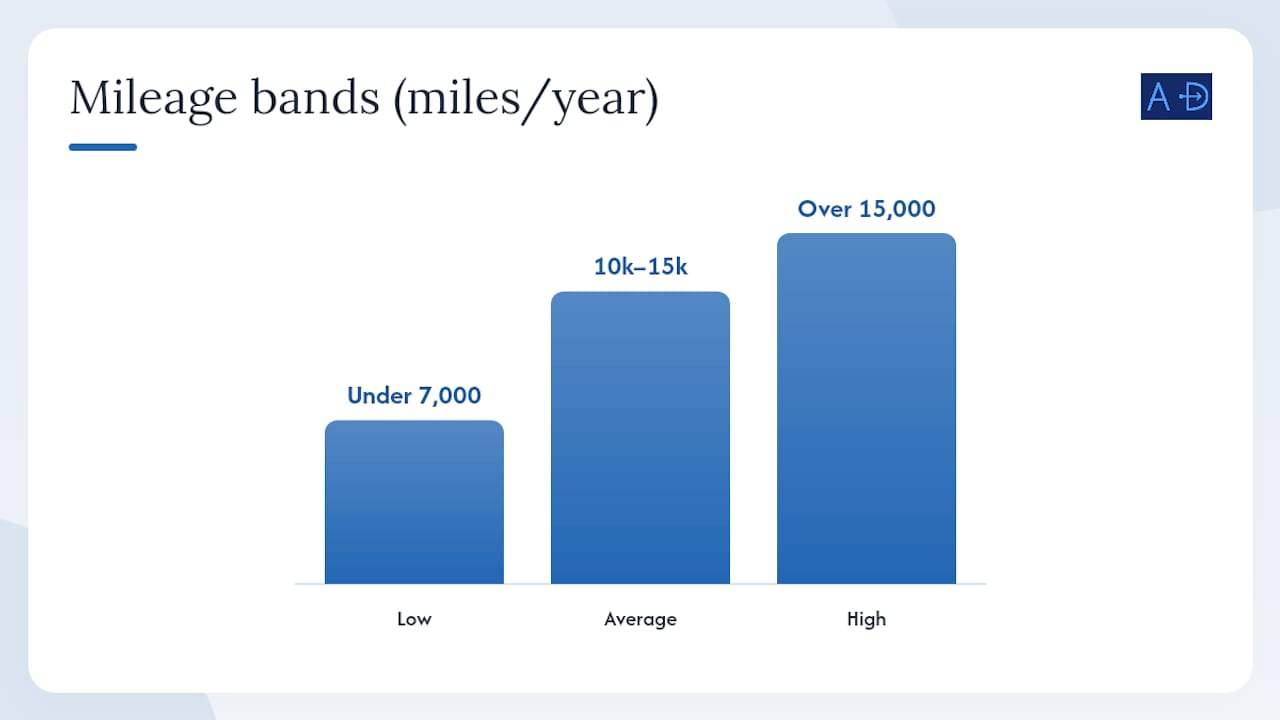
| Category | Miles per Year | Absolute Milestone | What to Expect |
|---|---|---|---|
| Low | Under 7,000 | Under 42,000 on a 6-yr car | Possible underuse risks; inspect rubber, seals, fluids |
| Average | 10,000–15,000 | 60,000–90,000 on a 6-yr car | Normal wear; standard inspection applies |
| High | Over 15,000 | Over 90,000 on a 6-yr car | Accelerated wear; prioritize service history |
Absolute mileage milestones to watch:
- 100,000 miles: A meaningful checkpoint, not a death sentence. Progressive notes that 100k+ vehicles aren't automatically disqualified, but service records and near-term maintenance costs become critical.
Compact cars and sedans typically handle higher annual mileage better than body-on-frame trucks or large SUVs, which accumulate more drivetrain stress per mile under load. A 120,000-mile Honda Civic with clean records is a very different proposition from a 120,000-mile pickup that spent years towing.
3. What matters more than the odometer number
Raw mileage tells you how far a car traveled. It says nothing about how it was treated. Consumer Reports is direct on this: maintenance history predicts longevity better than mileage, and modern cars can exceed 150,000–200,000 miles with proper care.
Critical non-mileage checks:
- Accident and frame history: — A vehicle history report (CARFAX or AutoCheck) will flag structural damage. Frame repairs affect safety geometry permanently.
Use type changes the equation significantly. Highway miles are gentler on engines than stop-and-go city driving, which stresses brakes, transmissions, and cooling systems. Rental and fleet vehicles often have higher-than-average mileage and inconsistent maintenance, even when the odometer looks reasonable.
Pro Tip: Ask specifically for oil-change receipts and any documented transmission service. Those two items, more than any other records, tell you whether the previous owner treated the car as a long-term investment or a short-term appliance.
4. How mileage moves price and ownership costs
Mileage is one of the primary variables used to set used-car prices, alongside year, trim, and condition. Higher miles generally mean lower asking price, but the relationship isn't linear. The steepest price drops from mileage tend to occur in the 0–60,000 range, where buyers are most sensitive. Above 100,000 miles, the price floor flattens because the pool of buyers narrows and sellers adjust expectations.
Direct cost impacts tied to mileage:
- Higher-mile cars are statistically closer to major service intervals (timing components, water pump, suspension bushings), so budget for those costs upfront.
- Insurance premiums use annual mileage as a rating factor, per KBB's guidance. A car you'll drive less than 7,500 miles/yr may qualify for a low-mileage discount.
- Fuel costs don't change with odometer reading, but a high-mile engine running slightly rich or with worn injectors can quietly reduce fuel economy.
When comparing listings, normalize by miles per year, not just total miles. A 2020 car with 80,000 miles and a 2022 car with 40,000 miles aren't the same age-to-mileage story. The 2020 car ran 16,000 miles/yr; the 2022 ran 13,333. Both are above average, but the 2020 is meaningfully higher. Price differences between otherwise identical listings should reflect that gap.
Stat to know: FHWA-based calculations put the U.S. average at roughly 11,327 miles per vehicle per year. Industry consensus and market buyer guides recommend using 12,000 miles per year as the practical midpoint for evaluating fair mileage, with regional and use-type variation noted.
5. How to verify an odometer and inspect before buying
Never take an odometer reading at face value. Odometer fraud is a documented problem in the U.S. used-car market, and the verification steps below take less than an hour.
Step-by-step verification:
- Pull the vehicle history report. Use CARFAX or AutoCheck with the VIN. Look for odometer events, title changes, and any reported rollback flags.
- Cross-check service records against the odometer. If a dealer oil-change receipt from 2023 shows 78,000 miles and the current listing says 72,000, that's fraud.
- Check the title history. Multiple state transfers in a short period can indicate a car being moved to obscure its history.
- Review prior registration and inspection records. Many states record odometer readings at registration renewal; gaps or drops are red flags.
- Run a pre-purchase inspection (PPI). A trusted independent mechanic should check compression, look for fluid leaks, inspect the undercarriage for collision repair evidence, and test the drivetrain.
Physical signs of odometer tampering:
- Worn pedals, steering wheel, and seat bolster that don't match the claimed mileage.
- Scratches or tool marks around the instrument cluster (a sign of physical tampering on older vehicles).
- Mismatched wear on tires (e.g., new tires on a "low-mile" car suggests the originals wore out).
- Service stickers inside the door jamb or under the hood showing higher mileage than the dash.
You can also review a car's history and inspection records to spot inconsistencies before you ever see the car in person.
Pro Tip: Ask the seller for the original window sticker or any dealer service records. Franchise dealers log every visit by VIN, and those records often survive ownership changes. A clean CARFAX combined with dealer service records is the strongest possible paper trail.
6. When very low mileage is actually a problem
A car with 18,000 miles on a 7-year-old body sounds like a steal. It might be. Or it might have spent years sitting in a garage, accumulating the kind of damage that doesn't show up on a test drive.
What underuse does to a car:
- Rubber seals and gaskets dry out and crack without regular heat cycles, leading to oil and coolant leaks.
- Tires develop flat spots from sitting stationary for months.
- Brake rotors corrode, and brake fluid absorbs moisture over time regardless of miles driven.
- Fuel systems can gum up from stale gasoline, especially in cars stored without a fuel stabilizer.
- Electrical contacts oxidize, causing intermittent sensor faults and starting issues.
Physical signs to look for:
- Mildew smell inside the cabin (suggests moisture intrusion during storage).
- Cracked or brittle rubber on belts, hoses, and weatherstripping.
- Rodent damage in the engine bay or under the seats.
- Uneven tire wear or flat-spotting vibration on a test drive.
NerdWallet flags that very low annual mileage (under 5,000 miles/yr) can be a warning sign because long-term storage degrades seals, rubber parts, and fluids in ways the odometer won't reveal. Given that the national average sits around 11,327 miles per year, a car logging less than half that figure deserves extra scrutiny, not a premium.
For very-low-mile cars, add a compression test and leak-down test to the standard PPI. Those two tests reveal engine health that visual inspection alone misses.

7. Quick checklist: is this listing's mileage fair?
Run through this before you commit to a test drive or deposit.
Green (proceed to test drive and PPI):
- Miles per year falls between 10,000 and 15,000.
- Service records match the odometer with no gaps.
- One or two owners; no rental or fleet flags.
- Physical wear (pedals, steering wheel, seats) matches the claimed mileage.
- Price aligns with comparable listings at similar mileage.
Amber (ask for more documentation before proceeding):
- Miles per year is under 7,000 or over 16,000.
- Service records are partial or missing for one ownership period.
- CARFAX shows an accident but the seller claims it was minor.
- Price is noticeably below comps without a clear explanation.
Red (walk away or negotiate a deep discount):
- Odometer reading conflicts with any documented service record.
- Physical wear is inconsistent with the claimed mileage.
- Seller refuses to provide a vehicle history report or allow a PPI.
- Multiple owners in a short period with no explanation.
Pro Tip: If the car falls in the amber zone, use the mileage discrepancy as a negotiation lever. A verified gap between expected and actual service intervals, or a higher-than-average miles-per-year figure, justifies a price reduction. Check comparable listings by mileage and region to quantify the ask before you negotiate.
The odometer is a starting point, not the whole story
Most buyers treat mileage as the headline number, and sellers know it. That's exactly why a well-maintained 110,000-mile car often represents better value than a 60,000-mile car with a spotty service record and three owners in four years.
The miles-per-year calculation is useful because it normalizes age and usage into one comparable figure. But the number only tells you whether the car was driven a lot or a little. It says nothing about how it was driven, whether the oil was changed on schedule, or whether the timing belt was replaced before it snapped. Those are the variables that actually determine what you'll spend in the next three years.
My recommendation: run the miles-per-year formula first to screen listings quickly, then spend your real energy on the service records and a proper PPI. If a seller can't produce records for a car with 90,000 miles, that's more disqualifying than the mileage itself. And if a car has 140,000 well-documented miles with consistent dealer service, don't let the number scare you off before you've looked under the hood.
Useful sources
- What Is Good Mileage for a Used Car? | NerdWallet
- Maps and Data — Average Annual Vehicle Miles Traveled by Major Vehicle Category | AFDC
- How Many Miles Americans Drive per Year — TrueDrivingCost
- Best Mileage for a Used Car: U.S. Buyer Guide | TorqueBrief
- What Is Good Mileage for a Used Car? | Progressive
- Average Miles Driven Per Year: Why It Is Important - MoneyGeek
- What is a reasonable life span for a modern car? | Consumer Reports
FAQ
What is good mileage for a used car?
A used car with roughly 10,000–15,000 miles per year of its age is considered average; anything under that band is low, and over 15,000 is high. The industry consensus supports 12,000 miles per year as the practical evaluation benchmark: a 5-year-old car with 60,000 miles is right on target.
How many miles are too high for a used car?
There's no universal cutoff, but Progressive notes that 100,000 miles is the point where service records and near-term maintenance costs become critical. A well-maintained 120,000-mile car can be a better buy than a neglected 70,000-mile one.
Is 50,000 miles a lot for a 3-year-old car?
Yes. A 3-year-old car at 50,000 miles works out to about 16,667 miles per year, which is well above the buyer-oriented 12,000-mile benchmark and even outside the usual 10,000–15,000 average band. It's not disqualifying, but you should verify the service history carefully and budget for earlier maintenance intervals.
What is a fair price for a used car with high mileage?
Fair market value for a used car depends on year, model, trim, condition, and mileage relative to comparable listings. As TorqueBrief notes, a documented higher-mile car can be priced fairly below market; use a tool like Addapted to compare mileage-adjusted prices across live listings before you negotiate.