

You can check any UK vehicle's MOT history instantly using just its registration number via the GOV.UK MOT history service, run by the DVSA. The record is free, tamper-proof, and covers cars, vans, and motorcycles since 2005, and HGVs, buses, and coaches since 2018. For used-car buyers, the real value isn't the latest pass or fail — it's the pattern: mileage trends across years, repeated advisories, and failure reasons that signal what a car is likely to cost you next.
Three things to check first:
- Mileage trend: Does it rise consistently, or are there drops between tests? A decrease is a red flag for clocking.
- Repeated advisories: The same item flagged year after year means it was never properly fixed.
- Recent failures: A car that failed and was quickly "repaired" right before listing deserves extra scrutiny.
The DVSA record is harder to alter than a service stamp book — making it one of the most reliable data points you have when assessing a used car's true condition.
Table of Contents
- How do you check a vehicle's MOT history?
- What does an MOT history report actually show?
- How to read MOT history when valuing a used car
- How to combine MOT history with market valuation
- What to do when MOT records are missing or inconsistent
- Pre-offer MOT and valuation checklist
- Key Takeaways
- Why MOT history matters more than most buyers realize
- Addapted makes the valuation step faster
- Useful sources and further reading
- FAQ
How do you check a vehicle's MOT history?
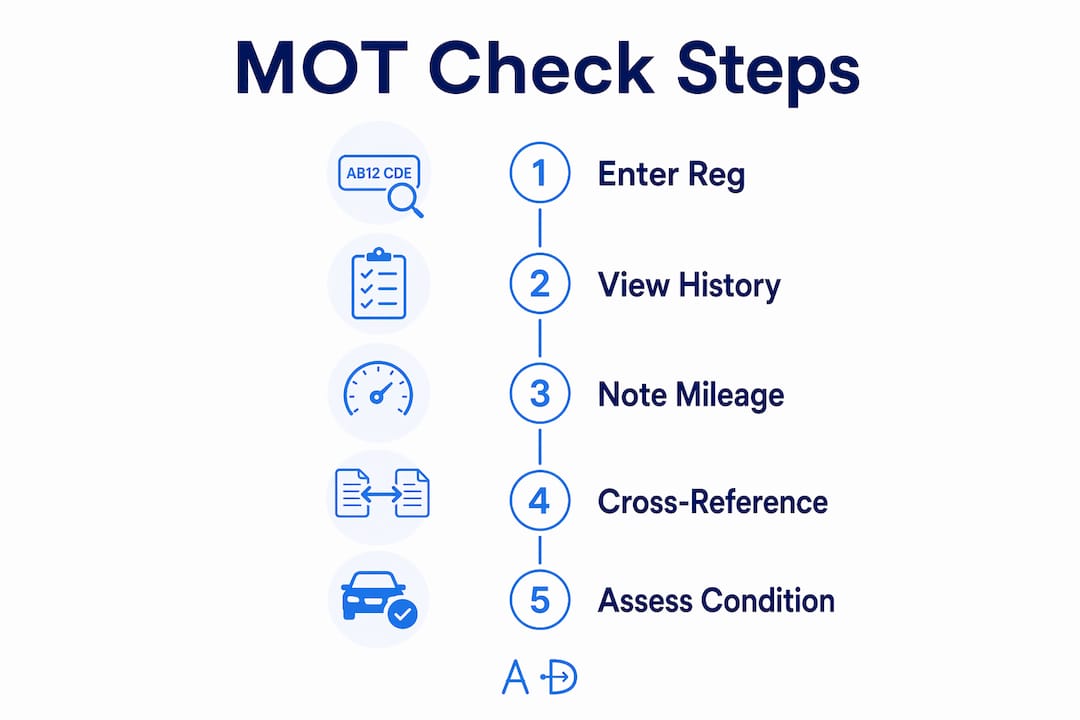
The process takes about 30 seconds. Here's exactly what to do:
- Go to GOV.UK MOT history.
- Enter the vehicle's registration number exactly as it appears on the number plate accessories — no spaces required, but the format matters.
- Confirm the vehicle details match what the seller told you (make, model, color).
- Review the full test history: dates, pass/fail results, mileage at each test, advisory notices, and failure reasons.
- Download or screenshot the certificates you want to keep — especially any that show past failures or repeat advisories.
- If you want mileage charts, color-coded advisories, or severity tagging, third-party tools that pull DVSA data in real time add those features, sometimes free and sometimes behind a paid tier.
You only need the registration number. The VIN or V5C is optional but useful if you want to cross-reference test centre records against the seller's documentation.
Pro Tip: Screenshot the test numbers, dates, and mileage readings before the viewing. Cross-reference them against the service book stamps and the listing's stated mileage — discrepancies show up fast when you have the numbers side by side.
What does an MOT history report actually show?
Every DVSA record contains the same core fields. Here's what each one tells you:
- Test date and expiry date: Confirms when the vehicle last passed and when the current certificate runs out.
- Pass/fail status: The headline result — but not the whole story.
- Mileage recorded: Logged by the test centre at each visit. This is your DVSA-anchored mileage timeline.
- Failure reasons: Specific items that caused a fail, categorized by severity (dangerous, major, minor).
- Advisory notices: Items that passed but are approaching the limit — worth tracking across years.
- Test centre and test number: Lets you verify the test was conducted at a real, registered centre.
- Downloadable certificates: Previous MOT certificates are available to download directly from the GOV.UK record.
One important limitation: MOT records don't show independent garage repairs or routine maintenance. A car could have had a full engine rebuild between tests and the DVSA record would show nothing. Always cross-reference with the service logbook.

How to read MOT history when valuing a used car
A clean recent pass is not a green light. What matters is the full picture across multiple years.
Red flags that should move your offer down:
- Mileage decreases between tests. Even a small drop warrants an explanation. Odometer fraud is the primary concern, though clerical errors at test stations do happen — verify against service receipts before drawing conclusions.
- Repeated major failures. Brakes, steering, or suspension failing more than once across different test years suggests chronic underinvestment in maintenance.
- Failures fixed immediately before sale. A car that failed in March and was relisted in April with a fresh pass deserves a closer look at what was done and whether it was done properly.
- Advisories that repeat across three or more years. An advisory that keeps appearing was never resolved — budget for that repair.
Secondary concerns (context-dependent):
- A single isolated advisory on an otherwise clean record is normal.
- Long gaps in test history can mean the car was off the road on a SORN declaration. Ask for the SORN documentation or storage receipts to confirm.
- Occasional mileage entry errors by test centres are real — one anomaly with a plausible explanation is different from a pattern.
Pro Tip: Weight multi-year patterns far more heavily than the most recent result. A car that passed last month after years of repeat advisories on the same components is a higher-risk buy than one with a single failure three years ago that was properly fixed.
An MOT certificate confirms the vehicle met minimum safety and environmental standards at the test date — it is not a warranty on current condition. Price accordingly.
How to combine MOT history with market valuation
This is where MOT data becomes money. Follow this workflow before making any offer:
- Pull the DVSA record and save the certificates. Note the mileage at every test.
- Chart the mileage trend. Is it consistent with the listing claim and the seller's stated annual mileage? Flag any anomaly.
- List every advisory and failure reason from the past three years. For each repeat item, get a rough repair estimate — a quick call to a local garage or a search on owner forums gives you a ballpark.
- Compare against current market listings. Use Addapted's price comparison to see the lowest, average, and highest prices for the same model, mileage band, and age.
- Apply a risk-adjusted discount. If the car sits at market median but carries two unresolved advisories and above-average mileage, your offer should sit below median — by roughly the estimated repair cost plus a margin for uncertainty.
Example: A five-year-old hatchback listed at the market average, with mileage running 15% above the typical annual figure and two recurring advisory items on the rear suspension. Estimated repair cost: £300–£400. A reasonable starting offer would be market median minus that repair estimate, minus a further buffer for the mileage premium — giving you a defensible number to open with rather than a gut feeling.
Addapted's instant valuation shows you where a specific vehicle sits on the live price spread, so you're not guessing at "average" from a handful of listings. That context is what turns MOT signals into a concrete offer.
What to do when MOT records are missing or inconsistent
Gaps and anomalies don't automatically mean fraud — but they do require a response.
- Double-check the registration. One transposed character returns a completely different vehicle's history. Try the GOV.UK service first, then a DVSA-linked third-party tool to confirm.
- Verify the VIN against the V5C. If the test centre records reference an 11-digit V5C number, ask the seller to produce the logbook and confirm it matches.
- Request documentation for any gap. A SORN declaration, storage receipts, or a written explanation from the seller should account for any period where no MOT was recorded.
- Ask for original MOT certificates and service receipts for any failure that was repaired. Receipts from the repairing garage confirm the work was done and what parts were used.
- If mileage decreases and the seller can't explain it, consider a car authenticity check that covers VIN verification and provenance — MOT data alone won't catch every form of fraud.
- Commission an independent inspection before committing if multiple anomalies remain unresolved. A pre-purchase inspection from a qualified mechanic costs far less than inheriting a problem vehicle.
Pro Tip: When contacting a seller about a mileage discrepancy, keep it factual: "The DVSA record shows the mileage dropped between the 2021 and 2022 tests — can you provide the service receipts from that period?" A legitimate seller will have documentation. Evasion is its own answer.
Pre-offer MOT and valuation checklist
Run through this before you make any offer, whether at a viewing or buying online:
- Run the GOV.UK MOT history lookup with the exact registration number
- Save or screenshot all certificates, especially those showing failures
- Chart mileage across every test year and flag any decrease or unusual jump
- List all advisory items from the past three years and note any repeats
- Estimate repair cost for each unresolved advisory
- Compare the vehicle's mileage and condition against current market listings
- Set an offer band: market median adjusted for repair estimates and mileage risk
- Request from the seller: V5C logbook, service receipts, receipts for any post-failure repairs, SORN declarations for any gaps
- For any unresolved anomaly, consider a full used car history check before committing
For cars with significant red flags, demand a minimum discount that covers the estimated repair cost. If the seller won't negotiate on a vehicle with documented issues, that's useful information too.
Key Takeaways
The most reliable way to value a used car is to treat the DVSA MOT record as your baseline and adjust from there based on mileage trends, repeat advisories, and failure patterns.
| Point | Details |
|---|---|
| Free, instant lookup | Enter any registration number at GOV.UK to get the full DVSA record — no cost, no sign-up. |
| Records go back to 2005 | Cars, vans, and motorcycles have digital MOT records from 2005; HGVs, buses, and coaches from 2018. |
| Patterns beat single results | Repeated advisories and mileage anomalies across years are stronger valuation signals than the latest pass. |
| MOT is not a warranty | A certificate confirms minimum safety standards at the test date only — not current condition. |
| Addapted adds market context | Use Addapted's instant valuation and live price bands to translate MOT risk signals into a specific, defensible offer. |
Why MOT history matters more than most buyers realize
Most buyers glance at the current MOT status, see "valid," and move on. That's the wrong read. The current certificate tells you the car cleared a minimum safety bar on one specific day — nothing more. What the full history tells you is how that car has been treated over years, by multiple owners, across dozens of components.
Multi-year advisory trends are often more predictive of future mechanical work than any single result. A car with five consecutive passes but recurring rear brake advisories is telling you something the seller isn't. The advisory didn't fail the car — but it's been getting worse, and at some point it will.
The buyers who get the best deals aren't the ones who negotiate hardest. They're the ones who walk in with documented evidence: here's the mileage trend, here's the repeat advisory, here's my repair estimate, here's where your asking price sits against the market. That's a conversation a seller can't easily dismiss.
Addapted makes the valuation step faster
Once you've pulled the DVSA record and flagged the signals that matter, the next step is placing that vehicle on the live market. Addapted gives you instant access to real-time price comparisons across active listings — lowest, average, and highest prices for any model, filtered by mileage and age. That's the number you need to anchor your offer.

The workflow is straightforward: run your GOV.UK MOT check, note the mileage trend and any advisory items, then use Addapted's car valuation tool to see exactly where the vehicle sits on the current price spread. If the MOT history suggests elevated risk, you'll know precisely how far below median your offer should land. Price-drop alerts mean you can also track a listing if the seller won't move today. Try Addapted free and run your first valuation before your next viewing.
Useful sources and further reading
- GOV.UK MOT history service — The official DVSA lookup. Free, instant, authoritative. Start here for every vehicle you're considering.
- Used Car History Check: What UK Buyers Must Know — Addapted's guide to combining MOT records with service history and authenticity checks for a fuller picture.
- What to Check When Buying a Used Car in the UK — A checklist-style guide covering the full pre-purchase inspection, from MOT status to physical condition.
- Car Authenticity Check: UK Buyer's Guide — Covers VIN verification and provenance checks for when MOT anomalies need deeper investigation.
- Negotiating Used Car Price in the UK — How to turn MOT-derived repair estimates and risk signals into a negotiation strategy.
FAQ
How do I check a vehicle's MOT history for free?
Enter the registration number at GOV.UK — the check is instant, free, and requires no account. The record covers all MOT tests since 2005 for cars, vans, and motorcycles, and since 2018 for HGVs, buses, and coaches.
Can I check MOT history with just the registration number?
Yes. The registration number is all you need for the official GOV.UK lookup. The VIN and V5C are optional extras useful for verifying test centre records against the seller's documents.
What does a mileage decrease in MOT history mean?
A drop in recorded mileage between tests is a potential sign of odometer fraud (clocking). It can also be a clerical error by the test station, so always ask the seller for service receipts to verify before drawing conclusions.
Does a valid MOT mean the car is in good condition?
No. An MOT certificate confirms the vehicle met minimum safety and environmental standards on the test date only — it is not a guarantee of current condition or a warranty against future faults.
How does Addapted help with MOT-based valuation?
Addapted's platform shows live lowest, average, and highest prices for any model, so you can position your offer on the real market spread after factoring in MOT-derived repair estimates and mileage risk.