

TL;DR:
- Running a VIN history check, comparing five market listings, and requesting a written out-the-door quote help determine if a car's price is fair. Verifying vehicle details, photos, and seller credibility online is essential before visiting. Using tools like Addapted speeds up research and strengthens your negotiation position with documented evidence.
Before you contact any seller, run a VIN history lookup, pull five like-for-like market comps, and request a written, itemized out-the-door quote by email. Those three actions, done in 15 minutes, tell you whether a listing's price is defensible or inflated.
Three checks you can run right now:
- VIN history lookup: Paste the 17-character VIN from the listing into a history service to surface title brands, odometer entries, and accident records.
- Mileage consistency check: Compare the listed mileage against every odometer reading in the history report. A gap or reversal is a red flag.
- Quick market comp peek: Search the same year, make, model, and trim on two listing aggregators. Note the lowest, highest, and midpoint asking prices.
Pro Tip: Request the itemized out-the-door quote by email before visiting the lot. A written quote locks in the numbers and gives you a paper trail to reference during negotiation.
Table of Contents
- What does a pre-purchase inspection checklist cover online?
- How do you check price history and market comparables online?
- How do you verify listing fields, photos, and seller credibility?
- How do you calculate the true out-the-door price?
- What red flags in online data should make you walk away?
- How do you document findings and negotiate with confidence?
- How does Addapted speed up the online inspection workflow?
- Key Takeaways
- The case for evidence-first car buying
- Addapted makes this checklist faster and sharper
- Useful sources for U.S. buyers
- FAQ
What does a pre-purchase inspection checklist cover online?
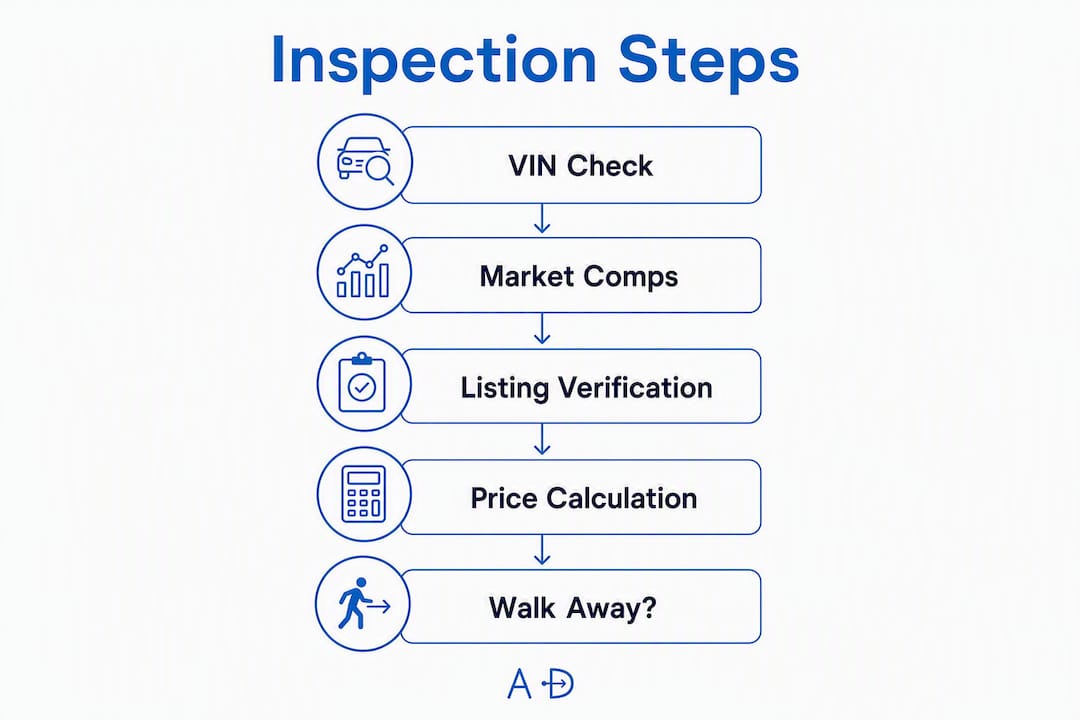
A structured online pre-purchase inspection checklist follows this order for a reason: each step validates the next.
- Decode the VIN. Confirm the VIN in the listing text matches the VIN visible in dashboard photos. A mismatch stops everything.
- Check listing fields. Verify year, trim level, engine, drivetrain, and mileage against the history report. Sellers sometimes list a higher trim to justify a higher price.
- Review photos. Look for watermarks, mismatched backgrounds, or recycled stock images. Request additional photos if the listing shows fewer than 20.
- Pull title and service records. Ask for the title status in writing and any documented service history. Branded titles (salvage, flood, lemon law buyback) require immediate disclosure.
- Build market comps. Assemble five active listings that match your target vehicle's year, trim, engine, drivetrain, and a tight mileage band. Building precise comps from like-for-like listings captures local demand and short-term listing behavior far better than generic tool lookups.
- Run valuation tools. Cross-check the asking price against at least two valuation engines using the correct transaction type (private-party vs. dealer retail).
- Calculate the out-the-door total. Add taxes, registration, doc fees, and estimated near-term maintenance before comparing listings.
For each step, save a dated screenshot and the listing URL. If a listing disappears before closing, your screenshots become negotiation evidence.
How do you check price history and market comparables online?
The goal is a defensible market range, not a single number. Here is a repeatable workflow:
- Collect five active listings: same year, make, model, trim, engine, and drivetrain, within a 20,000-mile band of your target vehicle.
- Remove the top and bottom outlier from your five comps.
- Calculate the midpoint of the remaining three. That is your baseline market range.
- Widen the geographic search radius only when local listings are thin.
- Cross-check that range against at least two tool types (see table below).
Different tools reveal different things. Selecting the wrong transaction type in a valuation engine can shift the estimate by thousands of dollars, so always confirm whether you are looking at private-party or dealer-retail figures.
| Tool category | What it shows | Key limitation |
|---|---|---|
| Valuation engine | Suggested private-party and dealer-retail value | Based on historical depreciation curves, not live listings |
| Listing aggregator | Active asking prices across dealers and private sellers | Asking price only; does not show what vehicles actually sold for |
| Price-history tool | Listing date, days on market, and price changes | Relies on listing data; gaps exist for private-party sales |
| VIN/history service | Odometer records, title events, accident history | Cannot assess current mechanical condition |
Price-check tools that compare asking price to modeled private-market value are useful sanity checks, but they anchor to historical depreciation curves. Always pair them with live comp data.
Addapted pulls live market pricing across multiple listings and shows you the lowest, highest, and average price for any model in seconds, replacing the manual aggregator step.
How do you verify listing fields, photos, and seller credibility?
VIN and mileage are the two fields most commonly manipulated. Confirm the VIN in the listing text matches the VIN in dashboard photos and any seller-provided documents. Then compare every odometer entry in the VIN history report against the listed mileage. A reading that drops between service visits is an odometer rollback indicator.

Photos tell a story if you read them carefully. Watch for watermarks from other listing sites, mismatched lighting between interior and exterior shots, or angles that avoid specific panels. If the listing has fewer than 20 photos, request more before proceeding. Recycled or digitally edited images are grounds to ask for a live video walk-around.
Title indicators matter more on newer vehicles. A salvage or flood title on a one-to-three-year-old SUV is almost always a walk-away. On a ten-year-old project truck, the same title brand changes the math but does not automatically disqualify the vehicle. Check open recalls at NHTSA's VIN lookup while you are verifying the title.
Seller type determines what documentation to demand. A licensed dealer must provide a Buyers Guide that states warranty terms or as-is status. A private seller has no such obligation, so ask explicitly for service records, the title in hand, and written confirmation of any verbal promises. For either seller type, get inspection rights in writing before you visit.
How do you calculate the true out-the-door price?
The advertised price is rarely what you pay. The formula:
OTD = Advertised price + sales tax + registration/title fees + dealer doc fees + mandatory accessories + estimated near-term maintenance + financing costs
| Line item | Typical range | Notes |
|---|---|---|
| Advertised price | Varies | Starting point only |
| Sales tax | Varies by state | Apply your state's rate to the sale price |
| Registration and title | Varies by state | Check your DMV's fee schedule |
| Dealer doc fee | Varies by state | Ask for this in writing upfront |
| Mandatory accessories | — | Reject add-ons you did not request |
| Near-term maintenance | — | Tires, brakes, fluids based on mileage |
| Financing costs | Varies | Calculate total interest over the loan term |
Out-the-door additions can push the total into the low thousands above the sticker price, depending on state and dealer practices. Calculate every line item rather than assume.
The FTC recommends requesting a written, itemized OTD quote before visiting a dealer. Cross-reference that quote against your market comp data, not the sticker price alone.
Pro Tip: If an independent inspection reveals repair needs, add those estimated costs to your OTD total. That combined number becomes your walk-away price in negotiation.
What red flags in online data should make you walk away?
Not every red flag carries the same weight. Here is a quick severity guide:
Critical (walk away or demand significant discount):
- Salvage, flood, or lemon law buyback title on a vehicle under five years old
- VIN mismatch between listing text and dashboard photo
- Odometer reading lower than a prior history report entry
- Price dropped more than 15% in under 30 days with no explanation
Major (demand documentation and independent inspection):
- Missing service records on a vehicle with under 60,000 miles
- Open safety recall not addressed by the seller
- Photos that appear reused from another listing or another vehicle entirely
- Seller refuses to provide a written OTD quote
Minor (note and factor into negotiation):
- Single minor accident with documented repair
- High mileage relative to age but consistent service history
- Branded title on a high-mileage vehicle priced accordingly
The BBB warns that history reports and valuations cannot reveal current mechanical condition or deferred maintenance. A critical flag online means you need an independent inspection before any money changes hands. Independent inspections typically cost $100–$200 and produce a written report with repair-cost estimates you can use directly in negotiation.
How do you document findings and negotiate with confidence?
Assemble this evidence package before contacting the seller:
- Dated screenshots of the listing (price, mileage, photos, description).
- VIN history report with title status and odometer entries highlighted.
- Links to your five comparable listings, saved with dates.
- Valuation tool outputs showing private-party and dealer-retail ranges.
- Estimated repair costs from any inspection findings.
Then send this email:
When you present a price adjustment, tie it to specific numbers: "Comparable listings in this zip code average $X; your listing is $Y above that range, and the inspection estimate adds $Z in near-term repairs." That framing is harder to dismiss than a gut-feel counter-offer.
Pro Tip: Request the APR, loan term, and all financing fees in writing. Calculate the total financed cost over the full term and add it to your OTD math. Monthly payment framing hides the real cost.
How does Addapted speed up the online inspection workflow?
Running the manual workflow above takes 45–90 minutes per listing. Addapted compresses the most time-intensive steps:
- Instant market snapshot: View the lowest, highest, and average prices for any model across live listings without building a manual comp set.
- Price-history timeline: See how a listing's price has changed and how long it has been on the market, surfacing the kind of rapid price drops that signal a problem.
- Mileage and listing-detail analysis: Addapted's car checker flags inconsistencies between listed mileage and market norms for that model year.
- AI-powered valuation: Get a reliable valuation in seconds, calibrated to current market data rather than static depreciation tables.
- Comparable-list builder: Pull a filtered set of near-identical active listings to validate your comp range without manual aggregator searches.
Start with the market snapshot for your target model, check the price-history timeline for the specific listing, then export your findings before contacting the seller. That three-step sequence inside Addapted replaces four to six manual steps and produces documentation you can attach to your negotiation email.
Try Addapted free at addapted.net to run a market snapshot on your next target vehicle.
Key Takeaways
Running a complete online pre-purchase inspection means verifying the VIN, building five precise market comps, calculating the full out-the-door price, and securing a written quote before you visit the lot.
| Point | Details |
|---|---|
| VIN check first | Confirm the VIN matches listing photos and history report before evaluating price. |
| Five like-for-like comps | Match year, trim, engine, drivetrain, and mileage band; remove outliers to get a defensible range. |
| Full OTD calculation | Add taxes, registration, doc fees, and near-term maintenance to every advertised price before comparing. |
| Written OTD quote | Request an itemized quote by email before visiting; it locks in numbers and prevents last-minute fee additions. |
| Use Addapted | Addapted's market snapshot, price-history timeline, and AI valuation replace four to six manual steps in the workflow. |
The case for evidence-first car buying
Most buyers walk into a dealership armed with a sticker price and a vague sense of what the car "should" cost. That is the weakest possible negotiating position. The method in this checklist flips that dynamic: you arrive with a documented market range, a calculated OTD total, and a paper trail the seller has to address specifically.
What most guides miss is that the online inspection is not just preparation. It is leverage. A dated screenshot showing a price drop, a comp set showing the market average, a written quote the dealer already sent you — those are not just information, they are constraints on what the seller can credibly claim. Dealers and private sellers both respond differently when a buyer demonstrates they have done the work.
The other thing worth saying plainly: valuation tools are a starting point, not a verdict. They anchor to historical data. Your comp set, built from live listings in your market, is almost always more accurate for the specific vehicle you are evaluating right now. Build the comps first, then use the tools to sanity-check the range.
Addapted makes this checklist faster and sharper
The manual version of this workflow is thorough but slow. Addapted was built specifically to compress it. You get a live market snapshot showing the lowest, highest, and average price for any model, a price-history timeline for individual listings, AI-powered valuation calibrated to current data, and a comparable-list builder that replaces manual aggregator searches.
The practical payoff: instead of spending an hour per listing on manual research, you run the core checks in minutes and export documentation ready for your negotiation email. Start a free trial at addapted.net and run a market snapshot on your next target vehicle before you contact the seller.
Useful sources for U.S. buyers
- FTC: Buying a Used Car from a Dealer — Covers Buyers Guide requirements, inspection rights, and written quote recommendations.
- NHTSA VIN Recall Lookup — Official tool for checking open safety recalls by VIN.
- FTC: Action Against Deceptive Sales Practices — Explains why written, itemized OTD quotes protect buyers.
- BBB: Buying a Car Online — Outlines the limits of history reports and the case for independent inspections.
- Used Car Price Check Guide — Explains how to compare a listed price against records and comparable vehicles before negotiating.
Items to always confirm in writing: the itemized OTD quote, the Buyers Guide (dealer sales), title status, and any verbal promises about repairs or warranties.
FAQ
What is the first step in an online pre-purchase inspection?
Decode the VIN and pull a history report before evaluating price. A VIN mismatch or title brand changes the entire valuation.
How many market comps do you need to verify a fair price?
Five like-for-like listings matching year, trim, engine, drivetrain, and a tight mileage band give you a defensible range; remove the top and bottom outlier before calculating your midpoint.
What should a written out-the-door quote include?
It should itemize the advertised price, sales tax, registration and title fees, dealer doc fees, and any mandatory accessories. The FTC recommends requesting this in writing before visiting the lot.
How does Addapted help with the pre-purchase inspection checklist?
Addapted provides a live market snapshot, price-history timeline, AI valuation, and comparable-list builder that replace four to six manual research steps, producing documentation you can use directly in negotiation.
When should you walk away from a listing based on online data alone?
Walk away when the VIN mismatches listing photos, the title carries a salvage or flood brand on a vehicle under five years old, or the odometer shows a rollback in the history report.