

TL;DR:
- The best time to buy a used car in the UK in 2026 is during late winter, after March and September plate changes, and at quarter-end days, as market conditions favor buyers. Timing provides leverage, but condition and market value checks are essential to secure a fair deal. Using real-time data tools helps identify genuine bargains and maximizes negotiation power in this buyer's market.
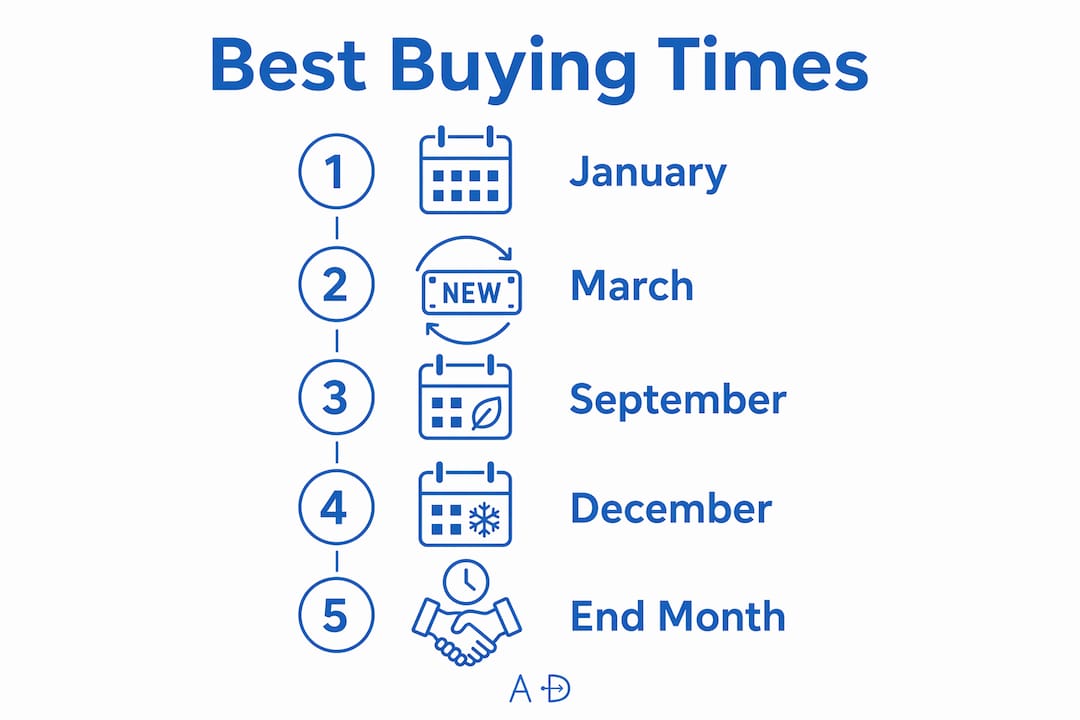
The single best timing strategy for UK used-car buyers in 2026 is to target late winter (January–February), the weeks immediately following the March and September plate changes, and the final days of any calendar quarter. Parkers reported rising supply and softening used values in April and May, with longer listing times and a modest month-on-month drop in prices. That combination tilts the market firmly toward buyers right now.
Three actions you can take immediately:
- Watch plate-change stock: Set search alerts for the weeks after March and September, when trade-ins from new-car buyers flood dealer forecourts and choice peaks.
- Call dealers in the final week of a quarter: March, June, September, and December quarter-ends create measurable negotiation leverage as sales staff push to hit manufacturer targets.
- Flag stale listings: Any car sitting on a listing for 45–60+ days is a prime negotiation target regardless of the month. Use Addapted's listing-age filters to spot them instantly.
Pro Tip: Set price-drop alerts on specific models now. When a listing drops in price after 30+ days, that's a dealer signaling they'll deal — not just a routine update.
Table of Contents
- Does timing really matter when buying a used car in the UK?
- Best months to buy a used car in the UK
- How new number-plate releases affect used-car stock and pricing
- Weekday, end-of-month and end-of-quarter timing for negotiation
- How seasonality changes by vehicle type
- Dealer vs. private sale: how timing and tactics differ
- What the 2026 market data says about used-car prices
- How to combine timing with condition checks and financing
- How to avoid pressure sales, hidden costs and red flags
- Your 2026 decision checklist: when to act and when to wait
- Key Takeaways
- The timing game is real, but it's not the whole game
- Addapted gives you the data to buy at the right price
- Useful sources and data
- FAQ
Does timing really matter when buying a used car in the UK?
Yes, but with one important caveat: timing shifts your negotiation leverage and the range of stock available to you. It does not change whether a car has a clean service history, honest mileage, or a sound chassis.
The main mechanisms are straightforward. Plate-change months (March and September) push a wave of part-exchanges onto forecourts, expanding your choices. Seasonal demand swings mean fewer buyers compete with you in January than in May. Dealer quarterly quotas create genuine pressure on sales staff to close deals in the final days of March, June, September, and December. Each of these creates a window where the balance of power shifts slightly toward you.
Pro Tip: Think of timing as a leverage window, not a rule. A well-priced car in excellent condition that appears in July is still worth buying. A poorly maintained car in December is still a bad deal, even if the dealer is desperate to hit quota.
Prioritize inspection, service history, and an independent valuation check first. Then use timing to sharpen the price.
Best months to buy a used car in the UK
The strongest months for buyers are February, March, August, September, and December. Winter months generally offer lower demand and more room to negotiate, while spring and summer see buyer activity peak and dealer willingness to discount shrink.

| Month | Price pressure | Stock volume | Buyer competition | Best for |
|---|---|---|---|---|
| January | Medium | Medium | Low | Negotiation, private sellers |
| February | High | Medium-High | Low | Pre-plate clearance deals |
| March | Medium | High | Medium | Post-plate choice, quarter-end |
| April | Medium | High | Medium | Trade-in stock from March rush |
| May–July | Low | Medium | High | Avoid unless deal is exceptional |
| August | Medium | Medium | Medium | Pre-September plate prep |
| September | Medium | High | Medium | Post-plate choice, quarter-end |
| October | Medium | High | Low | Trade-in stock from September rush |
| November | High | Medium | Low | Convertibles, sports cars |
| December | High | Medium | Low | Year-end quotas, motivated dealers |
What to expect and do each key month:
- January: Showrooms are quiet. Private sellers who listed in December and didn't sell often drop prices. Genuine room to negotiate, especially on cars that have been sitting since November.
- February: Dealers are clearing stock before the March plate rush. Pre-plate clearance is real — use it to push for extras or a price reduction on cars that have been on the lot since autumn.
- March: The biggest plate-change month. Go in the final week for quarter-end leverage, or wait until the second or third week of April when trade-ins are prepped and priced.
- August: Dealers prepare for the September plate change. Stock is being refreshed, and some older listings get discounted to clear space.
- September: Same dynamic as March. The second plate-change month of the year brings another wave of part-exchanges and another quarter-end deadline.
- December: Year-end targets combine with low footfall. Dealers chasing annual bonuses are often willing to sharpen a price or throw in a service plan.
Pro Tip: The last three days of any month are more powerful than the month itself. Call a dealer on the 28th or 29th and mention you're ready to complete today — that timing alone can unlock a discount that wasn't available a week earlier.
How new number-plate releases affect used-car stock and pricing
The UK's March and September plate changes are the two biggest events in the used-car calendar, and they create two distinct opportunities depending on whether you shop just before or just after the release.
Buying just before a plate change can yield discounts as dealers make space on the forecourt. Buying just after gives you greater selection, because trade-ins from new-car buyers take one to three weeks to be inspected, prepared, and listed. The sweet spot for choice is typically weeks two to four after the plate release.
New-model redesigns add another layer. When a manufacturer launches a full redesign, used prices for the outgoing generation soften noticeably. A minor facelift has a smaller effect, but a complete generational change can push previous-model values down by a meaningful margin. If you're flexible on model year, tracking a redesign launch and buying the outgoing generation in the months that follow is one of the most reliable ways to find value.
Practical sequence for plate-change buying:
- Two weeks before the plate change: search current listings and note prices on your target model.
- Plate-change week: call dealers and ask what part-exchanges they're expecting. Some will pre-agree a price on incoming stock.
- Weeks 2–4 after the plate change: visit forecourts. This is when choice peaks and dealers are motivated to move freshly prepped stock.
- Final days of the same month: combine post-plate choice with end-of-month pressure for maximum leverage.
Weekday, end-of-month and end-of-quarter timing for negotiation
The best days to visit a dealer are Wednesday and Thursday. Mid-week visits give you more of the salesperson's attention, less showroom noise, and a seller who isn't juggling five other customers. Weekends are when dealers hold the cards.

End-of-month and end-of-quarter visits are where the real leverage lives. Dealers making larger concessions to hit quotas at quarter-end is a well-documented pattern across franchised dealerships. The effect is strongest in the final two to three days of March, June, September, and December.
Tactical moves that increase your negotiating position:
- Call ahead and confirm the car is still available. Mentioning you're ready to complete this week signals you're a serious buyer, not a browser.
- Bring a finance pre-approval from your bank or a broker. Dealers who can't earn finance commission on you will often compensate by sharpening the car price.
- Get quotes from at least three dealers on the same week. Mentioning a competing offer (honestly) is one of the few tactics that consistently moves a price.
- Ask for extras rather than a straight discount if the price won't move: a full tank of fuel, a service, floor mats, or an extended warranty cost the dealer less than a cash reduction but have real value to you.
- For deeper tactics, the negotiating used car price guide covers how to structure an offer and when to walk away.
Pro Tip: Combine a Wednesday visit with the final week of a quarter. That pairing gives you the best of both worlds: a salesperson with time to focus on you and a manager with pressure to close deals before the quarter closes.
How seasonality changes by vehicle type
The "best month" shifts significantly depending on what you're buying. Treating timing as one-size-fits-all is one of the most common mistakes UK buyers make.
Timing advice needs to be adjusted by vehicle type: convertibles and sports cars peak in spring and summer demand, while family SUVs and MPVs follow school-year cycles. Here's how that breaks down in practice:
- Convertibles and sports cars: Demand spikes from March through July as buyers anticipate warmer weather. Buy in October through December when demand drops and sellers are motivated. A soft-top bought in November typically costs noticeably less than the same car in May.
- 4x4s and AWD vehicles: Demand rises from September onward as buyers think about winter driving. Target July and August before that seasonal spike hits. Dealers are less likely to discount a 4x4 in October than in midsummer.
- Family cars, MPVs, and estate cars: These follow the school-year cycle. Demand ticks up before the September term starts and again before Easter. Buy in January or February when family buyers are less active and stock from the December plate rush is still sitting on forecourts.
- Vans and commercial vehicles: Demand is steadier year-round but tends to dip in January when businesses are slow to restart spending. End-of-tax-year timing (March) can also motivate business sellers to move vehicles quickly.
- Electric vehicles: EV used values have been adjusting as new models arrive and government incentives shift. The general buyer-market tilt in 2026 applies here too, but check model-specific depreciation curves before assuming a listed price is a deal.
Dealer vs. private sale: how timing and tactics differ
Dealers give you structured timing windows. Private sellers are less predictable but can yield genuine bargains when the seller is motivated by circumstance rather than calendar.
Dealer advantages and timing:
- Plate-change months, quarter-ends, and year-end targets all create measurable pressure on dealer sales staff.
- Most franchised dealers offer some form of warranty, even on used stock, which reduces post-purchase risk.
- Preparation standards are generally higher: cars are typically HPI-checked, serviced, and presented to a standard.
- The trade-off is a higher starting price and less flexibility on very low offers.
Private seller advantages and timing:
- No quarterly targets, but sellers are often motivated by life events: a new car purchase, a house move, redundancy, or a growing family. These create genuine urgency that you can use.
- January is particularly strong for private deals. Post-Christmas bills motivate sellers who listed in December but didn't sell to drop their asking price.
- Less paperwork protection. Always run a full vehicle history check and arrange an independent inspection before completing a private purchase.
Comparison checklist by channel:
| Dimension | Franchised dealer | Private seller |
|---|---|---|
| Price/negotiation leverage | Quarter-end and year-end windows | Motivated by life events; January strong |
| Stock/choice | High, especially post-plate change | Variable; depends on individual listings |
| Timing availability | Predictable (plate months, quarter-ends) | Unpredictable; monitor listings continuously |
| Suitability by vehicle type | All types; especially newer stock | Older stock; specialist or enthusiast cars |
| Warranty/protection | Usually included or available | None; buyer beware |
Steps specific to each channel:
Dealer:
- Check the dealer's Trustpilot rating and Google reviews before visiting.
- Confirm the car has a full dealer-prepared HPI check and ask for the certificate.
- Request a copy of the service history and any recent work invoices.
- Get the finance quote in writing before discussing the car price separately.
Private seller:
- Run your own vehicle history check before viewing. Never skip this step.
- Arrange a pre-purchase inspection from an independent mechanic, especially for older or high-mileage cars.
- Ask to see the V5C logbook in person and confirm the seller's name matches.
- Make any offer conditional on the inspection result. Put that condition in writing.
What the 2026 market data says about used-car prices
The short answer: 2026 is a buyer's market, and the data supports acting sooner rather than waiting for a further price collapse that may not materialize.
Parkers reported rising supply and falling used-value indicators in April–May 2026, with longer listing times and a modest month-on-month drop in values. Separately, Parkers editorial noted a 7% increase in wholesale volumes at a time of year when that level of supply is unusually high. More stock, longer sitting times, and softening prices: that combination is as close to a textbook buyer's market as the UK used-car sector gets.
| Indicator | Direction in 2026 | What it means for buyers |
|---|---|---|
| Used-car values | Softening month-on-month | More room to negotiate on price |
| Wholesale supply volumes | Up 7% year-on-year (unusually high) | Greater choice; dealers holding more stock |
| Average listing duration | Increasing | More stale stock; stronger negotiation leverage |
| Buyer competition | Lower than recent peaks | Less pressure to decide quickly |
Two scenarios to watch for the rest of 2026:
- If supply continues rising: Values soften further, and the buyer advantage deepens. Waiting until September or December could yield additional savings, particularly on EVs and large SUVs.
- If economic conditions tighten: Motivated private sellers increase, but dealer discounting may slow if they pull stock rather than sell at a loss. In that case, the private market becomes the better hunting ground.
Pro Tip: Check 2026 UK used-car pricing trends before you start negotiating. Knowing whether values in your target segment are rising or falling over the past 30 days is more useful than any seasonal rule.
How to combine timing with condition checks and financing
Timing is a tool for leverage. Condition, service history, and finance terms are the foundation. Get the foundation wrong and no amount of calendar strategy saves you.
The practical sequence:
- Set your budget and arrange finance first. A pre-approved loan from your bank or a broker gives you a firm ceiling and removes the dealer's ability to blur the car price and finance cost together.
- Run a valuation check before you view. Use Addapted's instant valuation to see the lowest, highest, and average market price for the exact model, year, and mileage you're considering. A listed "discount" that's still above market average is not a deal.
- Check the vehicle history. An HPI check confirms outstanding finance, write-off status, stolen status, and mileage discrepancies. Never skip it, regardless of how good the timing window is.
- Book an independent inspection. For any car over £5,000 or with more than 60,000 miles, an independent mechanical inspection is worth every penny. A pre-purchase inspection from a qualified mechanic catches faults that a test drive won't reveal.
- Check the listing age. Cars listed for 45–60+ days are stale stock. That's your strongest negotiation signal, independent of the month.
Pre-purchase checklist:
- Full-service history present and verified (stamps or digital records)
- MOT history checked via the DVLA's free online tool
- V5C logbook inspected in person; seller's name matches
- Finance pre-approval confirmed before visiting the dealer
- Valuation cross-checked against market average data
- Listing age noted; price history reviewed for drops
- Independent inspection booked for any car with significant mileage or age
For a full step-by-step buying timeline, the how to buy a used car in the UK guide walks through each stage from search to completion.
How to avoid pressure sales, hidden costs and red flags
Dealer quota pressure and plate-change churn create the conditions where rushed decisions happen. Knowing the red flags in advance is the best defense.
Key red flags to watch:
- Vague or incomplete service history. "Lost the book but it was serviced regularly" is not a service history. Walk away or insist on digital records from the manufacturer's system.
- Inconsistent mileage. Cross-check the MOT history (free via the DVLA) against the odometer reading. Any gap is a serious warning sign.
- Recently replaced timing belt or chain without paperwork. A dealer who mentions recent work but can't produce an invoice is telling you something important.
- Pressure to sign today. A genuine deal doesn't expire in the next hour. Any salesperson who insists the price is only available right now is using a tactic, not stating a fact.
- Add-ons buried in the finance paperwork. Paint protection, GAP insurance, and extended warranties are often added to finance agreements without being clearly itemized. Read every line before signing.
- Admin fees not disclosed upfront. Ask for a full out-of-the-road price in writing before you get to the finance office. Dealer admin fees can add hundreds to the final cost.
Practical checks to run before signing:
- Ask for 48 hours to review any finance agreement. A legitimate dealer will agree.
- Get the full itemized price in writing: car price, any add-ons, admin fees, and the total cost of credit if financing.
- If the service history is incomplete, use that as a negotiation point or a reason to walk away.
- Mid-week visits (Wednesday/Thursday) reduce showroom pressure and give you more time with the salesperson without a queue forming behind you.
When to walk away: if the paperwork doesn't match what was discussed verbally, if the service history has unexplained gaps, or if you feel rushed into a decision, leave. The 2026 buyer's market means there will be another car. Patience is leverage.
Your 2026 decision checklist: when to act and when to wait
One-line verdict: If your target model is available now, has a clean history, and is priced at or below the market average, buy it. If it's overpriced or the history is unclear, wait. The 2026 market is on your side.
Decision rules:
- If the listing is 45+ days old and the price has dropped at least once: Strong buy signal. The dealer is motivated. Make an offer below the asking price.
- If it's the final week of March, June, September, or December: Use the quarter-end pressure. Call the dealer and ask what they can do on price if you complete this week.
- If the car is priced above the Addapted market average for that model: Wait or negotiate down. A listing above average in a softening market is a dealer testing patience, not offering a deal.
- If the service history has gaps or the MOT history shows mileage inconsistencies: Walk away regardless of timing or price.
- If you're buying a convertible or sports car: Wait until October–November when seasonal demand drops and sellers are more flexible.
- If you're buying a 4x4 or AWD vehicle: Target July–August before the autumn demand spike.
- If finance isn't arranged yet: Pause the search. Get pre-approval first so you can move quickly when the right car appears.
Quick checklist before making an offer:
- Valuation checked against current market average (use Addapted)
- Listing age confirmed (45+ days = negotiation leverage)
- HPI check completed
- Service history verified
- Independent inspection booked or completed
- Finance pre-approved
- Full itemized price requested in writing
Set a price-drop alert on Addapted for your target model. When a listing drops in price, that's the signal to act.
Key Takeaways
The best time to buy a used car in the UK in 2026 is during late winter, the weeks after March and September plate changes, and the final days of any calendar quarter, with the current buyer-market conditions making this one of the strongest windows in recent years.
| Point | Details |
|---|---|
| Best timing windows | Late winter (Jan–Feb), post-plate weeks (April, September), and quarter-end days (March, June, Sept, Dec) offer the strongest leverage. |
| 2026 market tilt | Parkers reported softening values and a 7% rise in wholesale volumes in early 2026, confirming a buyer's advantage. |
| Stale stock signal | Listings sitting 45–60+ days are prime negotiation targets regardless of the calendar month. |
| Vehicle-type timing | Buy convertibles in autumn/winter, 4x4s in midsummer, and family cars in January–February for best pricing. |
| Use Addapted | Addapted's instant valuation and listing-age filters help you confirm whether a listed price is genuinely below market before you negotiate. |
The timing game is real, but it's not the whole game
Most buyers approach used-car timing as if there's a magic date that unlocks the best price. There isn't. What actually exists is a set of structural pressures — dealer quotas, plate-change stock cycles, seasonal demand shifts — that create windows where the seller is slightly more motivated than usual. Those windows are real and worth using. But they're leverage, not a guarantee.
The piece of advice I'd give anyone buying in 2026 is this: if you can wait until late September or December, do it. You'll hit a post-plate stock peak and a year-end quota crunch simultaneously, and the current softening market means dealers will be holding more stock than they'd like. That's a strong combination. If you can't wait, focus on listing age over calendar month. A car that's been sitting for 60 days in July is a better negotiation target than a freshly listed car in December.
The other thing most guides understate is how much a valuation check changes the dynamic. Walking into a negotiation knowing the market average for that exact model, mileage, and year means you can't be told a price is "already discounted" when it isn't. That knowledge is worth more than any timing window.
Addapted gives you the data to buy at the right price
Knowing the best month to buy is only half the equation. The other half is knowing whether the specific car in front of you is actually priced fairly.

Addapted's platform gives you instant access to real-time pricing across live UK listings, so you can see the lowest, highest, and average price for any model before you walk into a negotiation. The listing-age filter flags stale stock automatically, and price-drop alerts notify you the moment a car you're watching becomes more negotiable. No guesswork, no relying on a dealer's word about what "market rate" is.
- Instant valuation: See what your target model is actually worth right now, not six months ago.
- Price-drop alerts: Get notified when a listing drops in price, so you act at the moment of maximum leverage.
- Listing-age filter: Identify cars that have been sitting 45+ days and are ready to be negotiated down.
Check the best car deals right now on Addapted, or run a valuation on your target model at addapted.net to see exactly where it sits against the current market.
Useful sources and data
The sources below are the most useful references for UK buyers who want to dig into the underlying data and guides used in this article.
Market reports and price data:
- Used car prices are falling: why buyers now have the advantage — Parkers
- What's the best time of year to buy a used car in the UK? — Bdaily
Buying guides and timing advice:
- When is the best time to buy a used car? — Autotrader
- When is the best time to buy a used car? — Carwow
- Best time to buy a car — Evans Halshaw
- Best time to buy used car UK — AutoAlpha
- When is the best time to buy a car? — Webuyanycar
- When is the best time to buy a used car? — Car and Driver
Addapted tools and editorial resources:
| Resource | What it covers |
|---|---|
| Used car price average guide | How to judge a fair price and use market averages in negotiation |
| 2026 UK used-car pricing trends | Current price direction by segment and what it means for buyers |
| Car valuation tool alternatives | Comparison of valuation tools available to UK buyers |
| How to buy a used car online — 2026 guide | Setting alerts, evaluating listings, and buying safely online |
FAQ
What is the cheapest month to buy a used car in the UK?
January and February are typically the cheapest months, with low buyer demand, motivated private sellers, and dealers clearing pre-plate stock. December is also strong for negotiation due to year-end dealer targets.
Will used-car prices drop further in 2026 in the UK?
Parkers reported softening values and a rise in wholesale supply volumes in early 2026, suggesting prices may ease further. Waiting until September or December could yield additional savings, but the current market already favors buyers.
When is the best time to buy a car in 2026?
The strongest windows in 2026 are the weeks after the March and September plate changes, the final days of any quarter (March, June, September, December), and January–February when demand is at its lowest.
Does the day of the week matter when buying a used car?
Yes. Wednesday and Thursday visits give you more salesperson attention and less showroom pressure than weekends. Combine a mid-week visit with the final days of a quarter for maximum negotiating leverage.
What is the best used car to buy in 2026 in the UK?
The best choice depends on your needs, but the 2026 buyer's market particularly favors buyers of EVs and large SUVs, where supply increases and value softening have been most pronounced. Always cross-check any model's current market average using a tool like Addapted before committing.